





Question: undefined 1. The snapback timing method was used to obtain the average times of each work element and the respective performance ratings for a given
undefined 1. The snapback timing method was usedundefined

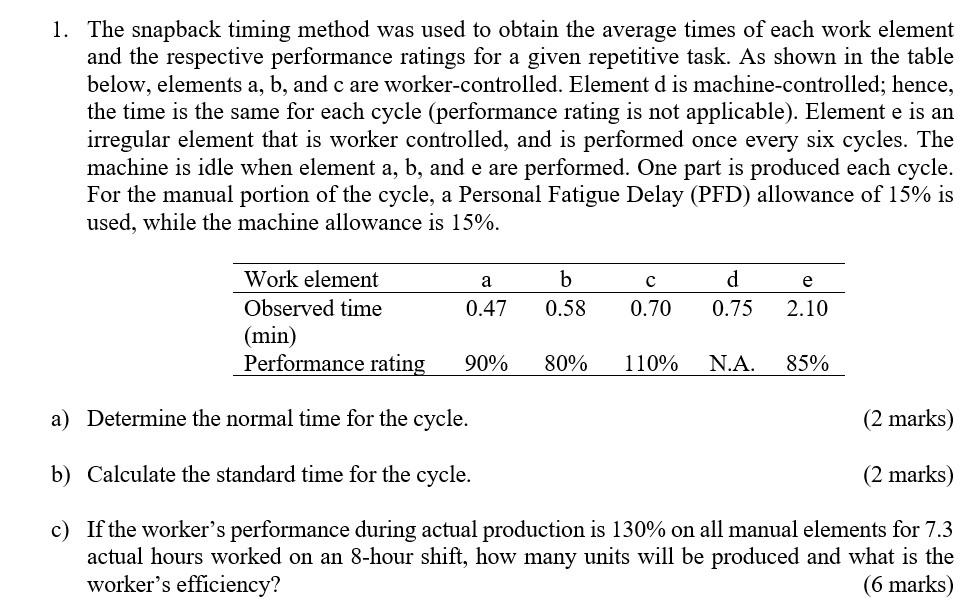
1. The snapback timing method was used to obtain the average times of each work element and the respective performance ratings for a given repetitive task. As shown in the table below, elements a, b, and c are worker-controlled. Element d is machine-controlled; hence, the time is the same for each cycle (performance rating is not applicable). Element e is an irregular element that is worker controlled, and is performed once every six cycles. The machine is idle when element a, b, and e are performed. One part is produced each cycle. For the manual portion of the cycle, a Personal Fatigue Delay (PFD) allowance of 15% is used, while the machine allowance is 15%. a 0.47 b 0.58 d 0.75 e 2.10 0.70 Work element Observed time (min) Performance rating 90% 80% 110% N.A. 85% a) Determine the normal time for the cycle. (2 marks) b) Calculate the standard time for the cycle. (2 marks) c) If the worker's performance during actual production is 130% on all manual elements for 7.3 actual hours worked on an 8-hour shift, how many units will be produced and what is the worker's efficiency? (6 marks)

Step by Step Solution

There are 3 Steps involved in it

1 Expert Approved Answer
Step: 1 Unlock blur-text-image

Question Has Been Solved by an Expert!

Get step-by-step solutions from verified subject matter experts

Step: 2 Unlock
Step: 3 Unlock

Students Have Also Explored These Related General Management Questions!