







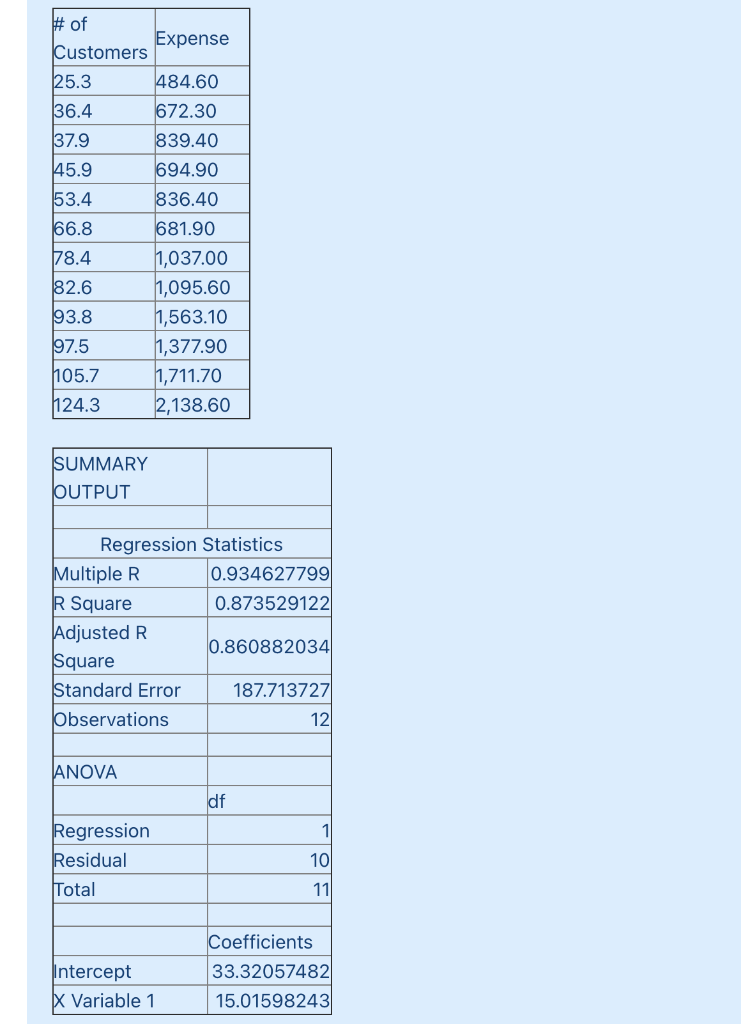
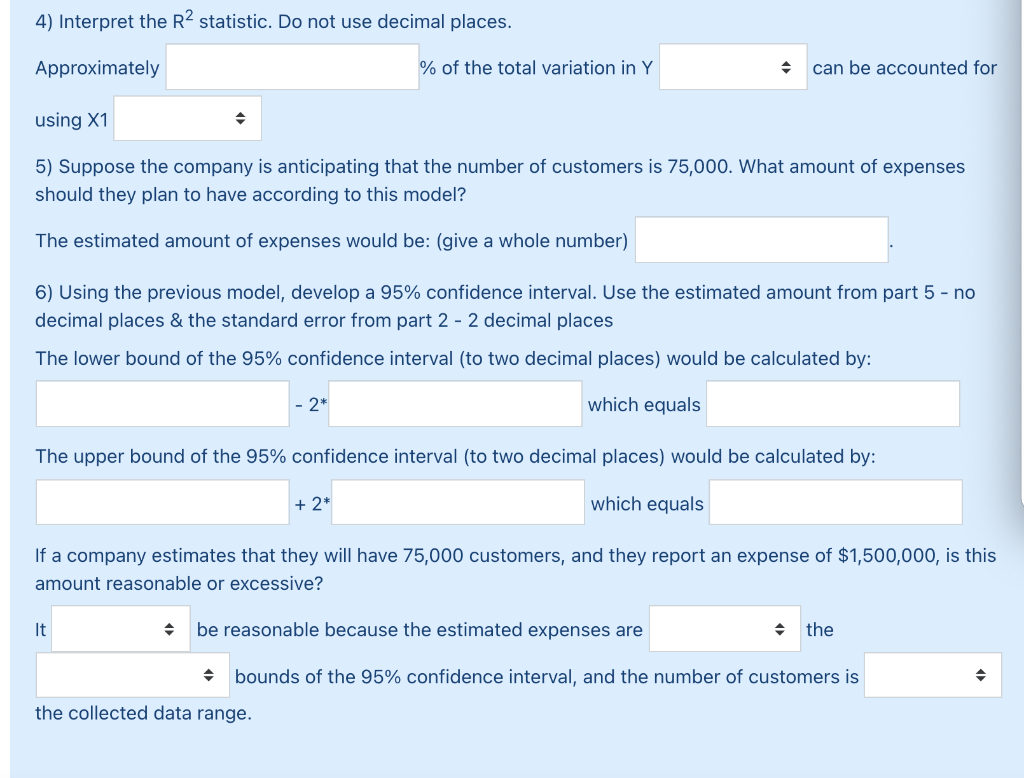
Question: undefined 4) Interpret the R2 statistic. Do not use decimal places. Approximately % of the total variation in Y can be accounted for using X1
 undefined
4) Interpret the R2 statistic. Do not use decimal places. Approximately % of the total variation in Y can be accounted for using X1 5) Suppose the company is anticipating that the number of customers is 75,000. What amount of expenses should they plan to have according to this model? The estimated amount of expenses would be: (give a whole number) 6) Using the previous model, develop a 95% confidence interval. Use the estimated amount from part 5 - no decimal places & the standard error from part 2 - 2 decimal places The lower bound of the 95% confidence interval (to two decimal places) would be calculated by: - 2* which equals The upper bound of the 95% confidence interval (to two decimal places) would be calculated by: + 2* which equals If a company estimates that they will have 75,000 customers, and they report an expense of $1,500,000, is this amount reasonable or excessive? It be reasonable because the estimated expenses are the bounds of the 95% confidence interval, and the number of customers is the collected data range. 4) Interpret the R2 statistic. Do not use decimal places. Approximately % of the total variation in Y can be accounted for using X1 5) Suppose the company is anticipating that the number of customers is 75,000. What amount of expenses should they plan to have according to this model? The estimated amount of expenses would be: (give a whole number) 6) Using the previous model, develop a 95% confidence interval. Use the estimated amount from part 5 - no decimal places & the standard error from part 2 - 2 decimal places The lower bound of the 95% confidence interval (to two decimal places) would be calculated by: - 2* which equals The upper bound of the 95% confidence interval (to two decimal places) would be calculated by: + 2* which equals If a company estimates that they will have 75,000 customers, and they report an expense of $1,500,000, is this amount reasonable or excessive? It be reasonable because the estimated expenses are the bounds of the 95% confidence interval, and the number of customers is the collected data range
Step by Step Solution
There are 3 Steps involved in it

Get step-by-step solutions from verified subject matter experts
 Study Help