





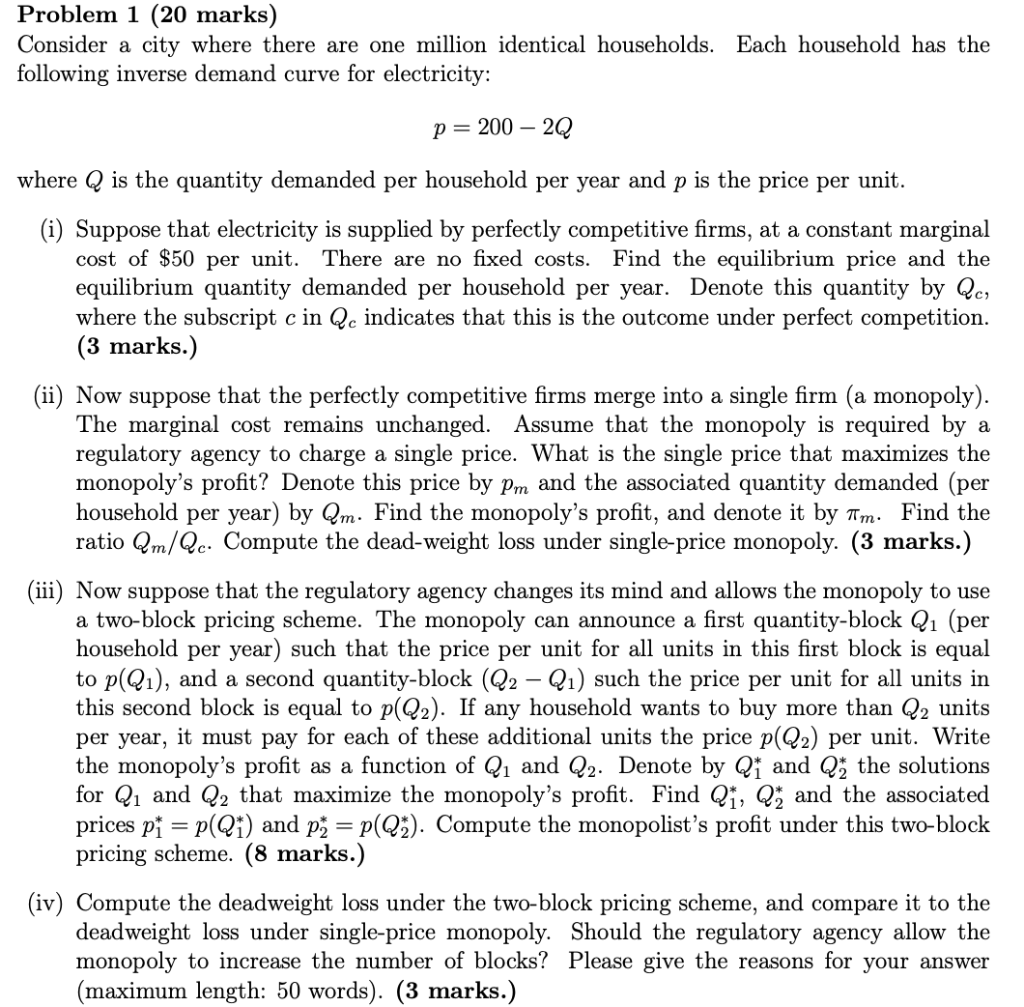
Question: undefined Problem 1 (20 marks) Consider a city where there are one million identical households. Each household has the following inverse demand curve for electricity:
undefined Problem 1 (20 marks) Consider a cityundefined

Problem 1 (20 marks) Consider a city where there are one million identical households. Each household has the following inverse demand curve for electricity: p= 200 20 where Q is the quantity demanded per household per year and p is the price per unit. (i) Suppose that electricity is supplied by perfectly competitive firms, at a constant marginal cost of $50 per unit. There are no fixed costs. Find the equilibrium price and the equilibrium quantity demanded per household per year. Denote this quantity by Qc, where the subscript c in Qc indicates that this is the outcome under perfect competition. (3 marks.) (ii) Now suppose that the perfectly competitive firms merge into a single firm (a monopoly). The marginal cost remains unchanged. Assume that the monopoly is required by a regulatory agency to charge a single price. What is the single price that maximizes the monopoly's profit? Denote this price by Pm and the associated quantity demanded (per household per year) by Qm. Find the monopoly's profit, and denote it by Tim. Find the ratio Qm/Qc. Compute the dead weight loss under single-price monopoly. (3 marks.) (iii) Now suppose that the regulatory agency changes its mind and allows the monopoly to use a two-block pricing scheme. The monopoly can announce a first quantity-block Q1 (per household per year) such that the price per unit for all units in this first block is equal to p(Q), and a second quantity-block (Q2 - Q) such the price per unit for all units in this second block is equal to p(Q2). If any household wants to buy more than Q2 units per year, it must pay for each of these additional units the price p(Q2) per unit. Write the monopoly's profit as a function of Q and Q2. Denote by Qi and Q7 the solutions for Q1 and Q2 that maximize the monopoly's profit. Find Q1, Q* and the associated prices pi = p(Qi) and pz = P(Q2). Compute the monopolist's profit under this two-block pricing scheme. (8 marks.) (iv) Compute the deadweight loss under the two-block pricing scheme, and compare it to the deadweight loss under single-price monopoly. Should the regulatory agency allow the monopoly to increase the number of blocks? Please give the reasons for your answer (maximum length: 50 words). (3 marks.)

Step by Step Solution

There are 3 Steps involved in it

1 Expert Approved Answer
Step: 1 Unlock blur-text-image

Question Has Been Solved by an Expert!

Get step-by-step solutions from verified subject matter experts

Step: 2 Unlock
Step: 3 Unlock

Students Have Also Explored These Related General Management Questions!