







Question: Under the simple uniform hashing model, a hash table comprises m slots (e.g., linked lists), and each insertion is equally likely to go to any
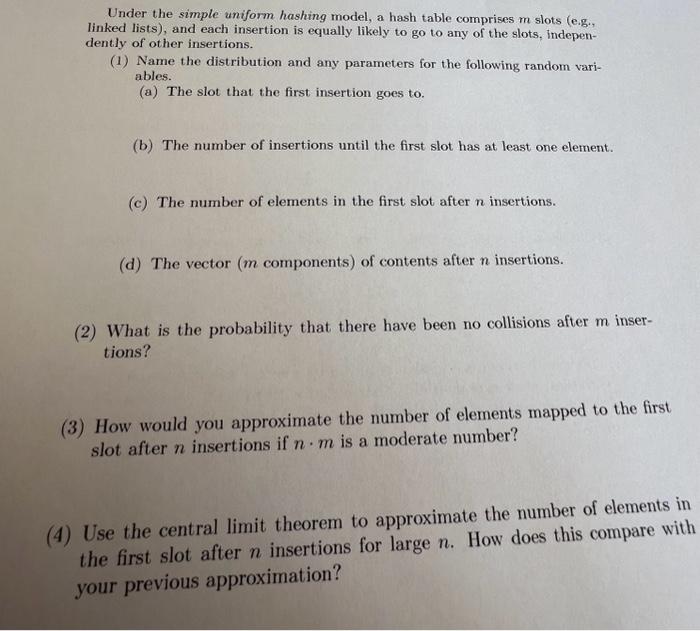
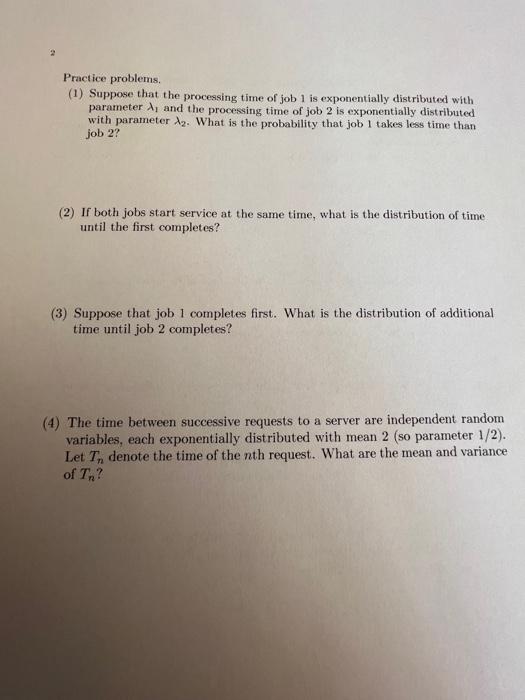
Under the simple uniform hashing model, a hash table comprises m slots (e.g., linked lists), and each insertion is equally likely to go to any of the slots, independently of other insertions. (1) Name the distribution and any parameters for the following random variables. (a) The slot that the first insertion goes to. (b) The number of insertions until the first slot has at least one element. (c) The number of elements in the first slot after n insertions. (d) The vector ( m components) of contents after n insertions. (2) What is the probability that there have been no collisions after m insertions? (3) How would you approximate the number of elements mapped to the first slot after n insertions if nm is a moderate number? (4) Use the central limit theorem to approximate the number of elements in the first slot after n insertions for large n. How does this compare with your previous approximation? Practice problems. (1) Suppose that the processing time of job 1 is exponentially distributed with parameter 1 and the processing time of job 2 is exponentially distributed with parameter 2. What is the probability that job 1 takes less time than job 2? (2) If both jobs start service at the same time, what is the distribution of time until the first completes? (3) Suppose that job 1 completes first. What is the distribution of additional time until job 2 completes? (4) The time between successive requests to a server are independent random variables, each exponentially distributed with mean 2 (so parameter 1/2). Let Tn denote the time of the nth request. What are the mean and variance of Tn
Step by Step Solution
There are 3 Steps involved in it

Get step-by-step solutions from verified subject matter experts
 Study Help