







Question: ( underline { text { Given: } } ) A flat, horizontal automobile hood ( 1 m long by 1 m
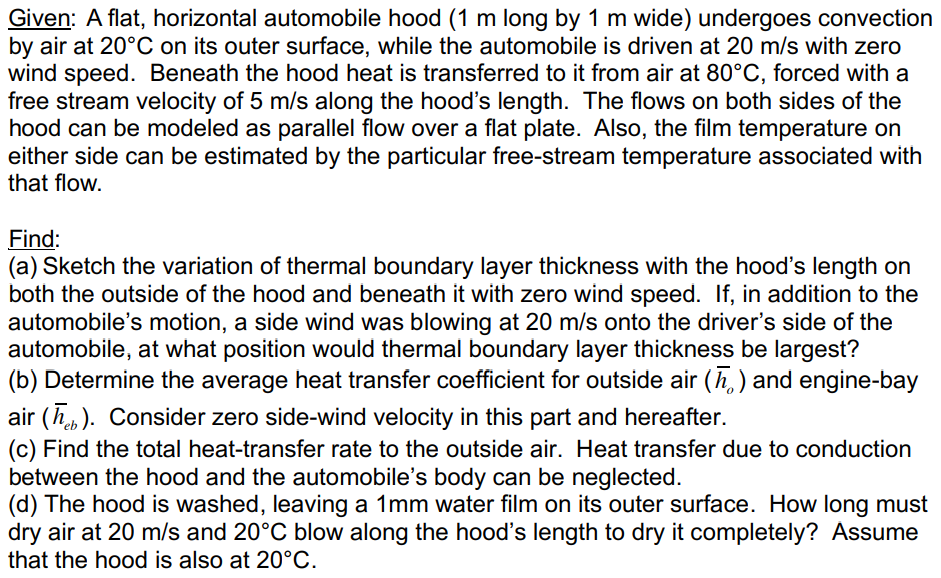
underlinetext Given: A flat, horizontal automobile hood m long by m wide undergoes convection by air at circmathrmC on its outer surface, while the automobile is driven at mathrm~mmathrms with zero wind speed. Beneath the hood heat is transferred to it from air at circmathrmC forced with a free stream velocity of mathrm~mmathrms along the hood's length. The flows on both sides of the hood can be modeled as parallel flow over a flat plate. Also, the film temperature on either side can be estimated by the particular freestream temperature associated with that flow.
Find:
a Sketch the variation of thermal boundary layer thickness with the hood's length on both the outside of the hood and beneath it with zero wind speed. If in addition to the automobile's motion, a side wind was blowing at mathrm~mmathrms onto the driver's side of the automobile, at what position would thermal boundary layer thickness be largest?
b Determine the average heat transfer coefficient for outside air leftbarhoright and enginebay air leftbarhe bright Consider zero sidewind velocity in this part and hereafter.
c Find the total heattransfer rate to the outside air. Heat transfer due to conduction between the hood and the automobile's body can be neglected.
d The hood is washed, leaving a mm water film on its outer surface. How long must dry air at mathrm~mmathrms and circmathrmC blow along the hood's length to dry it completely? Assume that the hood is also at circmathrmC
Step by Step Solution
There are 3 Steps involved in it
1 Expert Approved Answer
Step: 1 Unlock

Question Has Been Solved by an Expert!
Get step-by-step solutions from verified subject matter experts
Step: 2 Unlock
Step: 3 Unlock
 Study Help