







Question: Unit 4 Extra Credit: Problem 3 (1 point) Significance testing is similar to hypothesis testing, except rather than comparing a p-value to a level of
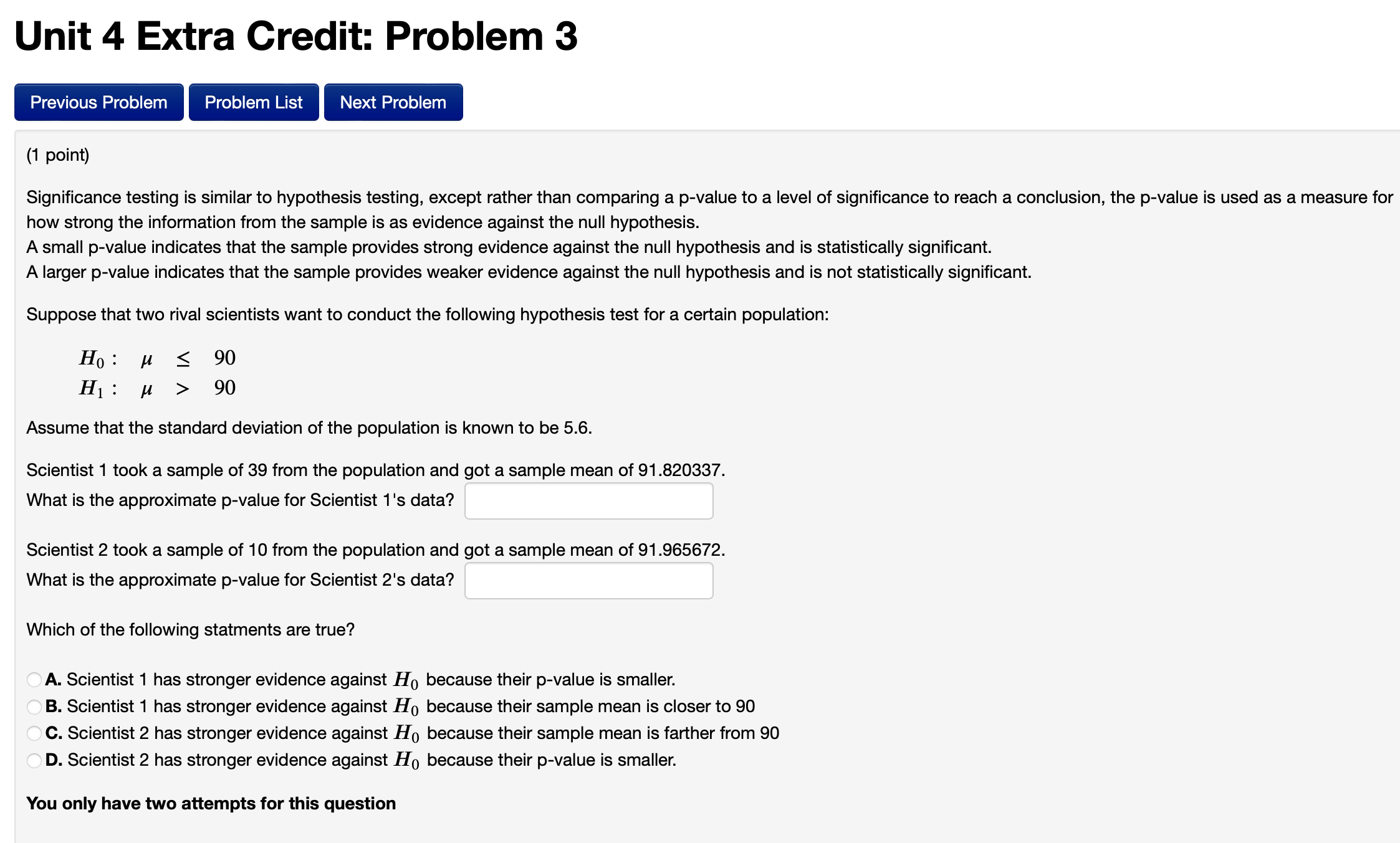
Unit 4 Extra Credit: Problem 3 (1 point) Significance testing is similar to hypothesis testing, except rather than comparing a p-value to a level of significance to reach a conclusion, the p-value is used as a measure for how strong the information from the sample is as evidence against the null hypothesis. A small pvalue indicates that the sample provides strong evidence against the null hypothesis and is statistically significant. A larger pvalue indicates that the sample provides weaker evidence against the null hypothesis and is not statistically significant. Suppose that two rival scientists want to conduct the following hypothesis test for a certain population: HQ: [4 S 90 H1 I [l > 90 Assume that the standard deviation of the population is known to be 5.6. Scientist 1 took a sample of 39 from the population and got a sample mean of 91 .820337. What is the approximate pvalue for Scientist 1's data? Scientist 2 took a sample of 10 from the population and got a sample mean of 91 .965672. What is the approximate pvalue for Scientist 2's data? Which of the following statments are true? A. Scientist 1 has stronger evidence against H0 because their pvalue is smaller. B. Scientist 1 has stronger evidence against H 0 because their sample mean is closer to 90 C. Scientist 2 has stronger evidence against H 0 because their sample mean is farther from 90 D. Scientist 2 has stronger evidence against H 0 because their pvalue is smaller. You only have two attempts for this
Step by Step Solution
There are 3 Steps involved in it

Get step-by-step solutions from verified subject matter experts
 Study Help