Question: Unit 8 Benchmarking Analysis case study - INTELEXT Intelex, a Canadian-based global leader in Environment, Health, Safety and Quality (EHSQ) SaaS, with offices in Toronto,
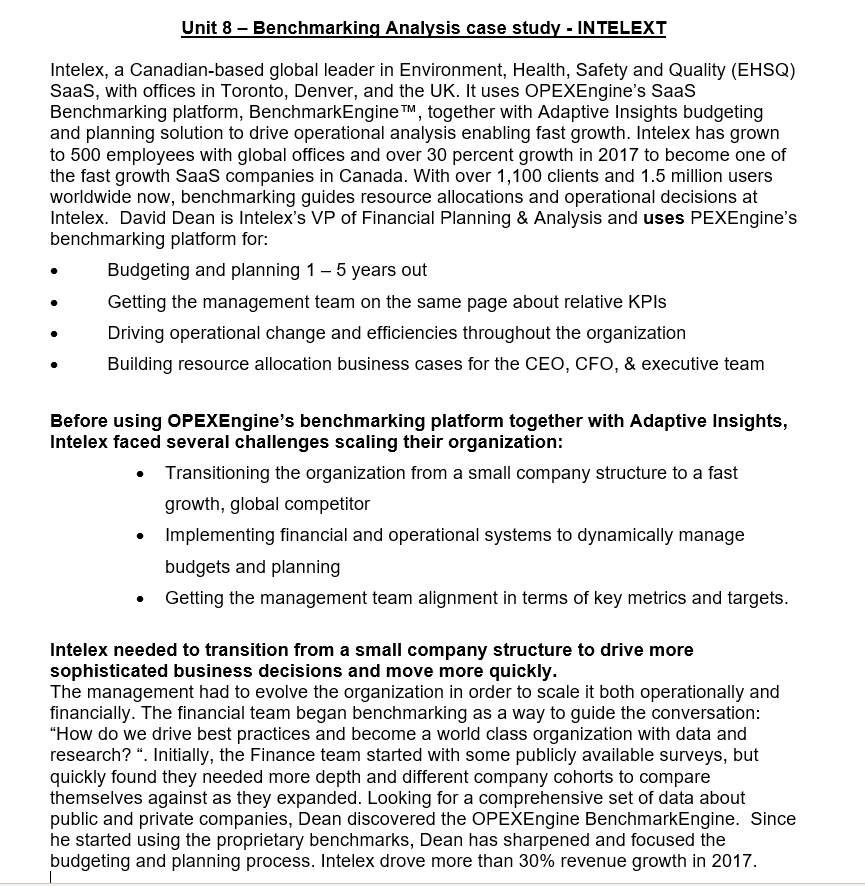
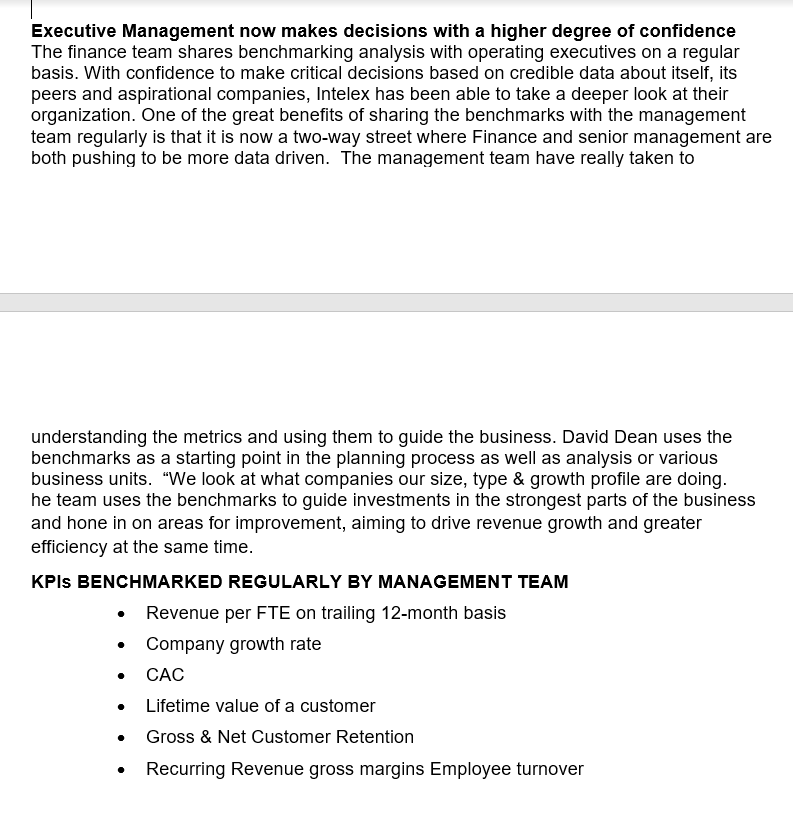
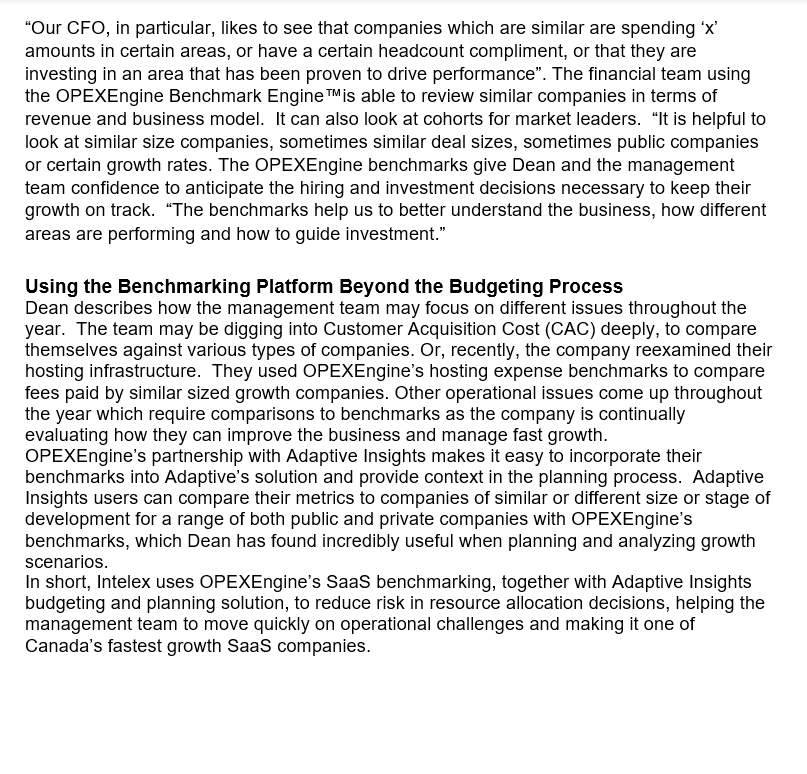
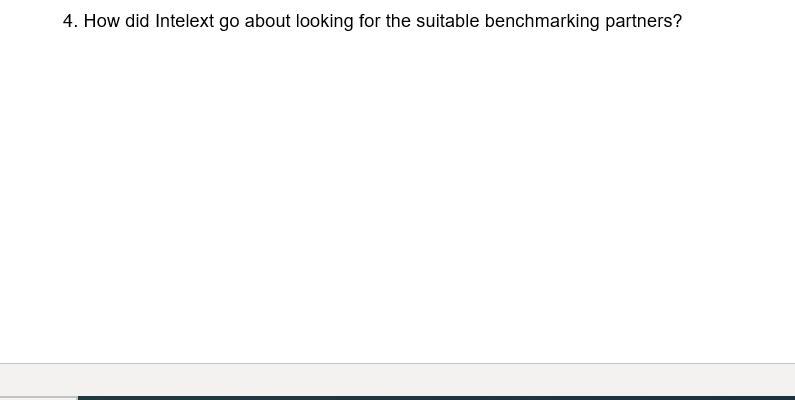
Unit 8 Benchmarking Analysis case study - INTELEXT Intelex, a Canadian-based global leader in Environment, Health, Safety and Quality (EHSQ) SaaS, with offices in Toronto, Denver, and the UK. It uses OPEXEngine's SaaS Benchmarking platform, BenchmarkEngine , together with Adaptive Insights budgeting and planning solution to drive operational analysis enabling fast growth. Intelex has grown to 500 employees with global offices and over 30 percent growth in 2017 to become one of the fast growth SaaS companies in Canada. With over 1,100 clients and 1.5 million users worldwide now, benchmarking guides resource allocations and operational decisions at Intelex. David Dean is Intelex's VP of Financial Planning & Analysis and uses PEXEngine's benchmarking platform for: Budgeting and planning 1 - 5 years out Getting the management team on the same page about relative KPIs Driving operational change and efficiencies throughout the organization Building resource allocation business cases for the CEO, CFO, & executive team Before using OPEXEngine's benchmarking platform together with Adaptive Insights, Intelex faced several challenges scaling their organization: Transitioning the organization from a small company structure to a fast growth, global competitor Implementing financial and operational systems to dynamically manage budgets and planning Getting the management team alignment in terms of key metrics and targets. Intelex needed to transition from a small company structure to drive more sophisticated business decisions and move more quickly. The management had to evolve the organization in order to scale it both operationally and financially. The financial team began benchmarking as a way to guide the conversation: "How do we drive best practices and become a world class organization with data and research?. Initially, the Finance team started with some publicly available surveys, but quickly found they needed more depth and different company cohorts to compare themselves against as they expanded. Looking for a comprehensive set of data about public and private companies, Dean discovered the OPEXEngine BenchmarkEngine. Since he started using the proprietary benchmarks, Dean has sharpened and focused the budgeting and planning process. Intelex drove more than 30% revenue growth in 2017. Executive Management now makes decisions with a higher degree of confidence The finance team shares benchmarking analysis with operating executives on a regular basis. With confidence to make critical decisions based on credible data about itself, its peers and aspirational companies, Intelex has been able to take a deeper look at their organization. One of the great benefits of sharing the benchmarks with the management team regularly is that it is now a two-way street where Finance and senior management are both pushing to be more data driven. The management team have really taken to understanding the metrics and using them to guide the business. David Dean uses the benchmarks as a starting point in the planning process as well as analysis or various business units. We look at what companies our size, type & growth profile are doing. he team uses the benchmarks to guide investments in the strongest parts of the business and hone in on areas for improvement, aiming to drive revenue growth and greater efficiency at the same time. KPIs BENCHMARKED REGULARLY BY MANAGEMENT TEAM Revenue per FTE on trailing 12-month basis Company growth rate CAC Lifetime value of a customer Gross & Net Customer Retention Recurring Revenue gross margins Employee turnover "Our CFO, in particular, likes to see that companies which are similar are spending 'x' amounts in certain areas, or have a certain headcount compliment, or that they are investing in an area that has been proven to drive performance. The financial team using the OPEXEngine Benchmark Engine Tis able to review similar companies in terms of revenue and business model. It can also look at cohorts for market leaders. It is helpful to look at similar size companies, sometimes similar deal sizes, sometimes public companies or certain growth rates. The OPEXEngine benchmarks give Dean and the management team confidence to anticipate the hiring and investment decisions necessary to keep their growth on track. The benchmarks help us to better understand the business, how different areas are performing and how to guide investment." Using the Benchmarking Platform Beyond the Budgeting Process Dean describes how the management team may focus on different issues throughout the year. The team may be digging into Customer Acquisition Cost (CAC) deeply, to compare themselves against various types of companies. Or, recently, the company reexamined their hosting infrastructure. They used OPEXEngine's hosting expense benchmarks to compare fees paid by similar sized growth companies. Other operational issues come up throughout the year which require comparisons to benchmarks as the company is continually evaluating how they can improve the business and manage fast growth. OPEXEngine's partnership with Adaptive Insights makes it easy to incorporate their benchmarks into Adaptive's solution and provide context in the planning process. Adaptive Insights users can compare their metrics to companies of similar or different size or stage of development for a range of both public and private companies with OPEXEngine's benchmarks, which Dean has found incredibly useful when planning and analyzing growth scenarios. In short, Intelex uses OPEXEngine's SaaS benchmarking, together with Adaptive Insights budgeting and planning solution, to reduce risk in resource allocation decisions, helping the management team to move quickly on operational challenges and making it one of Canada's fastest growth SaaS companies. 4. How did Intelext go about looking for the suitable benchmarking partners









 Study Help