







Question: Unit VII Sample Homework As we age, we must take into account that our memory will start to weaken. I, for example, am very
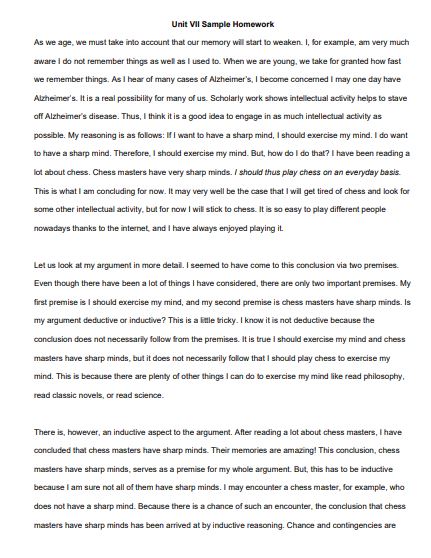
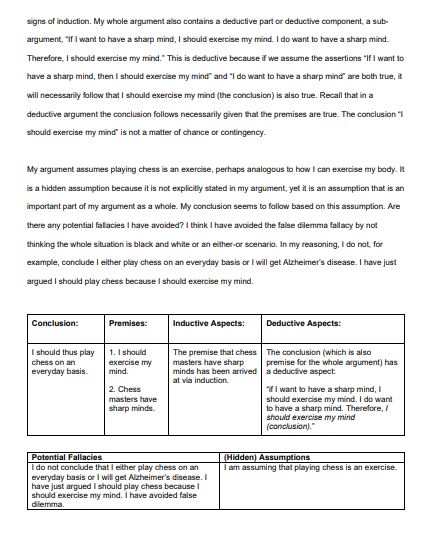
Unit VII Sample Homework As we age, we must take into account that our memory will start to weaken. I, for example, am very much aware I do not remember things as well as I used to. When we are young, we take for granted how fast we remember things. As I hear of many cases of Alzheimer's, I become concerned I may one day have Alzheimer's. It is a real possibility for many of us. Scholarly work shows intellectual activity helps to stave off Alzheimer's disease. Thus, I think it is a good idea to engage in as much intellectual activity as possible. My reasoning is as follows: If I want to have a sharp mind, I should exercise my mind. I do want to have a sharp mind. Therefore, I should exercise my mind. But, how do I do that? I have been reading a lot about chess. Chess masters have very sharp minds. I should thus play chess on an everyday basis. This is what I am concluding for now. It may very well be the case that I will get tired of chess and look for some other intellectual activity, but for now I will stick to chess. It is so easy to play different people nowadays thanks to the internet, and I have always enjoyed playing it. Let us look at my argument in more detail. I seemed to have come to this conclusion via two premises. Even though there have been a lot of things I have considered, there are only two important premises. My first premise is I should exercise my mind, and my second premise is chess masters have sharp minds. Is my argument deductive or inductive? This is a little tricky. I know it is not deductive because the conclusion does not necessarily follow from the premises. It is true I should exercise my mind and chess masters have sharp minds, but it does not necessarily follow that I should play chess to exercise my mind. This is because there are plenty of other things I can do to exercise my mind like read philosophy. read classic novels, or read science. There is, however, an inductive aspect to the argument. After reading a lot about chess masters, I have concluded that chess masters have sharp minds. Their memories are amazing! This conclusion, chess masters have sharp minds, serves as a premise for my whole argument. But, this has to be inductive because I am sure not all of them have sharp minds. I may encounter a chess master, for example, who does not have a sharp mind. Because there is a chance of such an encounter, the conclusion that chess masters have sharp minds has been arrived at by inductive reasoning. Chance and contingencies are signs of induction. My whole argument also contains a deductive part or deductive component, a sub- argument, "If I want to have a sharp mind, I should exercise my mind. I do want to have a sharp mind. Therefore, I should exercise my mind." This is deductive because if we assume the assertions "If I want to have a sharp mind, then I should exercise my mind" and "I do want to have a sharp mind" are both true, it will necessarily follow that I should exercise my mind (the conclusion) is also true. Recall that in a deductive argument the conclusion follows necessarily given that the premises are true. The conclusion" should exercise my mind" is not a matter of chance or contingency. My argument assumes playing chess is an exercise, perhaps analogous to how I can exercise my body. It is a hidden assumption because it is not explicitly stated in my argument, yet it is an assumption that is an important part of my argument as a whole. My conclusion seems to follow based on this assumption. Are there any potential fallacies I have avoided? I think I have avoided the false dilemma fallacy by not thinking the whole situation is black and white or an either-or scenario. In my reasoning, I do not, for example, conclude I either play chess on an everyday basis or I will get Alzheimer's disease. I have just argued I should play chess because I should exercise my mind. Conclusion: Premises: Inductive Aspects: Deductive Aspects: I should thus play chess on an everyday basis. 1. I should exercise my mind. 2. Chess masters have sharp minds. The premise that chess masters have sharp minds has been arrived at via induction. The conclusion (which is also premise for the whole argument) has a deductive aspect if I want to have a sharp mind, I should exercise my mind. I do want to have a sharp mind. Therefore, / should exercise my mind (conclusion)." Potential Fallacies I do not conclude that I either play chess on an everyday basis or I will get Alzheimer's disease. I have just argued I should play chess because I should exercise my mind. I have avoided false dilemma. (Hidden) Assumptions I am assuming that playing chess is an exercise.
Step by Step Solution
There are 3 Steps involved in it

Get step-by-step solutions from verified subject matter experts
 Study Help