Question: URGENT please answer correctly i do not need the definition i need the explanation ! please find :- 1) swiss cheese model 2) SHELL model
URGENT
please answer correctly i do not need the definition i need the explanation !
please find :-
1) swiss cheese model
2) SHELL model
urgent !
please provide me with :
1) swiss cheese model
2) SHELL model
for the below case study .
and please answer correctly , i do not need the definition, i need actual models.
thank you !
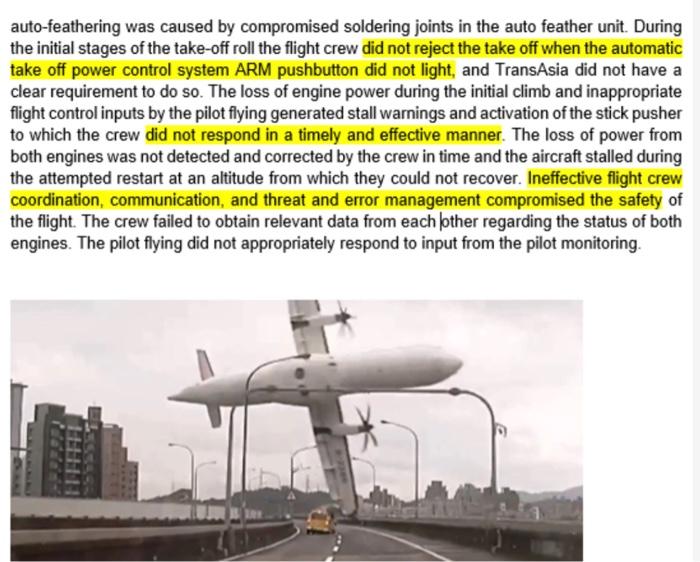
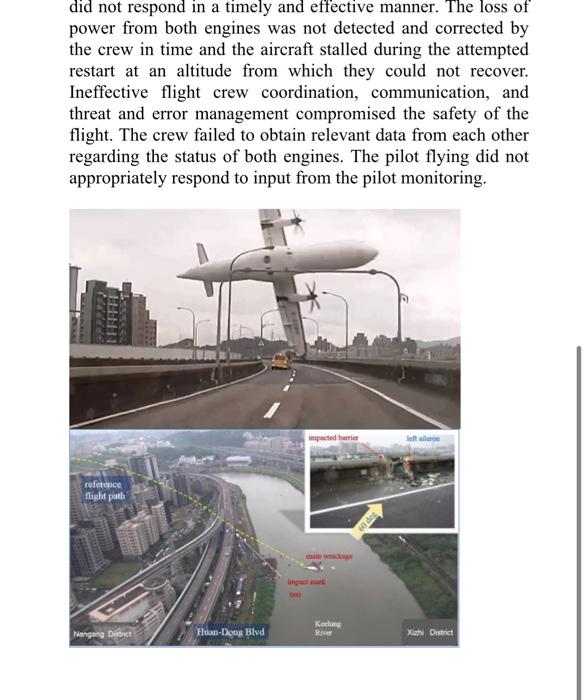
TransAsia Airways Flight 235 (TNA 235) was a domestic scheduled passenger flight from Taipei to Kinmen (Quemoy), Republic of China. On the 4 of February 2015, the aircraft serving the flight, a 10-month-old ATR 72-600, crashed into the Keelung River shortly after take-off from Taipei Songshan Airport, 5.4 km to the west of the city The aircraft had 53 passengers and five crew on board there were 15 survivors. The number of injuries was 17 in total, including two ground injuries. Three minutes after take-off, the pilots reported an engine flameout Flight 235 climbed to a maximum height of 1,510 feet (465m), then descended. The other engine, still working was shut down mistakenly. Immediately before crashing into the river, it banked sharply left and dipped a taxi travelling west on the Huandong Viaduct (causing two more injuries), then the viaduct itself, with its left wing. Flight 235 was the second fatal accident involving a TransAsia Airways ATR aircraft within seven months: Flight 222 had crashed on 23 July 2014, killing 48 of the 58 on board. Flight 235 departed Taipei Songshan Airport at 10:51 Taiwan time (02:52 UTC). for its destination of Kinmen Airport, with 53 passengers and five crew members on board. The estimated time of arrival was 11:51. Shortly after take-off, a fault in the auto-feather unit of the number 2 engine caused the automatic take-off power control system to auto-feather that engine (an auto-feather is when the propeller is no-longer generating thrust). The flight crew misdiagnosed the problem and shut down the still-functioning number 1 engine. The aircraft reached an altitude of 1,630 feet (500m) and then began descending until it crashed. The last pilot communication to air traffic control was: "Mayday, mayday, engine flameout." At 10:54. the aircraft crashed into the Keelung River, on the border of Nangang District of Taipei and Xizhi District of New Taipei At the time of the accident, no adverse weather phenomena were observed. At 11:00, the cloud base at Songshao was about 1,500 feet (46 m), the visibility was unlimited, and a light breeze was blowing from the east at 10 knots (19 km/h: 12 mph). The temperature was 16 C (61 F) The aircraft involved in the accident was an ATR 72-600 twin turboprop, registration B-22816 MSN 1141 The flight crew consisted of two pilots, both ranked as captains. The commander, who was acting as the pilot flying, was Liao Chien-Tsung. 42, with a total of 4.914 flying hours (including 3,401 hours on the ATR 72) and the other captain acting as the pilot-monitoring, was Liu Tze- Chung, 45, with a total of 6,922 flying hours, including 5,314 hours on the ATR 72. This indicated that both pilots had relatively an even amount of experience on the aircraft. There was also an observer, Hung Ping-Chung, 63, seated in the cockpit jump seat, who had a total of 16.121 flying hours, 6,482 of them on the ATR 72. There were two flight attendants. All crew members were Taiwanese citizens, however, the captain acting as the pilot-monitoring was a dual New Zealand-Taiwanese citizen. The Taiwanese Aviation Safety Council (ASC) led the investigation into the accident. The French BEA represented the country of manufacture, and the Transportation Safety Board of Canada represented the country of engine manufacture. Other parties to the investigation included the Taiwanese Civil Aeronautics Administration, the operator (TransAsia), the aircraft (ATR) and engine (Pratt & Whitney Canada) manufacturers, and Transport Canada. The cockpit voice recorder and fight data recorder were recovered on the evening of 4 February and the data were analysed. According to the executive director of the ASC, Thomas Wang, the aircraft's right engine triggered an alarm just 37 seconds after take-off. Whereas the crew reported a flameout, according to Wang, data showed one of the engines had in fact been moved into idle mode. Soon the right engine failed to produce enough thrust for its rotating propeller, lapsing into auto-feathering. A restart was attempted, but the aircraft crashed 72 seconds later On the 6" of February, investigators revealed that the left engine, which does not appear to have had suffered a malfunction, had been manually shut off, while cautioning that it was "too early to say it human error was a factor Investigators released the following preliminary sequence of events. All times are local (UTC+8). 10:49:00 - Checklist items were missed as the crew engaged in superfluous chatter 10:51:13 - Crew receives take-off clearance 10:52:34 - Tower instructs crew to contact Taipei Departure 10:52:38 - During the take-ff roll, the right engine failure alert master warning sounds for 3s. 10:53:04 - The pilot flying continues the take-off. Power to the left engine is reduced 10:53 12- The autopilot is not engaged and shortly thereafter the stick-shaker activates. 10:53 24 - The left engine is shutdown during the take off. 10:53:34 - Crew declares emergency: "Mayday, mayday, engine flameour 10:54:09 - The captain now calls for restarting the left engine multiple times 10:54 20 --- Left engine is restarted 10:54 34 --- Master warning sounds again. Moments later, the stail warning activates 10:54:35 -- An unidentified sound is heard 10:54.36 - Recordings end The ASC issued an interim report on 2 July. Without assigning responsibility for the crash, the report confirmed that a still-functional engine number one was incorrectly shut down by the pilot following the failure of engine number two. The report also stated that the pilot in command had failed to pass a simulator test in May 2014, partly due to his insufficient knowledge about the procedure for handling an engine flameout during take-off. He retook the test the following month, however, and successfully passed The final report found that, following the un-commanded auto-feather of engine number 2, the pilot flying the aircraft reduced power and subsequently shut down the operative engine number 1. The flight crew failed to perform the failure identification procedure and did not comply with standard operating procedures. As a result, the pilot flying the aircraft became confused regarding the identification and nature of the propulsion system malfunction. The auto-feathering was caused by compromised soldering joints in the auto feather unit. During the initial stages of the take-off roll the flight crew did not reject the take off when the automatic take off power control system ARM pushbutton did not light, and TransAsia did not have a clear requirement to do so. The loss of engine power during the initial climb and inappropriate flight control inputs by the pilot flying generated stall warnings and activation of the stick pusher to which the crew did not respond in a timely and effective manner. The loss of power from both engines was not detected and corrected by the crew in time and the aircraft stalled during the attempted restart at an altitude from which they could not recover. Ineffective flight crew coordination, communication, and threat and error management compromised the safety of the flight. The crew failed to obtain relevant data from each other regarding the status of both engines. The pilot flying did not appropriately respond to input from the pilot monitoring Case Study: TransAsia Airways Flight 235 TransAsia Airways Flight 235 (TNA 235) was a domestic scheduled passenger flight from Taipei to Kinmen (Quemoy), Republic of China. On the 4" of February 2015, the aircraft serving the flight, a 10-month-old ATR 72-600, crashed into the Keelung River shortly after take-off from Taipei Songshan Airport, 5.4 km to the west of the city. The aircraft had 53 passengers and five crew on board; there were 15 survivors. The number of injuries was 17 in total, including two ground injuries. Three minutes after take-off, the pilots reported an engine flameout. Flight 235 climbed to a maximum height of 1,510 feet (465m), then descended. The other engine, still working, was shut down mistakenly. Immediately before crashing into the river, it banked sharply left and clipped a taxi travelling west on the Huandong Viaduct (causing two more injuries), then the viaduct itself, with its left wing. Flight 235 was the second fatal accident involving a TransAsia Airways ATR aircraft within seven months: Flight 222 had crashed on 23 July 2014, killing 48 of the 58 on board. Flight 235 departed Taipei Songshan Airport at 10:51 Taiwan time (02:52 UTC), for its destination of Kinmen Airport, with 53 passengers and five crew members on board. The estimated time of arrival was 11:51. Shortly after take- off, a fault in the auto-feather unit of the number 2 engine caused the automatic take-off power control system to auto- feather that engine (an auto-feather is when the propeller is no-longer generating thrust). The flight crew misdiagnosed the problem and shut down the still-functioning number 1 engine. The aircraft reached an altitude of 1,630 feet (500m) and then began descending until it crashed. The last pilot communication to air traffic control was: "Mayday, mayday, engine flameout." At 10:54, the aircraft crashed into the Keelung River, on the border of Nangang District of Taipei and Xizhi District of New Taipei. Keelung River, on the border of Nangang District of Taipei and Xizhi District of New Taipei. At the time of the accident, no adverse weather phenomena were observed. At 11:00, the cloud base at Songshan was about 1,500 feet (46 m), the visibility was unlimited, and a light breeze was blowing from the east at 10 knots (19 km/h; 12 mph). The temperature was 16C (61 F). The aircraft involved in the accident was an ATR 72-600 twin turboprop, registration B-22816, MSN 1141. The flight crew consisted of two pilots, both ranked as captains. The commander, who was acting as the pilot flying, was Liao Chien-Tsung, 42, with a total of 4,914 flying hours (including 3,401 hours on the ATR 72) and the other captain acting as the pilot-monitoring, was Liu Tze-Chung, 45, with a total of 6,922 flying hours, including 5,314 hours on the ATR 72. This indicated that both pilots had relatively an even amount of experience on the aircraft. There was also an observer, Hung Ping-Chung, 63, seated in the cockpit jump seat, who had a total of 16,121 flying hours, 6,482 of them on the ATR 72. There were two flight attendants. All crew members were Taiwanese citizens; however, the captain acting as the pilot-monitoring was a dual New Zealand Taiwanese citizen. The Taiwanese Aviation Safety Council (ASC) led the investigation into the accident. The French BEA represented the country of manufacture, and the Transportation Safety Board of Canada represented the country of engine manufacture. Other parties to the investigation included the Taiwanese Civil Aeronautics Administration, the operator (TransAsia), the aircraft (ATR) and engine (Pratt & Whitney Canada) manufacturers, and Transport Canada. The cockpit voice recorder and flight data recorder were recovered on the evening of 4 February, and the data were analysed. According to the executive director of the ASC, Thomas Wang, the aircraft's right engine triggered an alarm just 37 seconds after take-off. Whereas the crew reported a flameout, according to Wang, data showed one of the engines had in fact been moved into idle mode. Soon the right engine failed to produce enough thrust for its rotating propeller, lapsing into auto- feathering. A restart was attempted, but the aircraft crashed 72 seconds later. feathering. A restart was attempted, but the aircraft crashed 72 seconds later. On the 6 of February, investigators revealed that the left engine, which does not appear to have had suffered a malfunction, had been manually shut off, while cautioning that it was "too early to say if human error was a factor". Investigators released the following preliminary sequence of events. All times are local (UTC+8). 10:49:00 - Checklist items were missed as the crew engaged in superfluous chatter 10:51:13 - Crew receives take-off clearance. 10:52:34 - Tower instructs crew to contact Taipei Departure. 10:52:38 - During the take-ff roll, the right engine failure alert, master warning sounds for 3s. 10:53:04 - The pilot flying continues the take-off. Power to the left engine is reduced. 10:53:12- The autopilot is not engaged and shortly thereafter the stick-shaker activates. 10:53:24 - The left engine is shutdown during the take off. 10:53:34 - Crew declares emergency: "Mayday, mayday, engine flameout" 10:54:09 - The captain now calls for restarting the left engine multiple times 10:54:20 - Left engine is restarted 10:54:34 - Master warning sounds again. Moments later, the stall warning activates. 10:54:35 - An unidentified sound is heard 10:54:36 - Recordings end The ASC issued an interim report on 2 July. Without assigning responsibility for the crash, the report confirmed that a still-functional engine number one was incorrectly shut down by the pilot following the failure of engine number two. The report also stated that the pilot in command had failed to pass a simulator test in May 2014, partly due to his insufficient knowledge about the procedure for handling an engine flameout during take-off. He retook the test the following month, however, and successfully passed. The final report found that, following the un-commanded auto-feather of engine number 2, the pilot flying the aircraft reduced power and subsequently shut down the operative engine number 1. The flight crew failed to perform the failure identification procedure and did not comply with standard operating procedures. As a result, the pilot flying the aircraft became confused regarding the identification and nature of the propulsion system malfunction. The auto-feathering was caused by compromised soldering joints in the auto feather unit. During the initial stages of the take-off roll the flight crew did not reject the take off when the automatic take off power control system ARM pushbutton did not light, and TransAsia did not have a clear requirement to do so. The loss did not respond in a timely and effective manner. The loss of power from both engines was not detected and corrected by the crew in time and the aircraft stalled during the attempted restart at an altitude from which they could not recover. Ineffective flight crew coordination, communication, and threat and error management compromised the safety of the flight. The crew failed to obtain relevant data from each other regarding the status of both engines. The pilot flying did not appropriately respond to input from the pilot monitoring. impacted left reference flight path 09 Keel River Nangang Dict Husn-Dong Blvd Xigh District









 Study Help