





Question: US Census Bureau - Field Data Collection Automation (FDCA) - MGT300 Case study 2 Requiring up to 1 million temporary workers to be hired, trained,
US Census Bureau - Field Data Collection
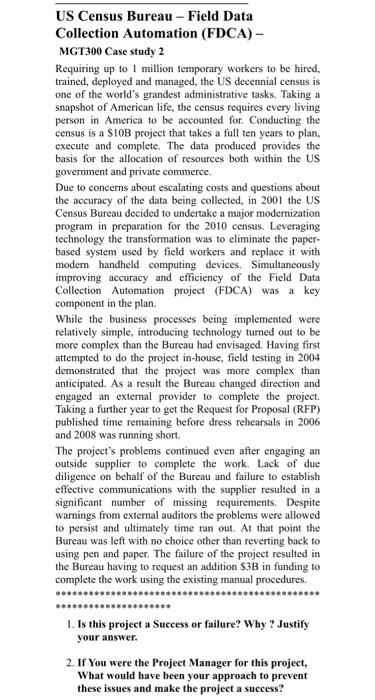
US Census Bureau - Field Data Collection Automation (FDCA) - MGT300 Case study 2 Requiring up to 1 million temporary workers to be hired, trained, deployed and managed, the US decennial census is one of the world's grandest administrative tasks. Taking a snapshot of American life, the census requires every living person in America to be accounted for. Conducting the census is a S10B project that takes a full ten years to plan, execute and complete. The data produced provides the basis for the allocation of resources both within the US government and private commerce. Due to concerns about escalating costs and questions about the accuracy of the data being collected in 2001 the US Census Bureau decided to undertake a major modernization program in preparation for the 2010 census. Leveraging technology the transformation was to eliminate the paper- based system used by field workers and replace it with modern handheld computing devices. Simultaneously improving accuracy and efficiency of the Field Data Collection Automation project (FDCA) was a key component in the plan. While the business processes being implemented were relatively simple, introducing technology turned out to be more complex than the Bureau had envisaged. Having first attempted to do the project in-house, field testing in 2004 demonstrated that the project was more complex than anticipated. As a result the Bureau changed direction and engaged an external provider to complete the project. Taking a further year to get the Request for Proposal (RFP) published time remaining before dress rehearsals in 2006 and 2008 was running short. The project's problems continued even after engaging an outside supplier to complete the work. Lack of due diligence on behalf of the Bureau and failure to establish effective communications with the supplier resulted in a significant number of missing requirements. Despite warnings from external auditors the problems were allowed to persist and ultimately time ran out. At that point the Bureau was left with no choice other than reverting back to using pen and paper. The failure of the project resulted in the Bureau having to request an addition $3B in funding to complete the work using the existing manual procedures. 1. Is this project a Success or failure? Why? Justify your answer. 2. If You were the Project Manager for this project, What would have been your approach to prevent these issues and make the project a success

Step by Step Solution

There are 3 Steps involved in it

1 Expert Approved Answer
Step: 1 Unlock blur-text-image

Question Has Been Solved by an Expert!

Get step-by-step solutions from verified subject matter experts

Step: 2 Unlock
Step: 3 Unlock

Students Have Also Explored These Related General Management Questions!