Question: Use google scholar to find articles that are about these topics. I need a minimum of five sources. For each source you use, provide the
Use google scholar to find articles that are about these topics. I need a minimum of five sources. For each source you use, provide the link. Make sure to use intext citation (provide in brackets the authors last name where nesscary)
Literature review This is where you sell your topic as interesting and important. This is also where most of your references will be included. Your readers must be convinced at the end of this section that you are going to put together a solid research paper. For your thesis statement, it is perfectly fine to state "The purpose of this paper is to ..." You must have a thesis statement so that your readers know the purpose of your study. Your literature review must be objective and you must also evidence how your study will make a contribution to the existing literature. The literature paper should be 2-3 p a g e s long
LITERATURE REVIEW
1. Introduction/THESIS
2. Body paragraph 1
Topic: Targeting of Specific Immigrant Groups in Hate Crimes
3. Body paragraph 2
Topic: The Economic Impact of Discrimination on Immigrant Workers
4. Body paragraph 3
Topic: Educational Discrimination Against Immigrant Students
5. Conclusion
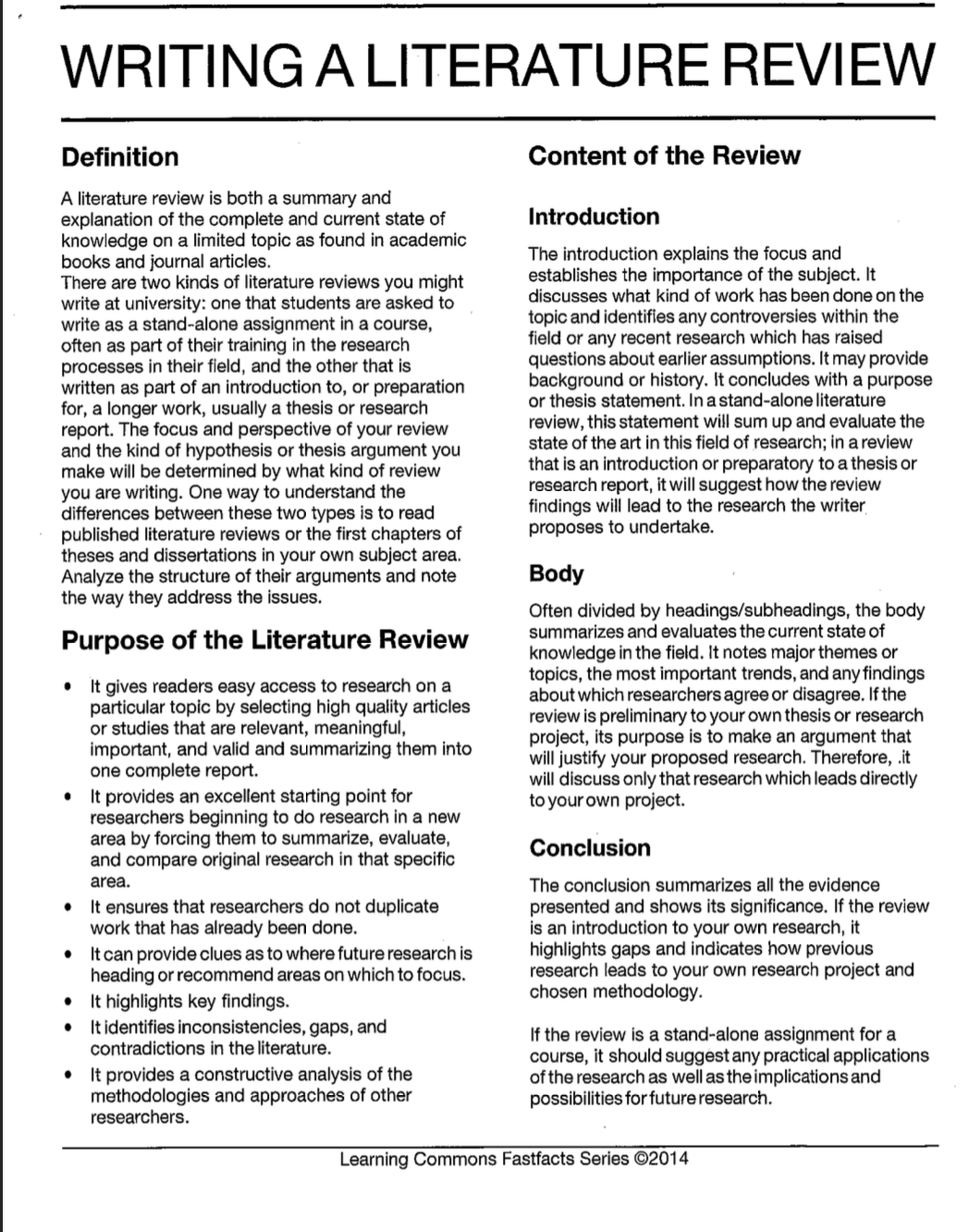
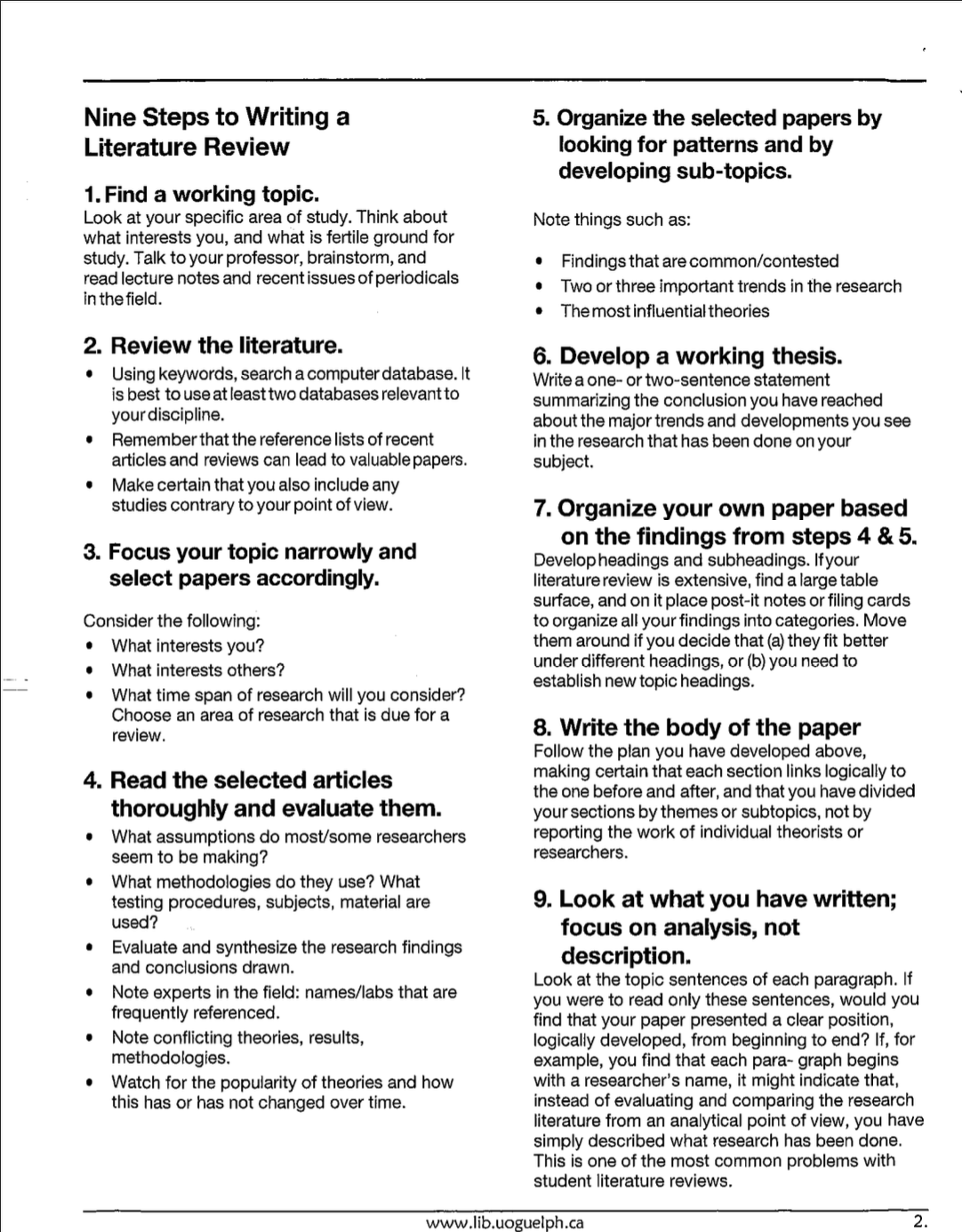
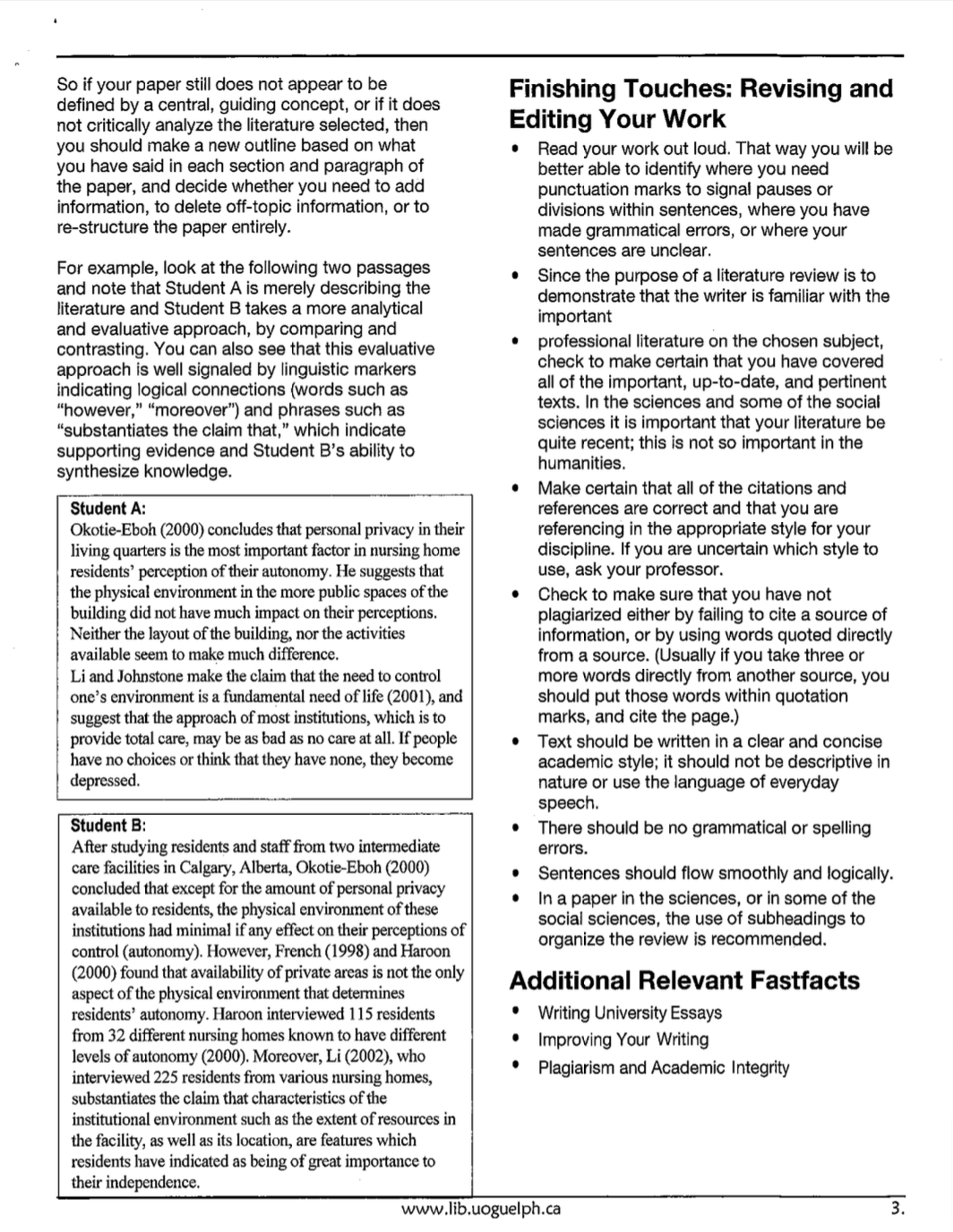
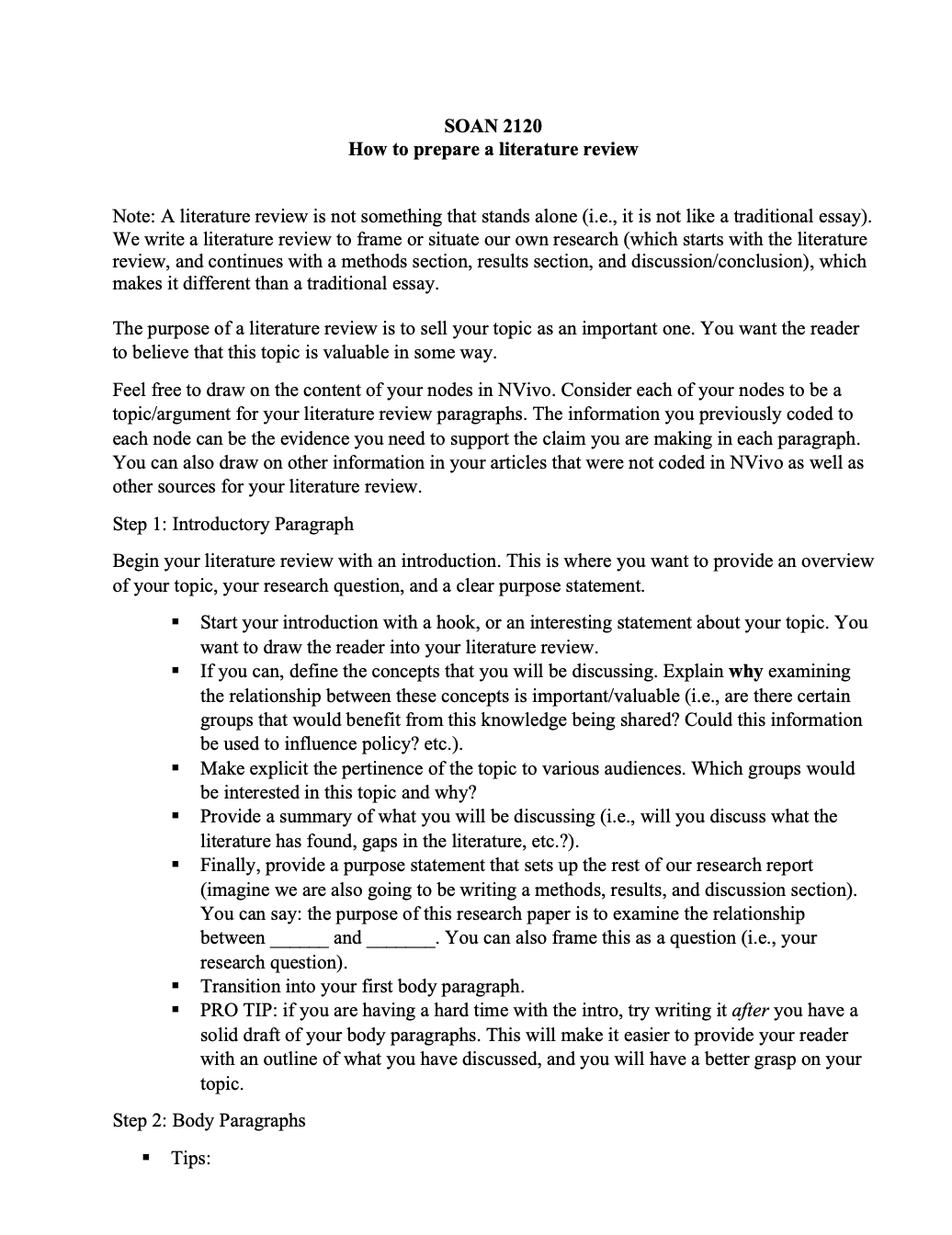
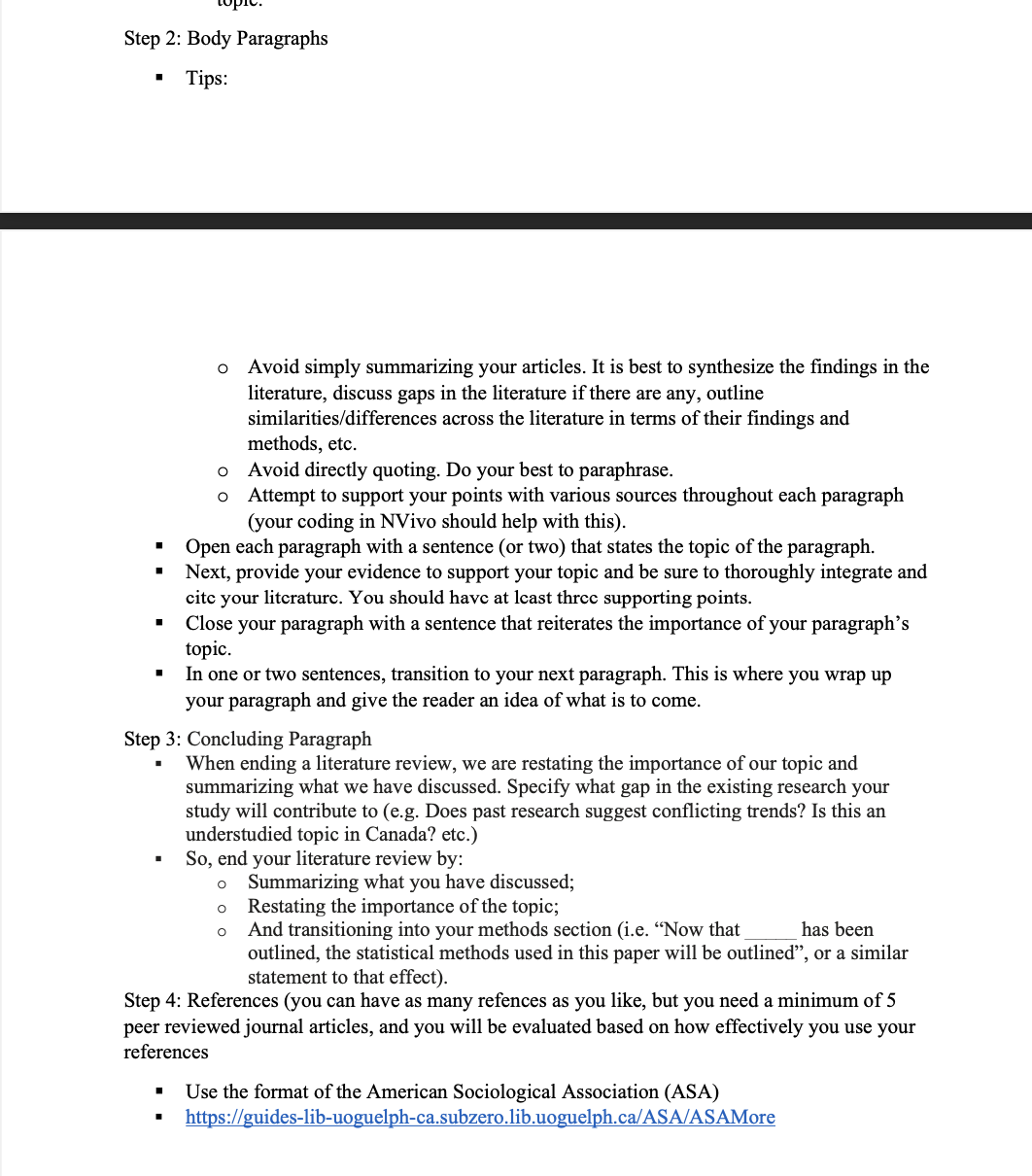
WRITING A LITERATURE REVIEW Definition A literature review is both a summary and explanation of the complete and current state of knowledge on a limited topic as found in academic books and journal articles. There are two kinds of literature reviews you might write at university: one that students are asked to write as a stand-alone assignment in a course, often as part of their training in the research processes in their fleld, and the other that is written as part of an introduction to, or preparation for, a longer work, usually a thesis or research report. The focus and perspective of your review and the kind of hypothesis or thesis argument you make will be determined by what kind of review you are writing. One way to understand the differences between these two types is to read published literature reviews or the first chapters of theses and dissertations in your own subject area. Analyze the structure of their arguments and note the way they address the issues. Purpose of the Literature Review * |t gives readers easy access to research on a particular topic by selecting high quality articles or studies that are relevant, meaningful, important, and valid and summarizing them into one complete report. * |t provides an excellent starting point for researchers beginning to do research in a new area by forcing them to summarize, evaluate, and compare original research in that specific area. |t ensures that researchers do not duplicate work that has already been done. It can provide clues as to where future research is heading or recommend areas on which to focus. |t highlights key findings. [tidentifies inconsistencies, gaps, and contradictions in the literature. |t provides a constructive analysis of the methodologies and approaches of other researchers. Content of the Review Introduction The introduction explains the focus and establishes the importance of the subject. It discusses what kind of work has been done on the topic and identifies any controversies within the field or any recent research which has raised questions about earlier assumptions. It may provide background or history. It concludes with a purpose or thesis statement. In a stand-alone literature review, this statement will sum up and evaluate the state of the art in this field of research; in a review that is an introduction or preparatory to a thesis or research report, it will suggest how the review findings will lead to the research the writer proposes to undertake. Body Often divided by headings/subheadings, the body summarizes and evaluates the current state of knowledge in the field. It notes major themes or topics, the most important trends, and any findings about which researchers agree or disagree. If the review is preliminary to your own thesis or research project, its purpose is to make an argument that will justify your proposed research. Therefore, .it will discuss only that research which leads directly toyour own project. Conclusion The conclusion summarizes all the evidence presented and shows its significance. If the review is an introduction to your own research, it highlights gaps and indicates how previous research leads to your own research project and chosen methodology. If the review is a stand-alone assignment for a course, it should suggestany practical applications ofthe research as well astheimplications and possibilities for future research. Learning Commons Fastfacts Series 2014 Nine Steps to Writing a Literature Review 1. Find a working topic. Look at your specific area of study. Think about what interests you, and what is fertile ground for study. Talk to your professor, brainstorm, and read lecture notes and recentissues of periodicals inthefield. 2. Review the literature. Using keywords, search a computer database. It is best to use at leasttwo databases relevant to yourdiscipline. * Remember that the reference lists of recent articles and reviews can lead to valuable papers. * Make certain that you also include any studies contrary to your point of view. 3. Focus your topic narrowly and select papers accordingly. Consider the following: What interests you? What interests others? * What time span of research will you consider? Choose an area of research that is due for a review, 4. Read the selected articles thoroughly and evaluate them. * What assumptions do most/some researchers seem to be making? What methodologies do they use? What testing procedures, subjects, material are used? Evaluate and synthesize the research findings and conclusions drawn. * Note experts in the field: names/labs that are frequently referenced. * Note conflicting theories, results, methodologies. Watch for the popularity of theories and how this has or has not changed over time. 5. Organize the selected papers by looking for patterns and by developing sub-topics. Note things such as: * Findings that are common/contested * Two or three important trends in the research Themostinfluentialtheories 6. Develop a working thesis. Write a one- or two-sentence statement summarizing the conclusion you have reached about the major trends and developments you see in the research that has been done on your subject. 7. Organize your own paper based on the findings from steps 4 & 5. Developheadings and subheadings. Ifyour literature review is extensive, find a large table surface, and on it place post-it notes or filing cards to organize all your findings into categories. Move them around if you decide that (a) they fit better under different headings, or (b) you need to establish new topic headings. 8. Write the body of the paper Follow the plan you have developed above, making certain that each section links logically to the one before and after, and that you have divided your sections by themes or subtopics, not by reporting the work of individual theorists or researchers. 9. Look at what you have written; focus on analysis, not description. Look at the topic sentences of each paragraph. If you were to read only these sentences, would you find that your paper presented a clear position, logically developed, from beginning to end? If, for example, you find that each para- graph begins with a researcher's name, it might indicate that, instead of evaluating and comparing the research literature from an analytical point of view, you have simply described what research has been done. This is one of the most common problems with student literature reviews. www.lib.uoguelph.ca 2. So if your paper still does not appear to be defined by a central, guiding concept, or if it does nat critically analyze the literature selected, then you should make a new outline based on what you have said in each section and paragraph of the paper, and decide whether you need to add information, to delete off-topic information, or to re-structure the paper entirely. For example, look at the following two passages and note that Student A is merely describing the literature and Student B takes a more analytical and evaluative approach, by comparing and contrasting. You can also see that this evaluative approach is well signaled by linguistic markers indicating logical connections (words such as \"however,\" \"moreover\") and phrases such as \"substantiates the claim that,\" which indicate supporting evidence and Student B's ability to synthesize knowledge. Student A: Okotie-Eboh (2000) concludes that personal privacy in their living quarters is the most important factor in nursing home residents' perception of their autonomy. He suggests that the physical environment in the more public spaces of the building did not have much impact on their perceptions. Neither the layout of the building, nor the activities available seem to make much difference. Li and Johnstone make the claim that the need to control one's environment is a fundamental need of life (2001), and suggest that the approach of most institutions, which is to provide total care, may be as bad as no care at all. If people have no choices or think that they have none, they become depressed. Student B: After studying residents and staff from two intermediate care facilities in Calgary, Alberta, Okotie-Eboh (2000) concluded that except for the amount of personal privacy available to residents, the physical environment of these institutions had minimal if any effect on their perceptions of control (autonomy). However, French (1998) and Haroon (2000) found that availability of private arcas is not the only aspect of the physical environment that determines residents' autonomy. Haroon interviewed 115 residents from 32 different nursing homes known to have different levels of autonomy (2000). Moreover, Li (2002), who interviewed 225 residents from various nursing homes, substantiates the claim that characteristics of the institutional environment such as the extent of resources in the facility, as well as its location, are features which residents have indicated as being of great importance to their independence. www lib,uoguelph.ca Finishing Touches: Revising and Editing Your Work * Read your work out loud. That way you will be better able to identify where you need punctuation marks to signal pauses or divisions within sentences, where you have made grammatical errors, or where your sentences are unclear. * Since the purpose of a literature review is to demonstrate that the writer is familiar with the important professional literature on the chosen subject, check to make certain that you have covered all of the important, up-to-date, and pertinent texts. In the sciences and some of the social sciences it is important that your literature be quite recent; this is not so important in the humanities. Make certain that all of the citations and references are correct and that you are referencing in the appropriate style for your discipline. If you are uncertain which style to use, ask your professor. Check to make sure that you have not plagiarized either by failing to cite a source of information, or by using words quoted directly from a source. (Usually if you take three or more words directly from another source, you should put those words within quotation marks, and cite the page.) * Text should be written in a clear and concise academic style; it should not be descriptive in nature or use the language of everyday speech. * There should be no grammatical or spelling errors. * Sentences should flow smoothly and logically. * |na paper in the sciences, or in some of the social sciences, the use of subheadings to organize the review is recommended. Additional Relevant Fastfacts Writing University Essays * |mproving Your Writing * Plagiarism and Academic Integrity SOAN 2120 How to prepare a literature review Note: A literature review is not something that stands alone (i.e., it is not like a traditional essay). We write a literature review to frame or situate our own research (which starts with the literature review, and continues with a methods section, results section, and discussion/conclusion), which makes it different than a traditional essay. The purpose of a literature review is to sell your topic as an important one. You want the reader to believe that this topic is valuable in some way. Feel free to draw on the content of your nodes in NVivo. Consider each of your nodes to be a topic/argument for your literature review paragraphs. The information you previously coded to each node can be the evidence you need to support the claim you are making in each paragraph. You can also draw on other information in your articles that were not coded in NVivo as well as other sources for your literature review. Step 1: Introductory Paragraph Begin your literature review with an introduction. This is where you want to provide an overview of your topic, your research question, and a clear purpose statement. = Start your introduction with a hook, or an interesting statement about your topic. You want to draw the reader into your literature review. = [If you can, define the concepts that you will be discussing. Explain why examining the relationship between these concepts is important/valuable (i.e., are there certain groups that would benefit from this knowledge being shared? Could this information be used to influence policy? etc.). = Make explicit the pertinence of the topic to various audiences. Which groups would be interested in this topic and why? * Provide a summary of what you will be discussing (i.e., will you discuss what the literature has found, gaps in the literature, etc.?). * Finally, provide a purpose statement that sets up the rest of our research report (imagine we are also going to be writing a methods, results, and discussion section). You can say: the purpose of this research paper is to examine the relationship between and . You can also frame this as a question (i.e., your research question). * Transition into your first body paragraph. = PRO TIP: if you are having a hard time with the intro, try writing it after you have a solid draft of your body paragraphs. This will make it easier to provide your reader with an outline of what you have discussed, and you will have a better grasp on your topic. Step 2: Body Paragraphs * Tips: Step 2: Step 4: lUFlLr. Body Paragraphs Tips: o Avoid simply summarizing your articles. It is best to synthesize the findings in the literature, discuss gaps in the literature if there are any, outline similarities/differences across the literature in terms of their findings and methods, etc. o Avoid directly quoting. Do your best to paraphrase. o Attempt to support your points with various sources throughout each paragraph (your coding in NVivo should help with this). Open each paragraph with a sentence (or two) that states the topic of the paragraph. Next, provide your evidence to support your topic and be sure to thoroughly integrate and cite your litcraturc. You should havce at lcast threc supporting points. Close your paragraph with a sentence that reiterates the importance of your paragraph's topic. In one or two sentences, transition to your next paragraph. This is where you wrap up your paragraph and give the reader an idea of what is to come. Concluding Paragraph When ending a literature review, we are restating the importance of our topic and summarizing what we have discussed. Specify what gap in the existing research your study will contribute to (e.g. Does past research suggest conflicting trends? Is this an understudied topic in Canada? etc.) So, end your literature review by: o Summarizing what you have discussed,; o Restating the importance of the topic; o And transitioning into your methods section (i.e. \"Now that has been outlined, the statistical methods used in this paper will be outlined\
Step by Step Solution
There are 3 Steps involved in it
1 Expert Approved Answer
Step: 1 Unlock
Question Has Been Solved by an Expert!
Get step-by-step solutions from verified subject matter experts
Step: 2 Unlock
Step: 3 Unlock
Students Have Also Explored These Related Business Writing Questions!









 Study Help