







Question: Use -infty or infty where appropriate to describe the behavior at each zero of the denominator and identify all vertical asymptotes. g(x)=(x)/(6-x) lim_(x->6^(-))f(x)=infty ;lim_(x->6^(+))f(x)=-infty
Use
-\\\\infty or
\\\\infty where appropriate to describe the behavior at each zero of the denominator and identify all vertical asymptotes.\
g(x)=(x)/(6-x)\
\\\\lim_(x->6^(-))f(x)=\\\\infty ;\\\\lim_(x->6^(+))f(x)=-\\\\infty ;x=0is a vertical asymptote
\\\\lim_(x->6^(-))f(x)=\\\\infty ;\\\\lim_(x->6^(+))f(x)=-\\\\infty ;x=6is a vertical asymptote
\\\\lim_(x->6^(-))f(x)=-\\\\infty ;\\\\lim_(x->6^(+))f(x)=\\\\infty ;x=6is a vertical asymptote
\\\\lim_(x->6^(-))f(x)=-\\\\infty ;\\\\lim_(x->6^(+))f(x)=-\\\\infty ;x=6is a vertical asymptote
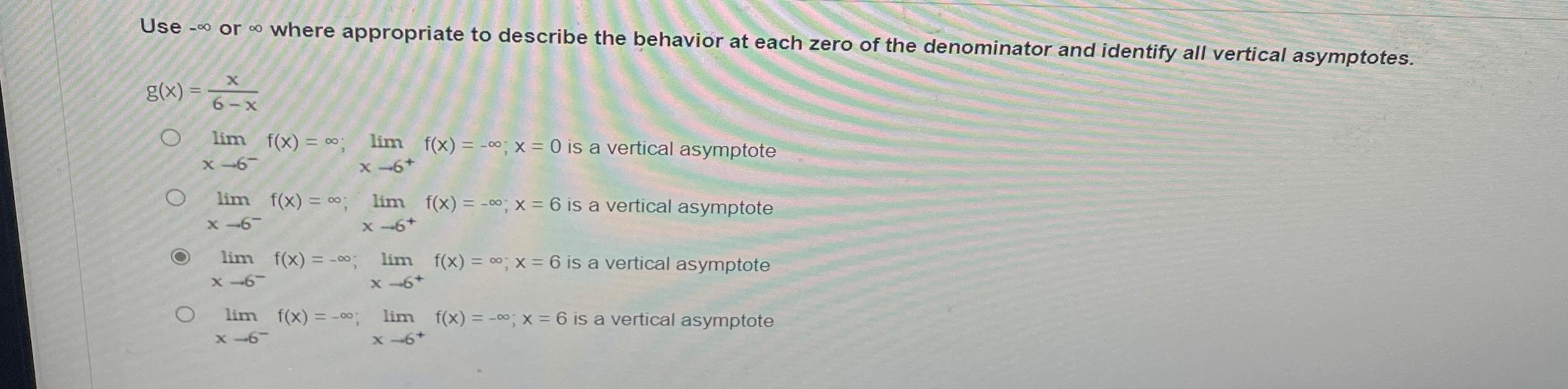
Use or where appropriate to describe the behavior at each zero of the denominator and identify all vertical asymptotes. g(x)=6xx limx6f(x)=;limx6+f(x)=;x=0 is a vertical asymptote limx6f(x)=;limx6+f(x)=;x=6 is a vertical asymptote limx6f(x)=;limx6+f(x)=;x=6 is a vertical asymptote limx6f(x)=;limx6+f(x)=;x=6 is a vertical asymptote
Step by Step Solution
There are 3 Steps involved in it
1 Expert Approved Answer
Step: 1 Unlock

Question Has Been Solved by an Expert!
Get step-by-step solutions from verified subject matter experts
Step: 2 Unlock
Step: 3 Unlock
 Study Help