







Question: Use Java Please!! Regulations: This assignment must be done individually. Any similarity between your code/answers and another student's, or a carbon-copy of an answer found
Use Java Please!!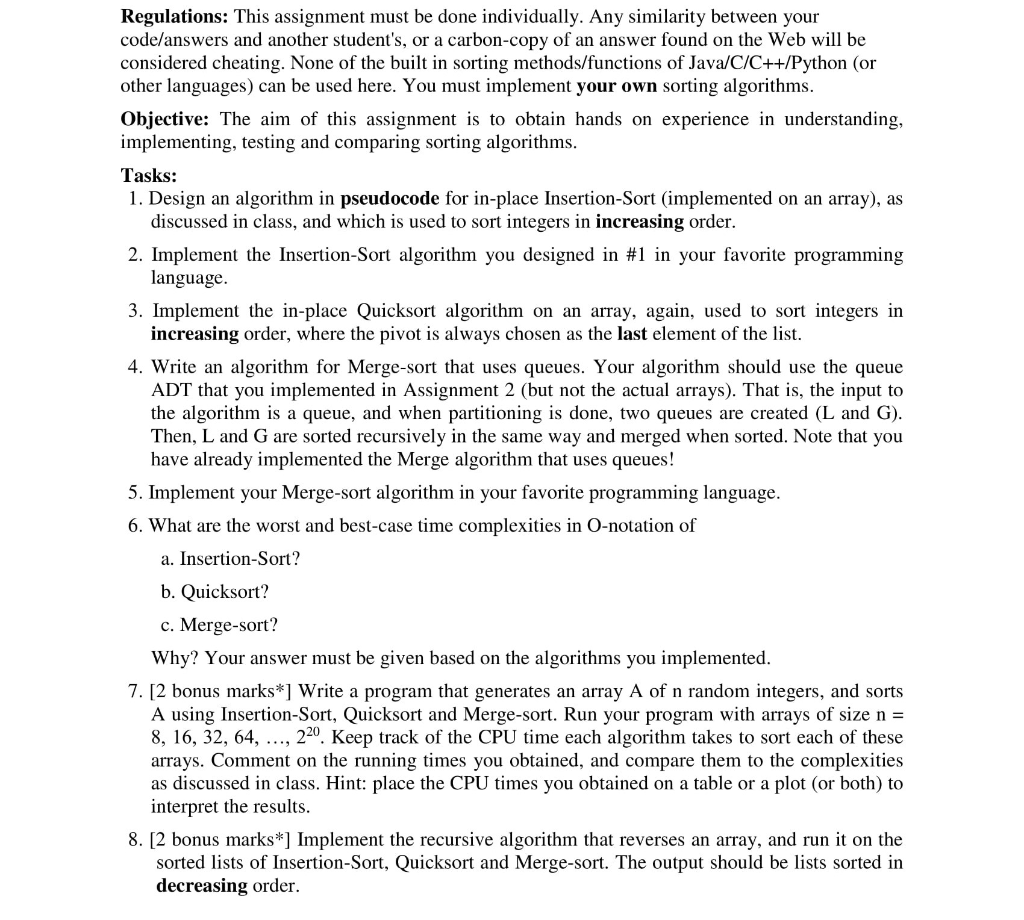
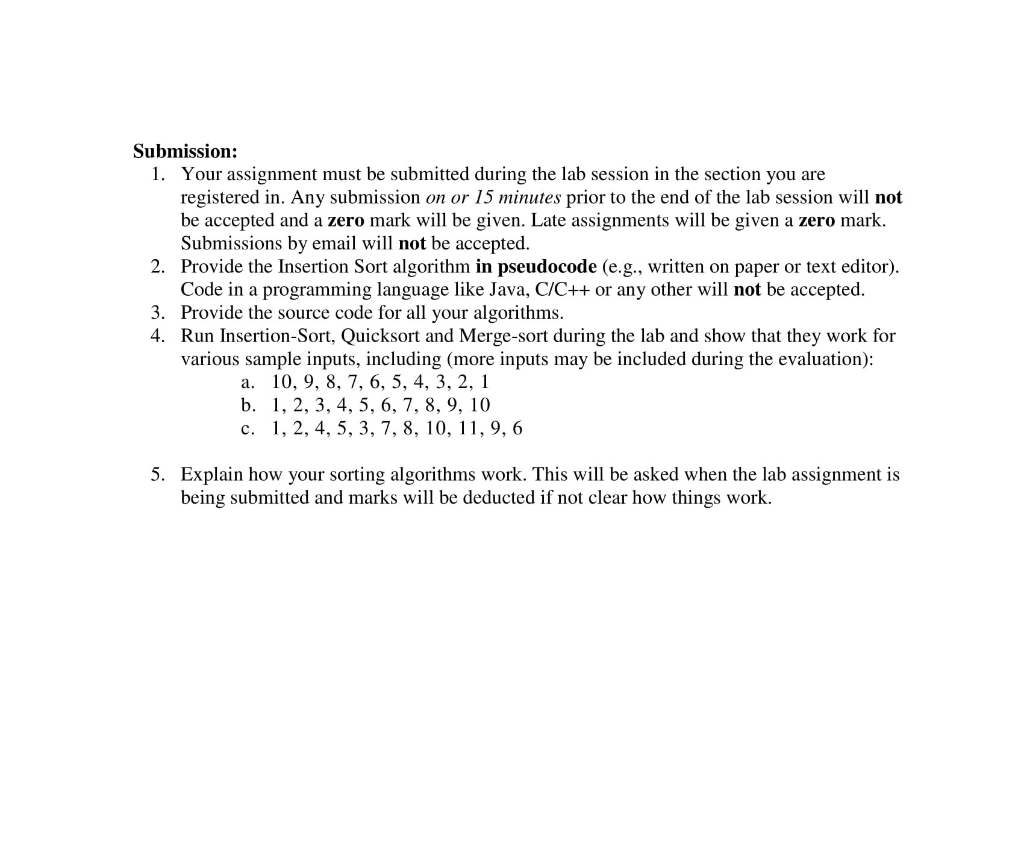
Regulations: This assignment must be done individually. Any similarity between your code/answers and another student's, or a carbon-copy of an answer found on the Web will be considered cheating. None of the built in sorting methods/functions of Java/C/C++/Python (or other languages) can be used here. You must implement your own sorting algorithms. Objective: The aim of this assignment is to obtain hands on experience in understanding, implementing, testing and comparing sorting algorithms. Tasks: 1. Design an algorithm in pseudocode for in-place Insertion-Sort (implemented on an array), as discussed in class, and which is used to sort integers in increasing order. 2. Implement the Insertion-Sort algorithm you designed in #1 in your favorite programming language. 3. Implement the in-place Quicksort algorithm on an array, again, used to sort integers in increasing order, where the pivot is always chosen as the last element of the list. 4. Write an algorithm for Merge-sort that uses queues. Your algorithm should use the queue ADT that you implemented in Assignment 2 (but not the actual arrays). That is, the input to the algorithm is a queue, and when partitioning is done, two queues are created (L and G). Then, L and G are sorted recursively in the same way and merged when sorted. Note that you have already implemented the Merge algorithm that uses queues! 5. Implement your Merge-sort algorithm in your favorite programming language. 6. What are the worst and best-case time complexities in O-notation of a. Insertion-Sort? b. Quicksort? c. Merge-sort? Why? Your answer must be given based on the algorithms you implemented. 7. [2 bonus marks*] Write a program that generates an array A of n random integers, and sorts A using Insertion-Sort, Quicksort and Merge-sort. Run your program with arrays of size n = 8, 16, 32, 64, ..., 220. Keep track of the CPU time each algorithm takes to sort each of these arrays. Comment on the running times you obtained, and compare them to the complexities as discussed in class. Hint: place the CPU times you obtained on a table or a plot (or both) to interpret the results. 8. [2 bonus marks *] Implement the recursive algorithm that reverses an array, and run it on the sorted lists of Insertion-Sort, Quicksort and Merge-sort. The output should be lists sorted in decreasing order. Submission: 1. Your assignment must be submitted during the lab session in the section you are registered in. Any submission on or 15 minutes prior to the end of the lab session will not be accepted and a zero mark will be given. Late assignments will be given a zero mark. Submissions by email will not be accepted. 2. Provide the Insertion Sort algorithm in pseudocode (e.g., written on paper or text editor). Code in a programming language like Java, C/C++ or any other will not be accepted. 3. Provide the source code for all your algorithms. 4. Run Insertion-Sort, Quicksort and Merge-sort during the lab and show that they work for various sample inputs, including (more inputs may be included during the evaluation): a. 10, 9, 8, 7, 6, 5, 4, 3, 2, 1. b. 1, 2, 3, 4, 5, 6, 7, 8, 9, 10 c. 1, 2, 4, 5, 3, 7, 8, 10, 11, 9, 6 5. Explain how your sorting algorithms work. This will be asked when the lab assignment is being submitted and marks will be deducted if not clear how things work. Regulations: This assignment must be done individually. Any similarity between your code/answers and another student's, or a carbon-copy of an answer found on the Web will be considered cheating. None of the built in sorting methods/functions of Java/C/C++/Python (or other languages) can be used here. You must implement your own sorting algorithms. Objective: The aim of this assignment is to obtain hands on experience in understanding, implementing, testing and comparing sorting algorithms. Tasks: 1. Design an algorithm in pseudocode for in-place Insertion-Sort (implemented on an array), as discussed in class, and which is used to sort integers in increasing order. 2. Implement the Insertion-Sort algorithm you designed in #1 in your favorite programming language. 3. Implement the in-place Quicksort algorithm on an array, again, used to sort integers in increasing order, where the pivot is always chosen as the last element of the list. 4. Write an algorithm for Merge-sort that uses queues. Your algorithm should use the queue ADT that you implemented in Assignment 2 (but not the actual arrays). That is, the input to the algorithm is a queue, and when partitioning is done, two queues are created (L and G). Then, L and G are sorted recursively in the same way and merged when sorted. Note that you have already implemented the Merge algorithm that uses queues! 5. Implement your Merge-sort algorithm in your favorite programming language. 6. What are the worst and best-case time complexities in O-notation of a. Insertion-Sort? b. Quicksort? c. Merge-sort? Why? Your answer must be given based on the algorithms you implemented. 7. [2 bonus marks*] Write a program that generates an array A of n random integers, and sorts A using Insertion-Sort, Quicksort and Merge-sort. Run your program with arrays of size n = 8, 16, 32, 64, ..., 220. Keep track of the CPU time each algorithm takes to sort each of these arrays. Comment on the running times you obtained, and compare them to the complexities as discussed in class. Hint: place the CPU times you obtained on a table or a plot (or both) to interpret the results. 8. [2 bonus marks *] Implement the recursive algorithm that reverses an array, and run it on the sorted lists of Insertion-Sort, Quicksort and Merge-sort. The output should be lists sorted in decreasing order. Submission: 1. Your assignment must be submitted during the lab session in the section you are registered in. Any submission on or 15 minutes prior to the end of the lab session will not be accepted and a zero mark will be given. Late assignments will be given a zero mark. Submissions by email will not be accepted. 2. Provide the Insertion Sort algorithm in pseudocode (e.g., written on paper or text editor). Code in a programming language like Java, C/C++ or any other will not be accepted. 3. Provide the source code for all your algorithms. 4. Run Insertion-Sort, Quicksort and Merge-sort during the lab and show that they work for various sample inputs, including (more inputs may be included during the evaluation): a. 10, 9, 8, 7, 6, 5, 4, 3, 2, 1. b. 1, 2, 3, 4, 5, 6, 7, 8, 9, 10 c. 1, 2, 4, 5, 3, 7, 8, 10, 11, 9, 6 5. Explain how your sorting algorithms work. This will be asked when the lab assignment is being submitted and marks will be deducted if not clear how things work
Step by Step Solution
There are 3 Steps involved in it

Get step-by-step solutions from verified subject matter experts
 Study Help