





Question: USE MARKOV ANALYSIS PLEASEE!!!! L A Moving to the next question prevents changes to this answer. Question 1 of 3 Question 1 40 points Save
USE MARKOV ANALYSIS PLEASEE!!!! L A Moving to theUSE MARKOV ANALYSIS PLEASEE!!!! L A Moving to the USE MARKOV ANALYSIS PLEASEE!!!!

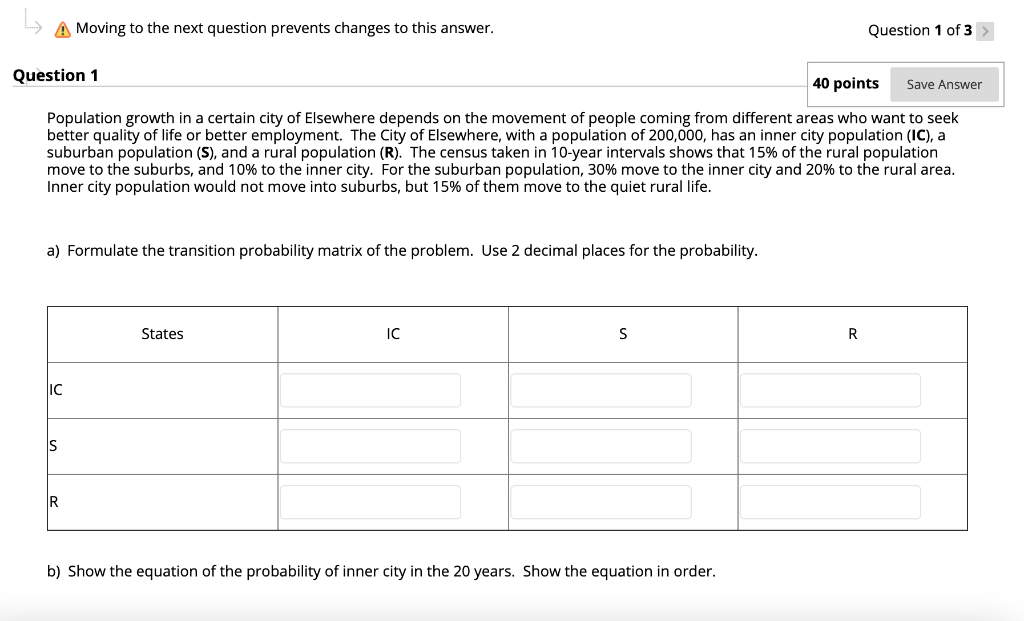
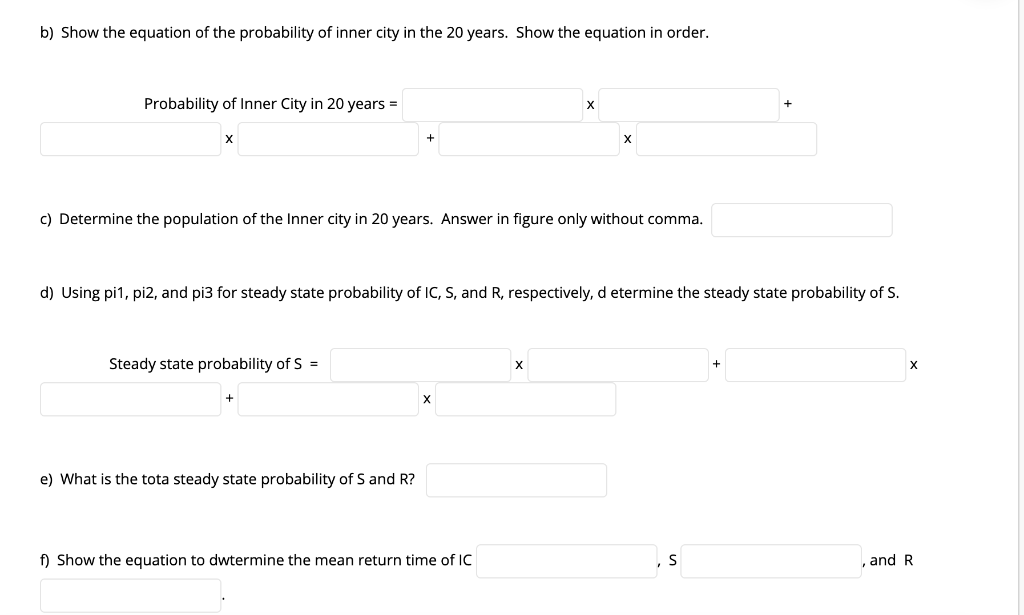
L A Moving to the next question prevents changes to this answer. Question 1 of 3 Question 1 40 points Save Answer Population growth in a certain city of Elsewhere depends on the movement of people coming from different areas who want to seek better quality of life or better employment. The City of Elsewhere, with a population of 200,000, has an inner city population (IC), a suburban population (S), and a rural population (R). The census taken in 10-year intervals shows that 15% of the rural population move to the suburbs, and 10% to the inner city. For the suburban population, 30% move to the inner city and 20% to the rural area. Inner city population would not move into suburbs, but 15% of them move to the quiet rural life. a) Formulate the transition probability matrix of the problem. Use 2 decimal places for the probability. States IC S R IC IS IR b) Show the equation of the probability of inner city in the 20 years. Show the equation in order. b) Show the equation of the probability of inner city in the 20 years. Show the equation in order. Probability of Inner City in 20 years = + c) Determine the population of the Inner city in 20 years. Answer in figure only without comma. d) Using pi1, pi2, and pi3 for steady state probability of IC, S, and R, respectively, determine the steady state probability of S. Steady state probability of S = X e) What is the tota steady state probability of S and R? f) Show the equation to dwtermine the mean return time of IC S and R

Step by Step Solution

There are 3 Steps involved in it

1 Expert Approved Answer
Step: 1 Unlock blur-text-image

Question Has Been Solved by an Expert!

Get step-by-step solutions from verified subject matter experts

Step: 2 Unlock
Step: 3 Unlock

Students Have Also Explored These Related General Management Questions!