







Question: Use MATLAB language to solve the following problems. (1) Linear Interpolation Use linear interpolation to curve-fit the data generated by the following function: 2 '4
Use MATLAB language to solve the following problems.
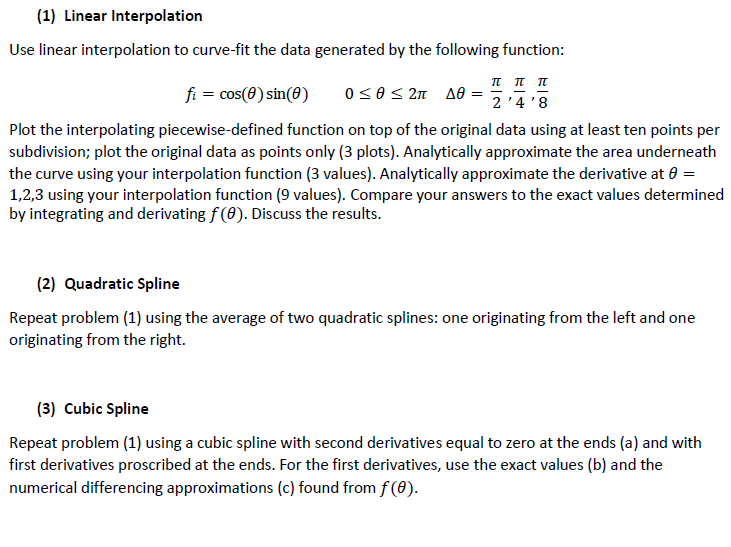
(1) Linear Interpolation Use linear interpolation to curve-fit the data generated by the following function: 2 '4 8 Plot the interpolating piecewise-defined function on top of the original data using at least ten points per subdivision; plot the original data as points only (3 plots). Analytically approximate the area underneath the curve using your interpolation function (3 values). Analytically approximate the derivative at 6- 1,2,3 using your interpolation function (9 values). Compare your answers to the exact values determined by integrating and derivating f(8). Discuss the results. (2) Quadratic Spline Repeat problem (1) using the average of two quadratic splines: one originating from the left and one originating from the right. (3) Cubic Spline Repeat problem (1) using a cubic spline with second derivatives equal to zero at the ends (a) and with first derivatives proscribed at the ends. For the first derivatives, use the exact values (b) and the numerical differencing approximations (c) found from f (8). (1) Linear Interpolation Use linear interpolation to curve-fit the data generated by the following function: 2 '4 8 Plot the interpolating piecewise-defined function on top of the original data using at least ten points per subdivision; plot the original data as points only (3 plots). Analytically approximate the area underneath the curve using your interpolation function (3 values). Analytically approximate the derivative at 6- 1,2,3 using your interpolation function (9 values). Compare your answers to the exact values determined by integrating and derivating f(8). Discuss the results. (2) Quadratic Spline Repeat problem (1) using the average of two quadratic splines: one originating from the left and one originating from the right. (3) Cubic Spline Repeat problem (1) using a cubic spline with second derivatives equal to zero at the ends (a) and with first derivatives proscribed at the ends. For the first derivatives, use the exact values (b) and the numerical differencing approximations (c) found from f (8)
Step by Step Solution
There are 3 Steps involved in it

Get step-by-step solutions from verified subject matter experts
 Study Help