







Question: use Matlab to slove 2.1 Discrete-Time Convolution In this section, you will generate filtering results for commonly used simple FIR filters. Some of these will
use Matlab to slove
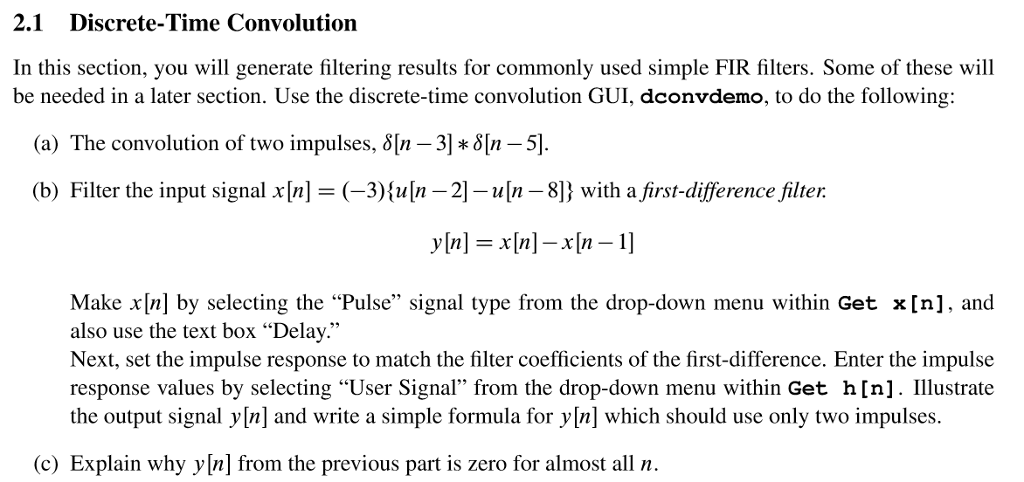
2.1 Discrete-Time Convolution In this section, you will generate filtering results for commonly used simple FIR filters. Some of these will be needed in a later section. Use the discrete-time convolution GUI, dconvdemo, to do the following: (a) The convolution of two impulses, In-3] * [n-51. (b) Filter the input signal x[n] = (-3)(u[n-2)-n-8]} with a first-diference filter yin] = x[n]-x(n-1] Make x[n] by selecting the "Pulse" signal type from the drop-down menu within Get x[n], and also use the text box "Delay" Next, set the impulse response to match the filter coefficients of the first-difference. Enter the impulse response values by selecting "User Signal" from the drop-down menu within Get h[n]. Illustrate the output signal y[n] and write a simple formula for y[n] which should use only two impulses. rr t s sple yini which should uwe c) Explain why y[n] from the previous part is zero for almost all 2.1 Discrete-Time Convolution In this section, you will generate filtering results for commonly used simple FIR filters. Some of these will be needed in a later section. Use the discrete-time convolution GUI, dconvdemo, to do the following: (a) The convolution of two impulses, In-3] * [n-51. (b) Filter the input signal x[n] = (-3)(u[n-2)-n-8]} with a first-diference filter yin] = x[n]-x(n-1] Make x[n] by selecting the "Pulse" signal type from the drop-down menu within Get x[n], and also use the text box "Delay" Next, set the impulse response to match the filter coefficients of the first-difference. Enter the impulse response values by selecting "User Signal" from the drop-down menu within Get h[n]. Illustrate the output signal y[n] and write a simple formula for y[n] which should use only two impulses. rr t s sple yini which should uwe c) Explain why y[n] from the previous part is zero for almost all
Step by Step Solution
There are 3 Steps involved in it

Get step-by-step solutions from verified subject matter experts
 Study Help