







Question: USE MATLAB! USE MATLAB! f(x)= f(a)+ f'(a) ( (@)+ -a} QUESTION 2: A function f(x) can be represented by its Taylor series centered at a
USE MATLAB!
USE MATLAB!
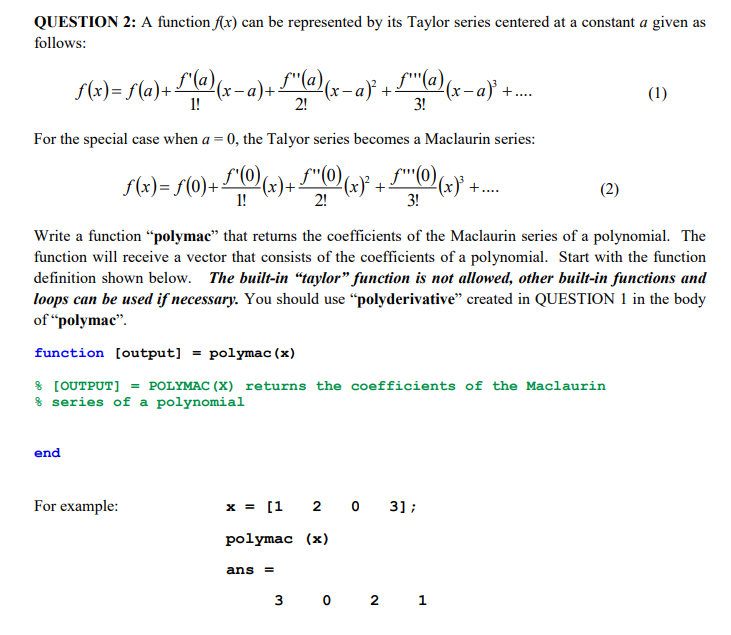
f(x)= f(a)+ f'(a) ( (@)+ -a} QUESTION 2: A function f(x) can be represented by its Taylor series centered at a constant a given as follows: (x-a)+ F"(a) (x a) + f'"(a)(x a) +.... 1! 2! 3! (1) For the special case when a = 0, the Talyor series becomes a Maclaurin series: f(x)=f(0)+ 'O)(x)+ ) + F"(O)(x)} + F"(O)(x) + 1! 2! (2) 3! f... Write a function polymac" that returns the coefficients of the Maclaurin series of a polynomial. The function will receive a vector that consists of the coefficients of a polynomial. Start with the function definition shown below. The built-in "taylor function is not allowed, other built-in functions and loops can be used if necessary. You should use polyderivative created in QUESTION 1 in the body of "polymac". function (output] = polymac (x) $ (OUTPUT] = POLYMAC (X) returns the coefficients of the Maclaurin $ series of a polynomial end For example: x = [1 2 0 3]; polymac (x) ans = 3 0 2 1 f(x)= f(a)+ f'(a) ( (@)+ -a} QUESTION 2: A function f(x) can be represented by its Taylor series centered at a constant a given as follows: (x-a)+ F"(a) (x a) + f'"(a)(x a) +.... 1! 2! 3! (1) For the special case when a = 0, the Talyor series becomes a Maclaurin series: f(x)=f(0)+ 'O)(x)+ ) + F"(O)(x)} + F"(O)(x) + 1! 2! (2) 3! f... Write a function polymac" that returns the coefficients of the Maclaurin series of a polynomial. The function will receive a vector that consists of the coefficients of a polynomial. Start with the function definition shown below. The built-in "taylor function is not allowed, other built-in functions and loops can be used if necessary. You should use polyderivative created in QUESTION 1 in the body of "polymac". function (output] = polymac (x) $ (OUTPUT] = POLYMAC (X) returns the coefficients of the Maclaurin $ series of a polynomial end For example: x = [1 2 0 3]; polymac (x) ans = 3 0 2 1
Step by Step Solution
There are 3 Steps involved in it

Get step-by-step solutions from verified subject matter experts
 Study Help