







Question: Use OCaml programming language to generate functions for the following scenarios built-in functions or special forms however, you may implement additional helper functions on top
Use OCaml programming language to generate functions for the following scenarios
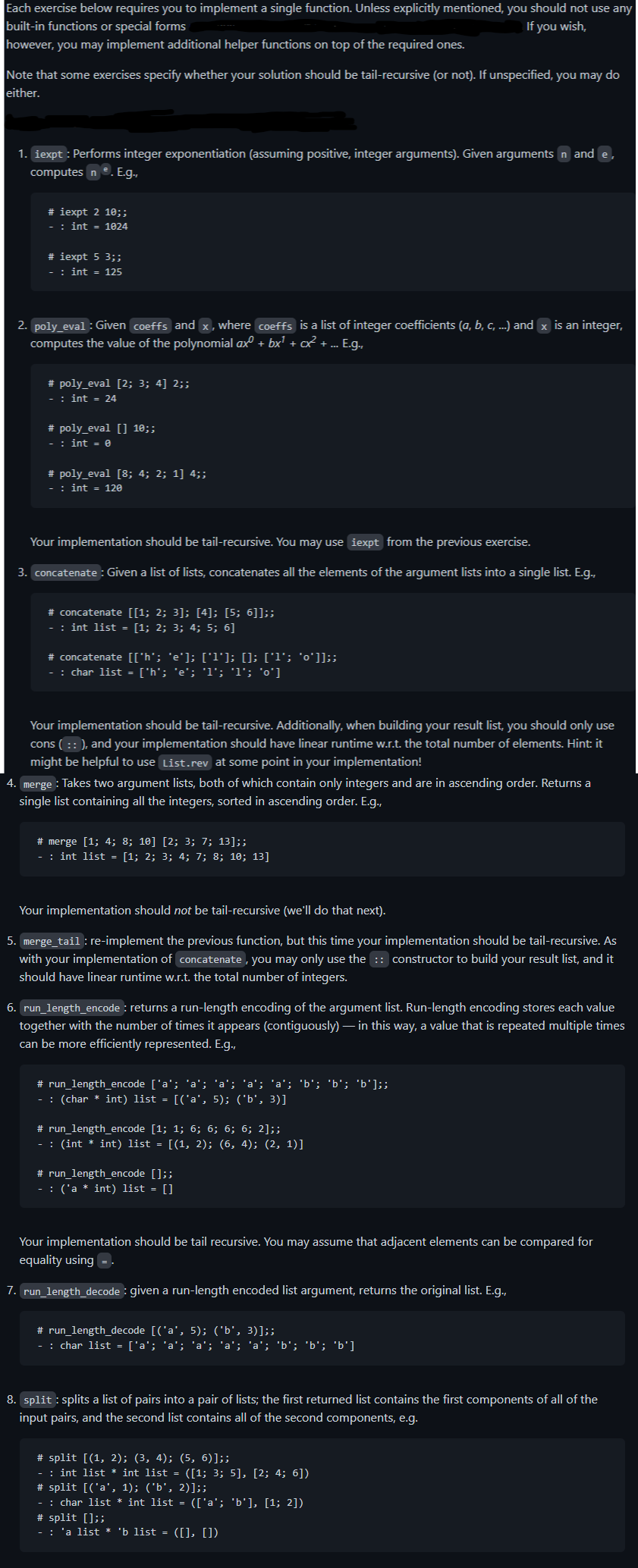
built-in functions or special forms however, you may implement additional helper functions on top of the required ones. Note that some exercises specify whether your solution should be tail-recursive (or not). If unspecified, you may do either. 1. iexpt : Performs integer exponentiation (assuming positive, integer arguments). Given arguments n and e, computes n. E.g., \# iexpt 210; - : int =1024 \# iexpt 53;; - . int =125 2. poly_eval : Given coeffs and x, where coeffs is a list of integer coefficients (a,b,c,) and x is an integer, computes the value of the polynomial ax0+bx1+cx2+ E.g.r \# poly_eval [2;3;4]2;; - : int =24 \# poly_eval [] 10; - : int =0 \# poly_eval [8;4;2;1]4; - : int =120 Your implementation should be tail-recursive. You may use iexpt from the previous exercise. 3. concatenate : Given a list of lists, concatenates all the elements of the argument lists into a single list. E.g., \# concatenate [[1;2;3];[4];[5;6]];; Your implementation should be tail-recursive. Additionally, when building your result list, you should only use cons (::), and your implementation should have linear runtime w.r.t. the total number of elements. Hint it might be helpful to use List.rev at some point in your implementation! 4. merge : Takes two argument lists, both of which contain only integers and are in ascending order. Returns a single list containing all the integers, sorted in ascending order. E.g., \# merge [1;4;8;10][2;3;7;13];; : int list =[1;2;3;4;7;8;10;13] Your implementation should not be tail-recursive (we'll do that next). 5. merge_tail : re-implement the previous function, but this time your implementation should be tail-recursive. As with your implementation of concatenate, you may only use the :: constructor to build your result list, and it should have linear runtime w.r.t. the total number of integers. 6. run_length_encode : returns a run-length encoding of the argument list. Run-length encoding stores each value together with the number of times it appears (contiguously) in this way, a value that is repeated multiple times can be more efficiently represented. E.g., \# run_length_encode ['a'; 'a'; 'a'; 'a'; 'a'; 'b'; 'b'; 'b'];; : (char * int) list =[(a,5);(b,3)] \# run_length_encode [1;1;6;6;6;6;2];; - : (int * int) list =[(1,2);(6,4);(2,1)] \# run_length_encode [];; Your implementation should be tail recursive. You may assume that adjacent elements can be compared for equality using = 7. run_length_decode : given a run-length encoded list argument, returns the original list. E.g. \# run_length_decode [(a,5); (b,3)];; char list =[a;;a; ' a '; 'a'; 'b'; 'b'; 'b'] 8. split : splits a list of pairs into a pair of lists; the first returned list contains the first components of all of the input pairs, and the second list contains all of the second components, e.g. \# split [(1,2);(3,4);(5,6)];; # split [(C,1) int (lb,2)];3;5],[2;4;6]) - : char list * int list =([a '; ' 'b' ],[1;2])
Step by Step Solution
There are 3 Steps involved in it

Get step-by-step solutions from verified subject matter experts
 Study Help