Question: USE ONLY INFORMATION BELOW TO WRITE A PARAGRAPH HAVE 170 WORDS TO ANSWER THIS QUESTION, Conduct an in-depth analysis for Theoretical Foundation Theoretical Foundation Corporate
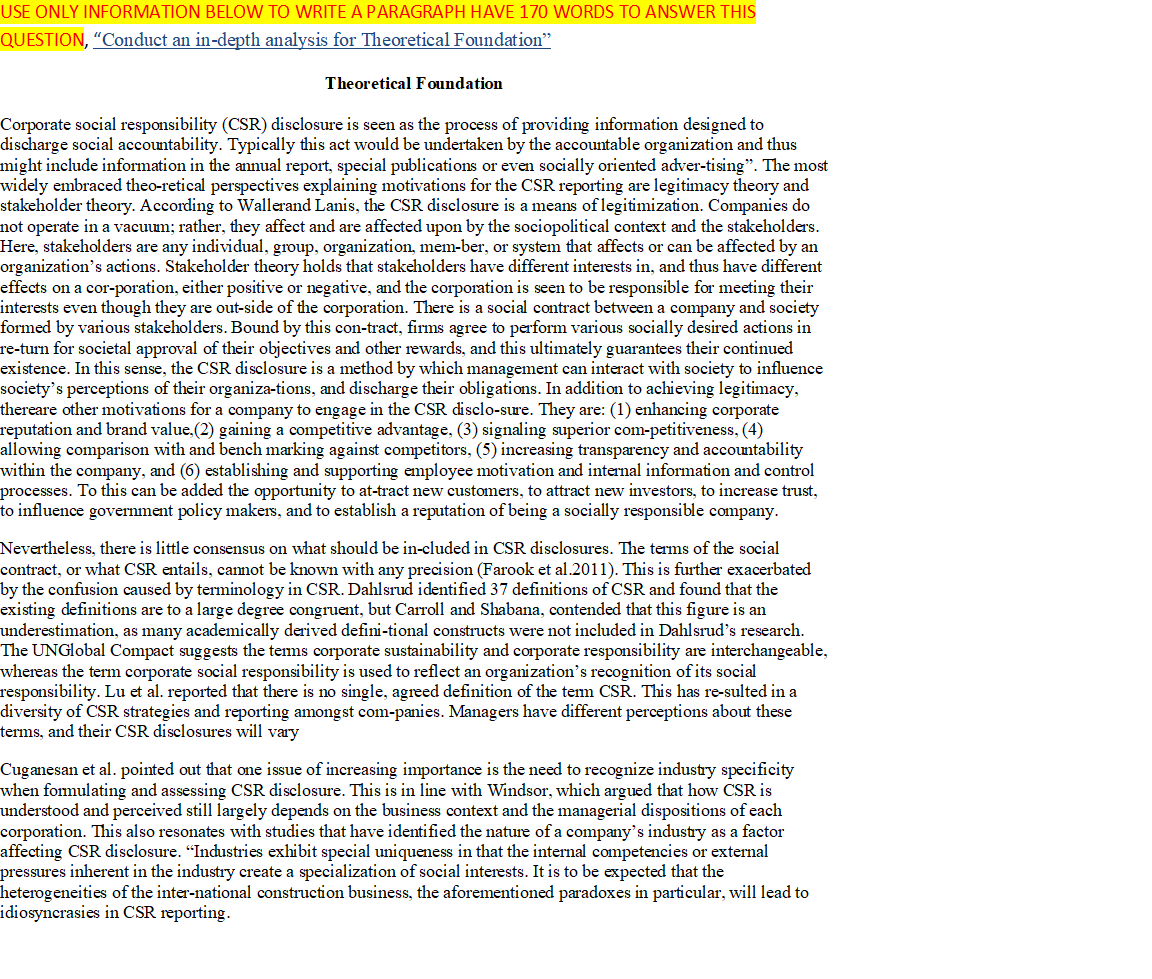
USE ONLY INFORMATION BELOW TO WRITE A PARAGRAPH HAVE 170 WORDS TO ANSWER THIS QUESTION, Conduct an in-depth analysis for Theoretical Foundation Theoretical Foundation Corporate social responsibility (CSR) disclosure is seen as the process of providing information designed to discharge social accountability. Typically this act would be undertaken by the accountable organization and thus might include information in the annual report, special publications or even socially oriented adver-tising. The most widely embraced theo-retical perspectives explaining motivations for the CSR reporting are legitimacy theory and stakeholder theory. According to Wallerand Lanis, the CSR disclosure is a means of legitimization. Companies do not operate in a vacuum; rather, they affect and are affected upon by the sociopolitical context and the stakeholders. Here, stakeholders are any individual, group, organization, mem-ber, or system that affects or can be affected by an organization's actions. Stakeholder theory holds that stakeholders have different interests in, and thus have different effects on a cor-poration, either positive or negative, and the corporation is seen to be responsible for meeting their interests even though they are out-side of the corporation. There is a social contract between a company and society formed by various stakeholders. Bound by this con-tract, firms agree to perform various socially desired actions in re-turn for societal approval of their objectives and other rewards, and this ultimately guarantees their continued existence. In this sense, the CSR disclosure is a method by which management can interact with society to influence society's perceptions of their organiza-tions, and discharge their obligations. In addition to achieving legitimacy, thereare other motivations for a company to engage in the CSR disclo-sure. They are: (1) enhancing corporate reputation and brand value (2) gaining a competitive advantage, (3) signaling superior com-petitiveness, (4) allowing comparison with and bench marking against competitors, (5) increasing transparency and accountability within the company, and (6) establishing and supporting employee motivation and internal information and control processes. To this can be added the opportunity to at-tract new customers, to attract new investors, to increase trust, to influence government policy makers, and to establish a reputation of being a socially responsible company. Nevertheless, there is little consensus on what should be in-cluded in CSR disclosures. The terms of the social contract, or what CSR entails, cannot be known with any precision (Farook et al.2011). This is further exacerbated by the confusion caused by terminology in CSR. Dahlsrud identified 37 definitions of CSR and found that the existing definitions are to a large degree congruent, but Carroll and Shabana, contended that this figure is an underestimation, as many academically derived defini-tional constructs were not included in Dahlsrud's research. The UNGlobal Compact suggests the terms corporate sustainability and corporate responsibility are interchangeable, whereas the term corporate social responsibility is used to reflect an organization's recognition of its social responsibility. Lu et al. reported that there is no single, agreed definition of the term CSR. This has re-sulted in a diversity of CSR strategies and reporting amongst com-panies. Managers have different perceptions about these terms, and their CSR disclosures will vary Cuganesan et al. pointed out that one issue of increasing importance is the need to recognize industry specificity when formulating and assessing CSR disclosure. This is in line with Windsor, which argued that how CSR is understood and perceived still largely depends on the business context and the managerial dispositions of each corporation. This also resonates with studies that have identified the nature of a company's industry as a factor affecting CSR disclosure. Industries exhibit special uniqueness in that the internal competencies or external pressures inherent in the industry create a specialization of social interests. It is to be expected that the heterogeneities of the inter-national construction business, the aforementioned paradoxes in particular, will lead to idiosyncrasies in CSR reporting









 Study Help