







Question: use python Certain companies allow their employees to opt into a dental benefits plan for a small fee (depending on the tier purchased). When an
 use python
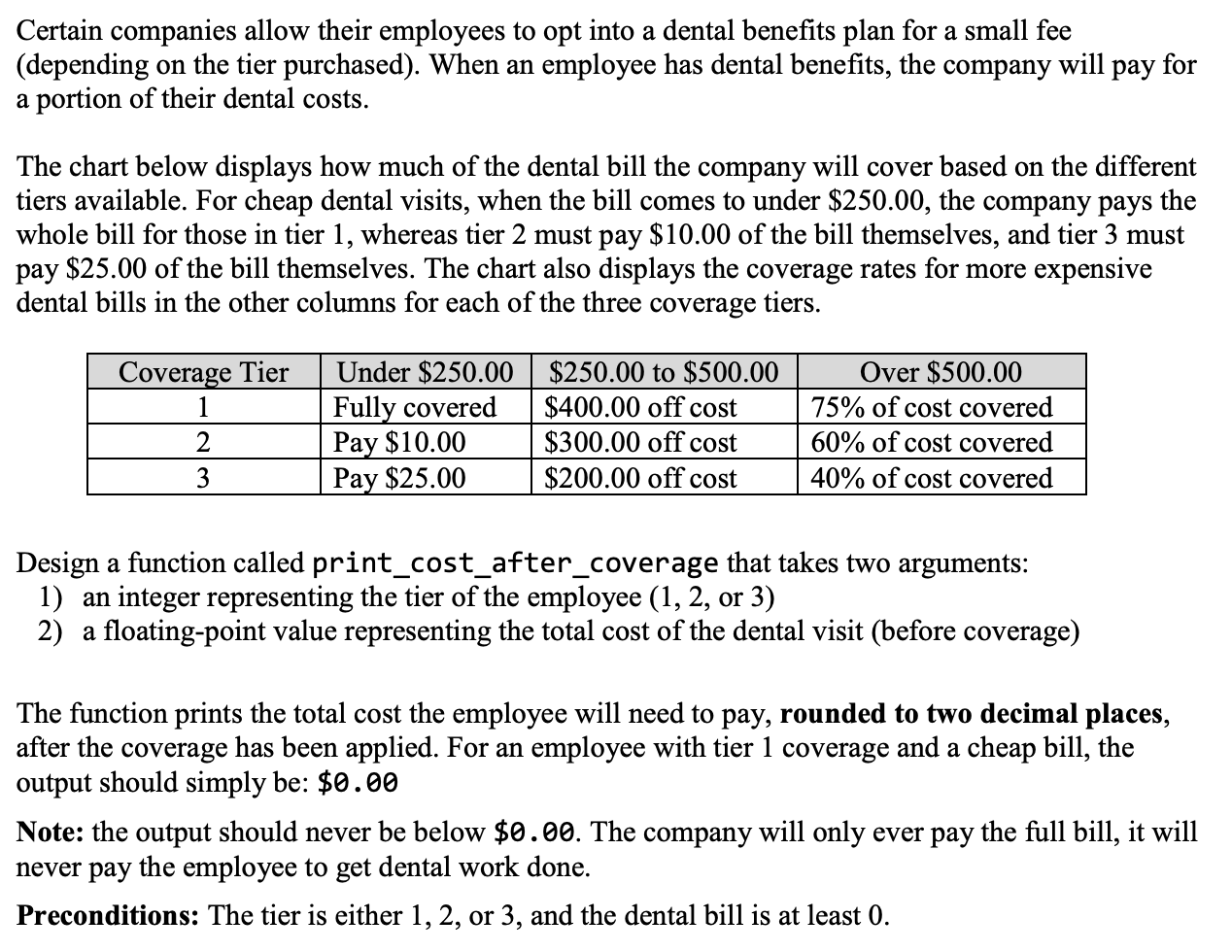
Certain companies allow their employees to opt into a dental benefits plan for a small fee (depending on the tier purchased). When an employee has dental benefits, the company will pay for a portion of their dental costs. The chart below displays how much of the dental bill the company will cover based on the different tiers available. For cheap dental visits, when the bill comes to under $250.00, the company pays the whole bill for those in tier 1, whereas tier 2 must pay $10.00 of the bill themselves, and tier 3 must pay $25.00 of the bill themselves. The chart also displays the coverage rates for more expensive dental bills in the other columns for each of the three coverage tiers. Coverage Tier 1 2 Under $250.00 Fully covered Pay $10.00 Pay $25.00 $250.00 to $500.00 $400.00 off cost $300.00 off cost $200.00 off cost Over $500.00 75% of cost covered 60% of cost covered 40% of cost covered 3 Design a function called print_cost_after_coverage that takes two arguments: 1) an integer representing the tier of the employee (1, 2, or 3) 2) a floating-point value representing the total cost of the dental visit (before coverage) The function prints the total cost the employee will need to pay, rounded to two decimal places, after the coverage has been applied. For an employee with tier 1 coverage and a cheap bill, the output should simply be: $0.00 Note: the output should never be below $0.00. The company will only ever pay the full bill, it will never pay the employee to get dental work done. Preconditions: The tier is either 1, 2, or 3, and the dental bill is at least 0
Step by Step Solution
There are 3 Steps involved in it

Get step-by-step solutions from verified subject matter experts
 Study Help