







Question: Use python In math, every positive integer can be classified as either a deficient number, an abundant number, or a perfect number: a deficient number
Use python
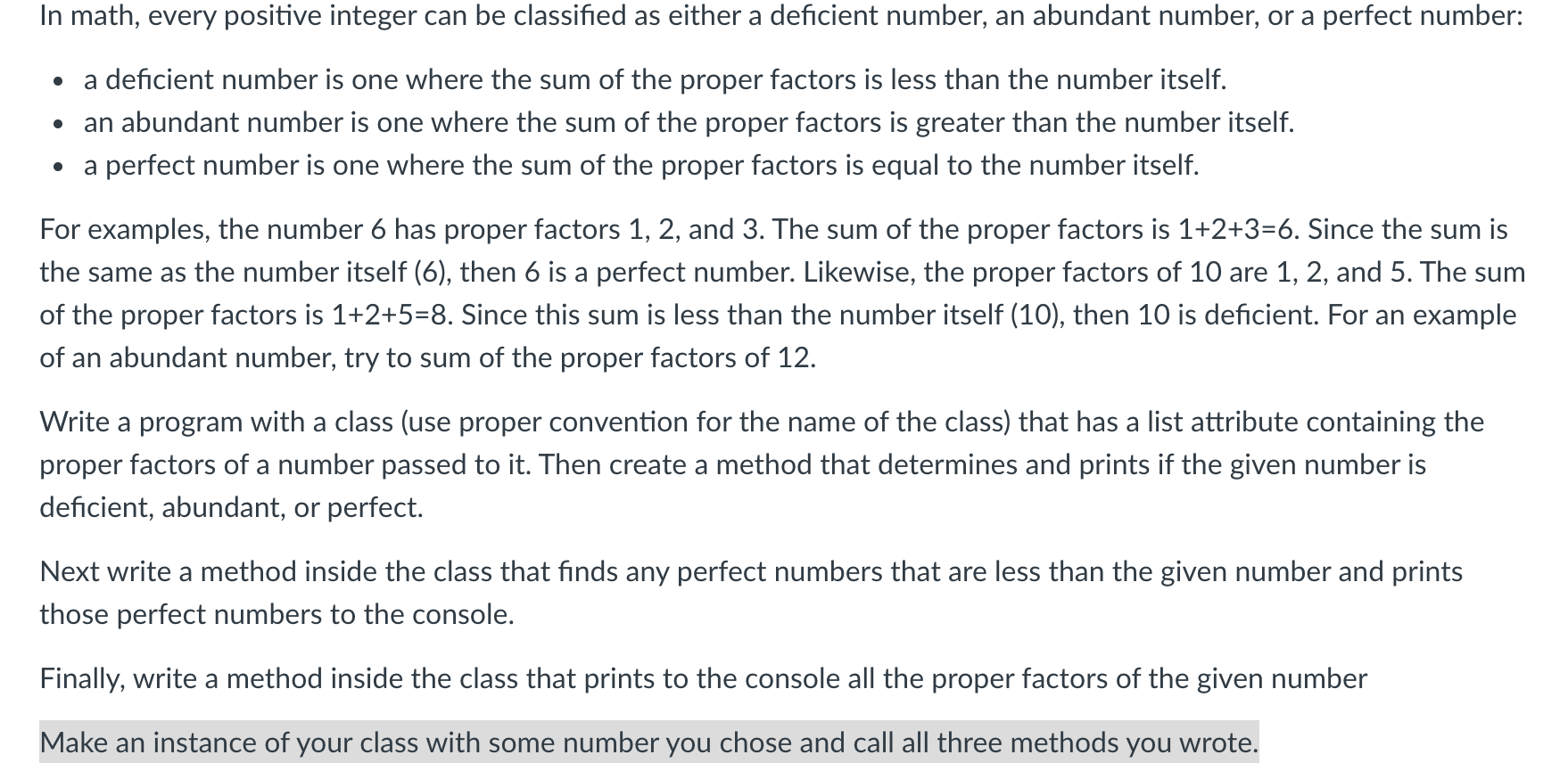
In math, every positive integer can be classified as either a deficient number, an abundant number, or a perfect number: a deficient number is one where the sum of the proper factors is less than the number itself. an abundant number is one where the sum of the proper factors is greater than the number itself. a perfect number is one where the sum of the proper factors is equal to the number itself. For examples, the number 6 has proper factors 1, 2, and 3. The sum of the proper factors is 1+2+3=6. Since the sum is the same as the number itself (6), then 6 is a perfect number. Likewise, the proper factors of 10 are 1, 2, and 5. The sum of the proper factors is 1+2+5=8. Since this sum is less than the number itself (10), then 10 is deficient. For an example of an abundant number, try to sum of the proper factors of 12. Write a program with a class (use proper convention for the name of the class) that has a list attribute containing the proper factors of a number passed to it. Then create a method that determines and prints if the given number is deficient, abundant, or perfect. Next write a method inside the class that finds any perfect numbers that are less than the given number and prints those perfect numbers to the console. Finally, write a method inside the class that prints to the console all the proper factors of the given number Make an instance of your class with some number you chose and call all three methods you wrote
Step by Step Solution
There are 3 Steps involved in it

Get step-by-step solutions from verified subject matter experts
 Study Help