





Question: 7. Recall that a positive integer n is perfect whenever o (n), the sum of all its positive divisors, equals 2n. It is customary to
7. Recall that a positive integer n is perfect
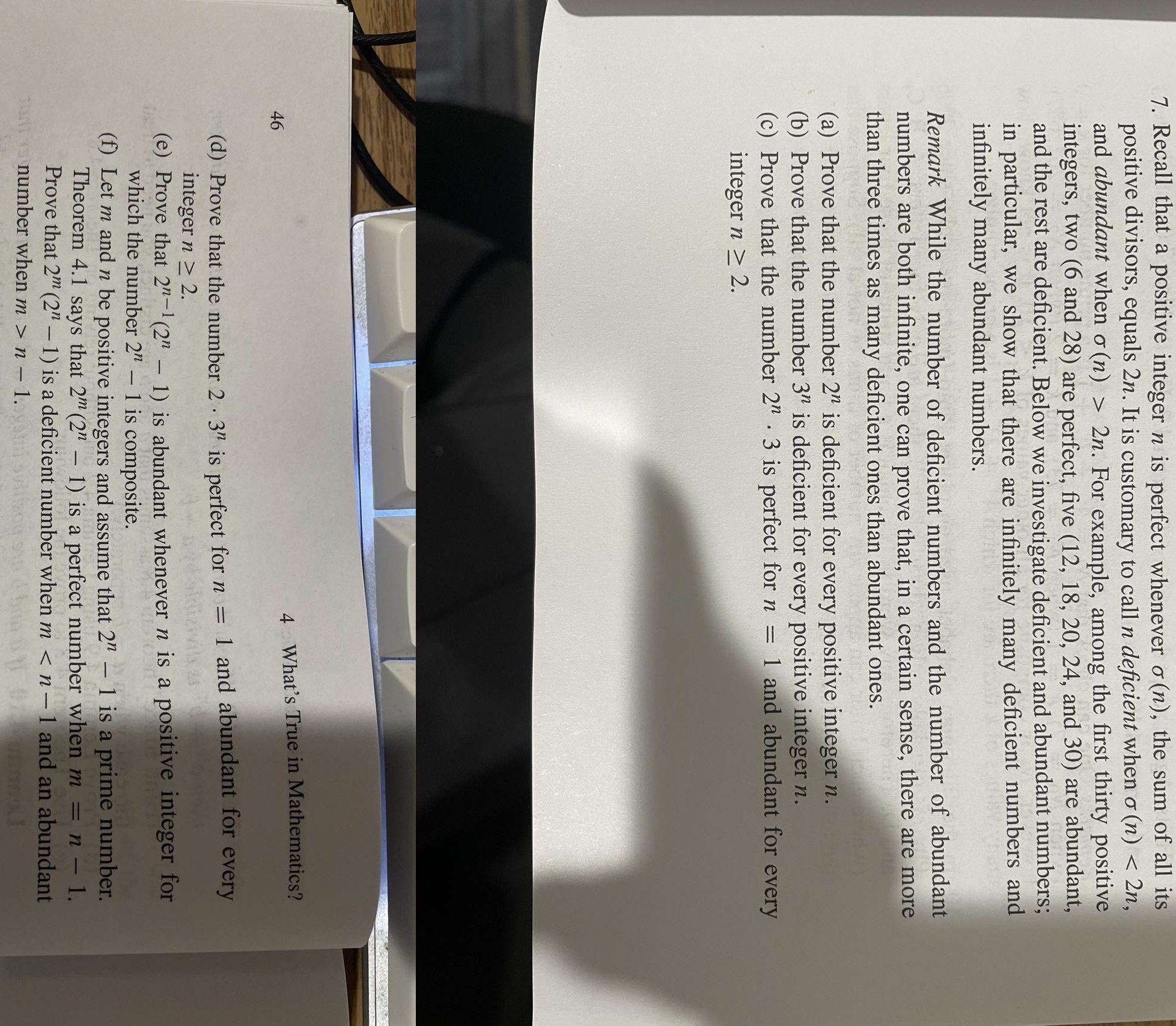
7. Recall that a positive integer n is perfect whenever o (n), the sum of all its positive divisors, equals 2n. It is customary to call n deficient when o (n) 2n. For example, among the first thirty positive integers, two (6 and 28) are perfect, five (12, 18, 20, 24, and 30) are abundant, and the rest are deficient. Below we investigate deficient and abundant numbers; in particular, we show that there are infinitely many deficient numbers and infinitely many abundant numbers. Remark While the number of deficient numbers and the number of abundant numbers are both infinite, one can prove that, in a certain sense, there are more than three times as many deficient ones than abundant ones. (a) Prove that the number 2" is deficient for every positive integer n. b) Prove that the number 3" is deficient for every positive integer n. c) Prove that the number 2" . 3 is perfect for n = 1 and abundant for every integer n > 2. 4 What's True in Mathematics? (d) Prove that the number 2 . 3" is perfect for n = 1 and abundant for every integer n > 2. (e) Prove that 2"-1(2" - 1) is abundant whenever n is a positive integer for which the number 2" - 1 is composite. (f) Let m and n be positive integers and assume that 2" - 1 is a prime number. Theorem 4.1 says that 2" (2" - 1) is a perfect number when m = n - 1. Prove that 2" (2" - 1) is a deficient number when m n - 1

Step by Step Solution

There are 3 Steps involved in it

1 Expert Approved Answer
Step: 1 Unlock blur-text-image

Question Has Been Solved by an Expert!

Get step-by-step solutions from verified subject matter experts

Step: 2 Unlock
Step: 3 Unlock

Students Have Also Explored These Related Mathematics Questions!