







Question: Use Python. Use these functions too. def inchesToMeters(length_in_inches): return (length_in_inches*0.0254) def poundsToKgs(weight_in_pounds): return(weight_in_pounds*0.453592) def bmi(heightInch,weightPound): #function to calculate bmi return poundsToKgs(weightPound)/(inchesToMeters(heightInch)**2) print(bmi(68,151.5)) #to print result
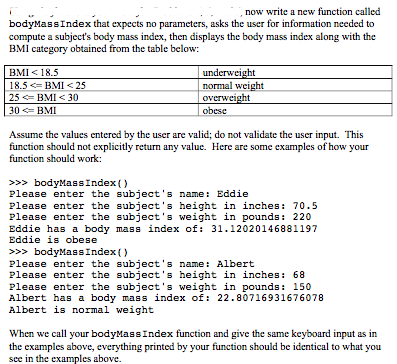
Use Python. Use these functions too.
def inchesToMeters(length_in_inches): return (length_in_inches*0.0254)
def poundsToKgs(weight_in_pounds): return(weight_in_pounds*0.453592)
def bmi(heightInch,weightPound): #function to calculate bmi
return poundsToKgs(weightPound)/(inchesToMeters(heightInch)**2)
print(bmi(68,151.5)) #to print result
print(bmi(71.5,220)) #to print result
bodyMassIndex that expects no parameters, asks the user for information needed to compute a subjects body mass index, then displays the body mass index along with the BMI category obtained from the table below: BMI 18.5 18.5 BMI >> bodyMassIndex) Please enter the subject's name: Eddie Please enter the subject's height in inches: 70.5 Please enter the subject's weight in pounds: 220 Eddie has a body mass index of: 31.12020146881197 Eddie is obese >>> bodyMassIndex) Please enter the subject's name: Albert Please enter the subject's height in inches: 68 Please enter the subject's weight in pounds: 150 Albert has a body mass index of: 22.80716931676078 Albert is normal weight When we call your bodyMassIndex function and give the same keyboard input as in the examples above, everything printed by your function should be identical to what you see in the examples above
Step by Step Solution
There are 3 Steps involved in it

Get step-by-step solutions from verified subject matter experts
 Study Help