







Question: Use R studio Question 9 Here we apply Bayesian inference to an everyday problem. Suppose we have a coin and are not sure if it
Use R studio
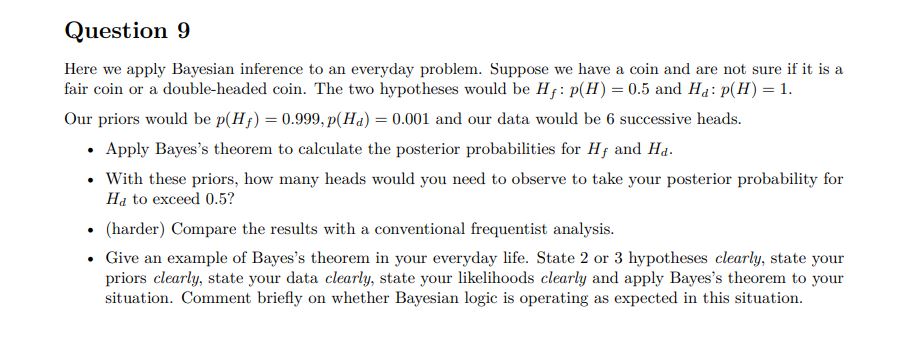
Question 9 Here we apply Bayesian inference to an everyday problem. Suppose we have a coin and are not sure if it is a fair coin or a double-headed coin. The two hypotheses would be Hf: p(H) = 0.5 and Ha: p(H) = 1. Our priors would be p(H+) = 0.999, p(Hd) = 0.001 and our data would be 6 successive heads. Apply Bayes's theorem to calculate the posterior probabilities for H and Hd. . With these priors, how many heads would you need to observe to take your posterior probability for Ha to exceed 0.5? (harder) Compare the results with a conventional frequentist analysis. Give an example of Bayes's theorem in your everyday life. State 2 or 3 hypotheses clearly, state your priors clearly, state your data clearly, state your likelihoods clearly and apply Bayes's theorem to your situation. Comment briefly on whether Bayesian logic is operating as expected in this situation.
Step by Step Solution
There are 3 Steps involved in it

Get step-by-step solutions from verified subject matter experts
 Study Help