







Question: Use the building code attached to solve problem (a) Calculate the snow loading for a pumping station in Dartmouth with a 35 pitched roof containing
Use the building code attached to solve problem
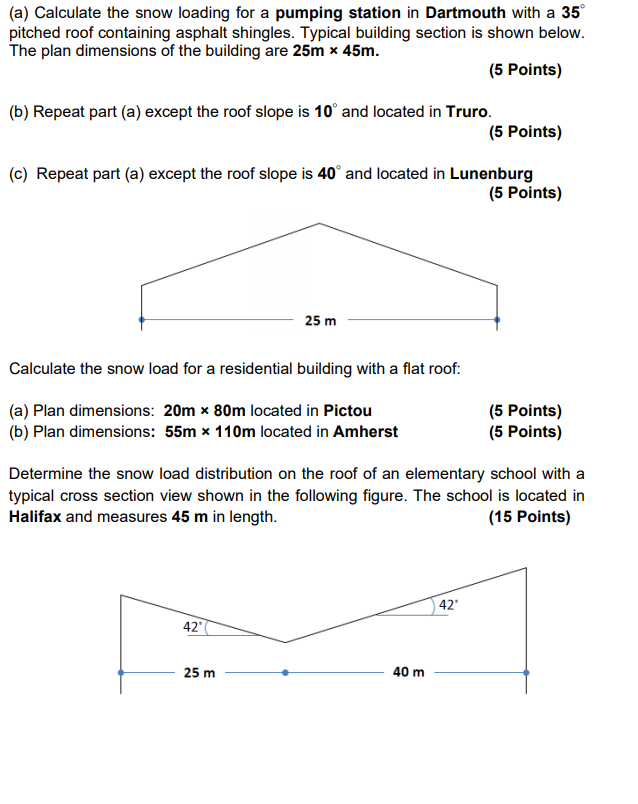
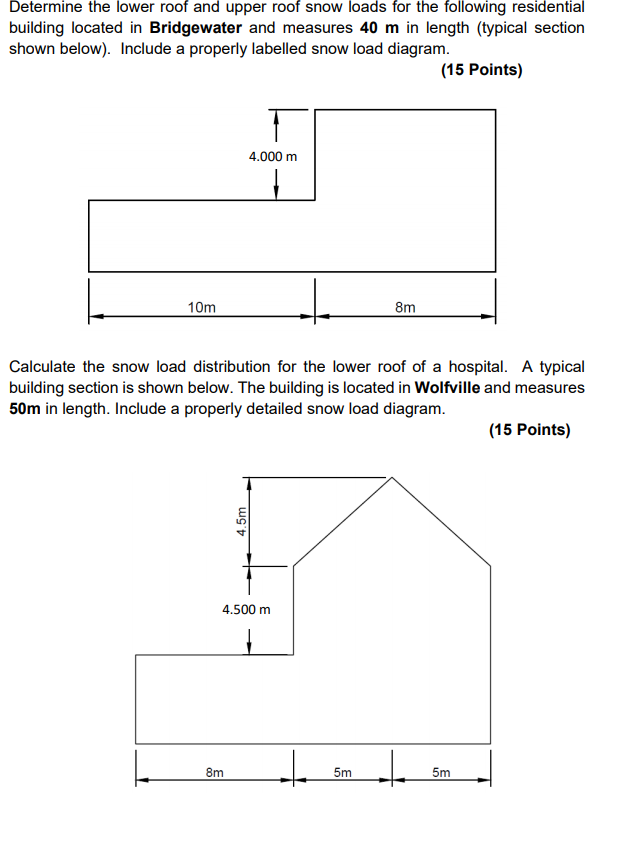
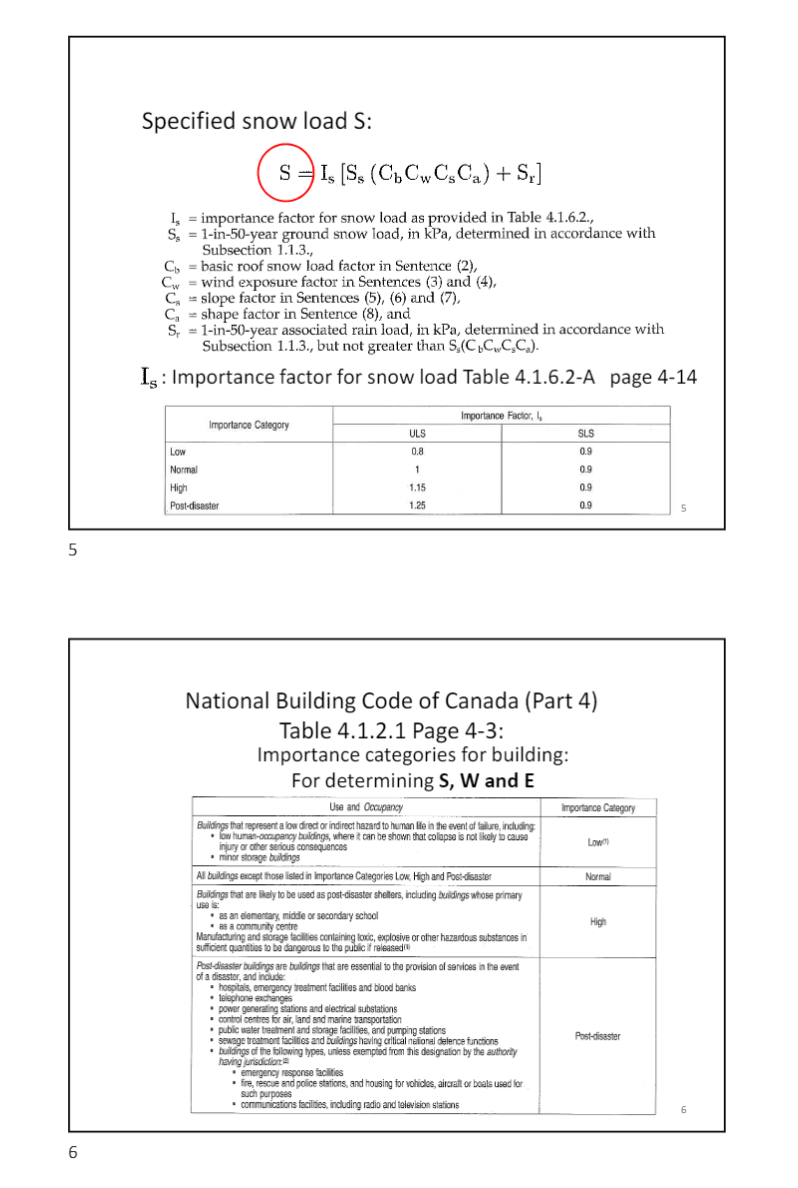
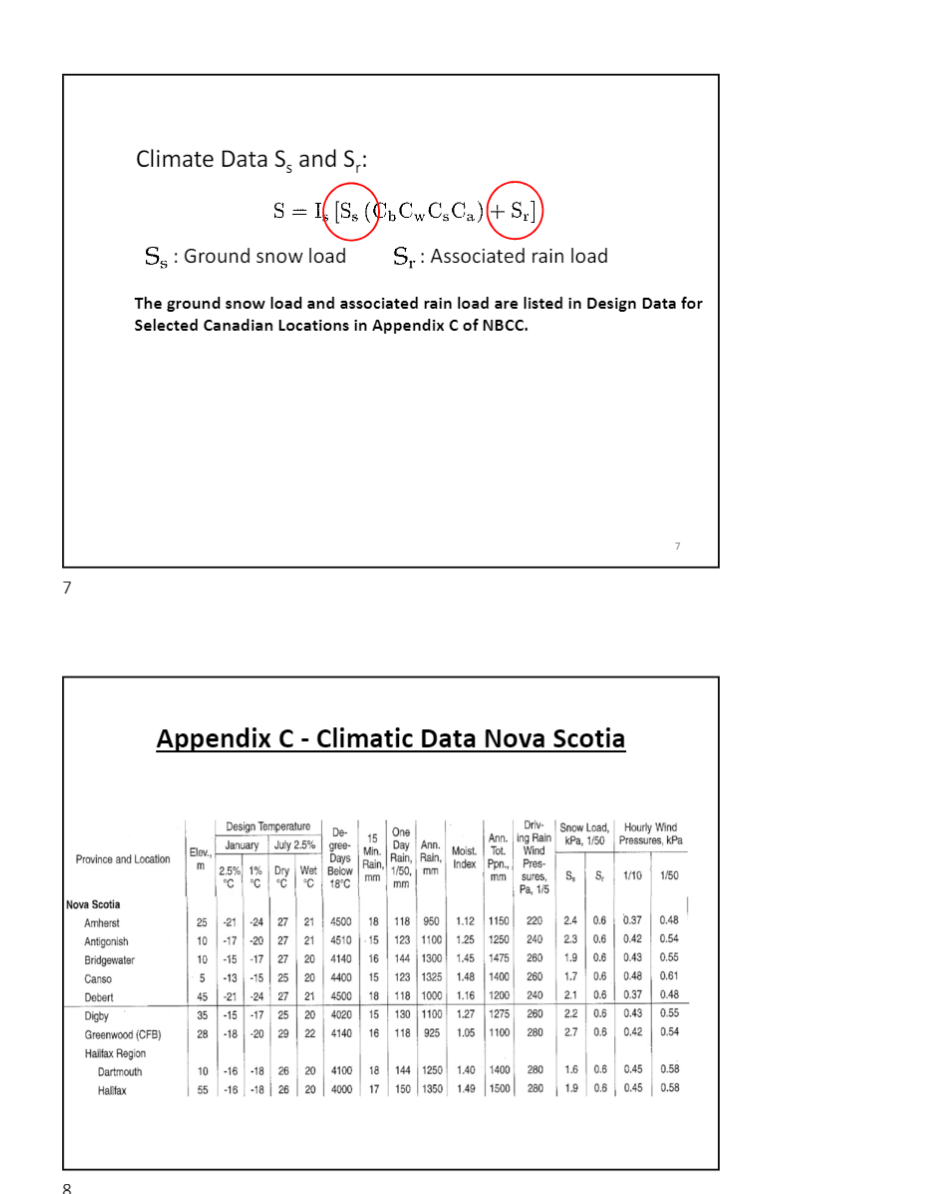
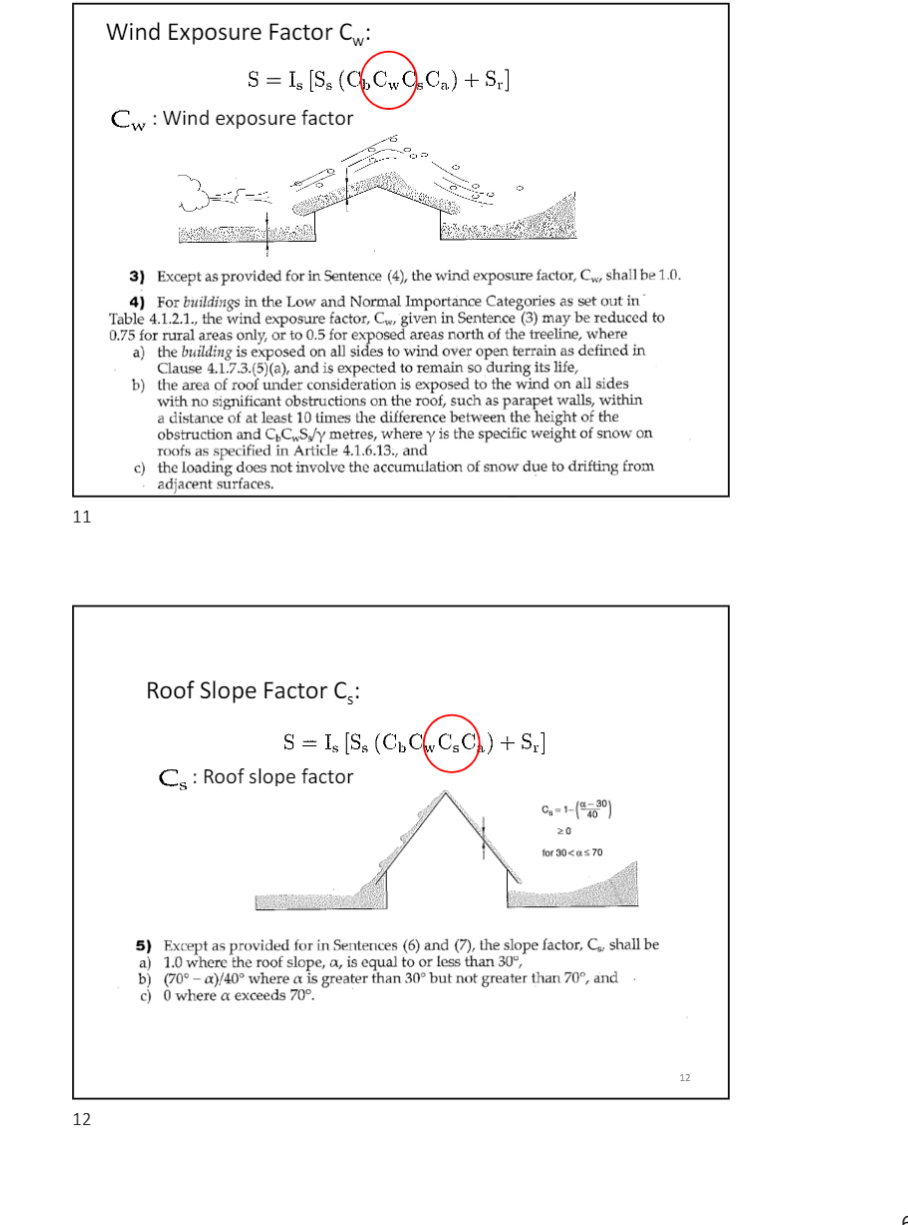
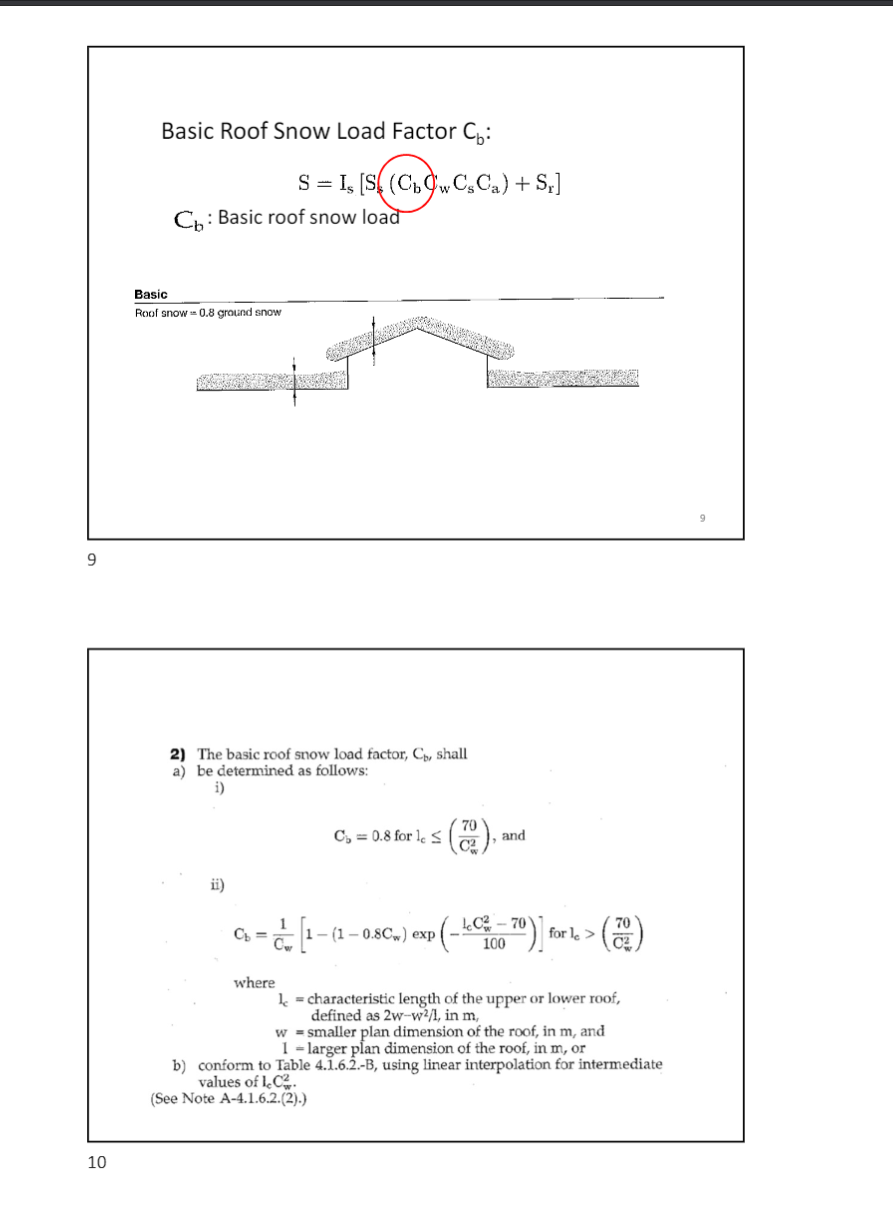
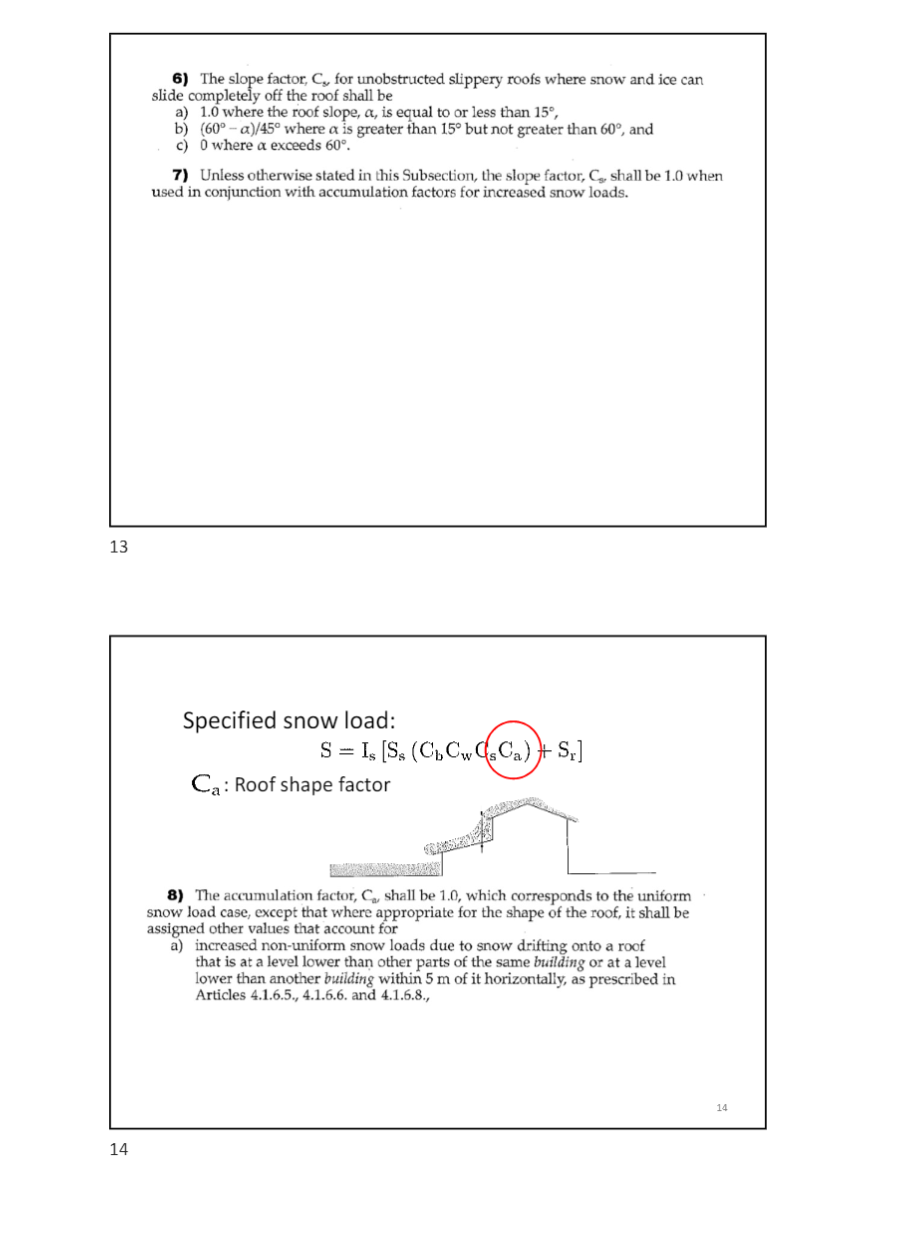
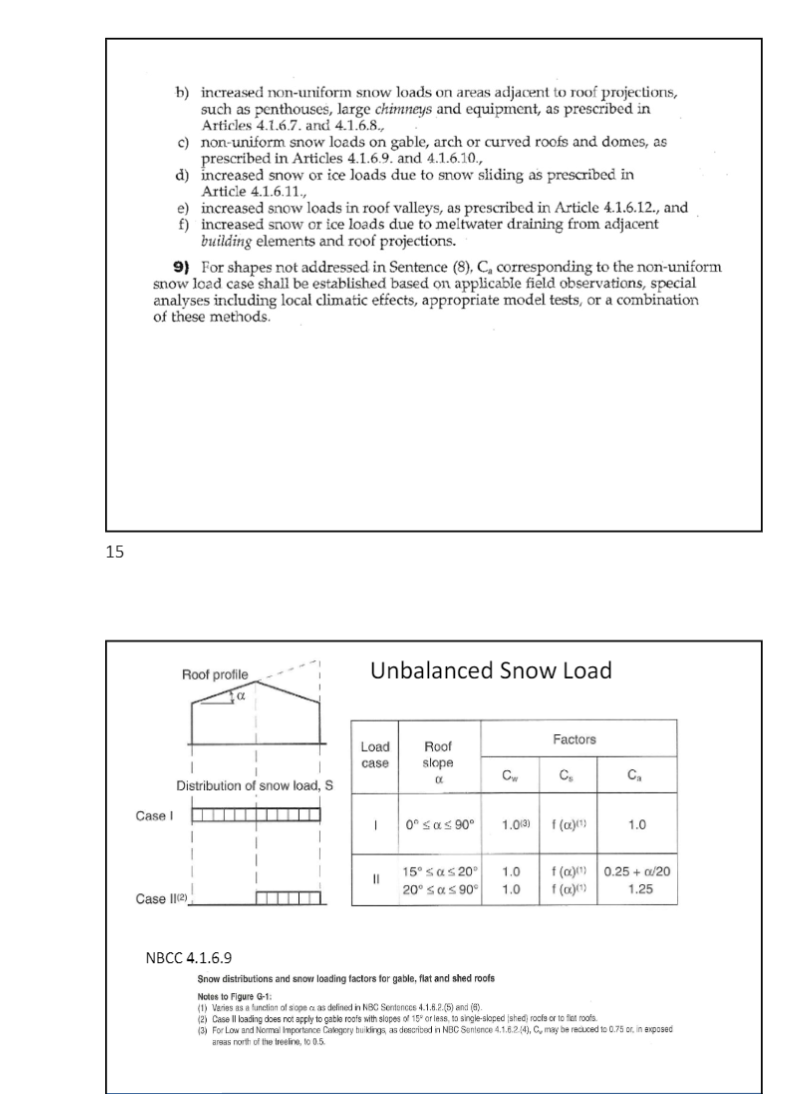
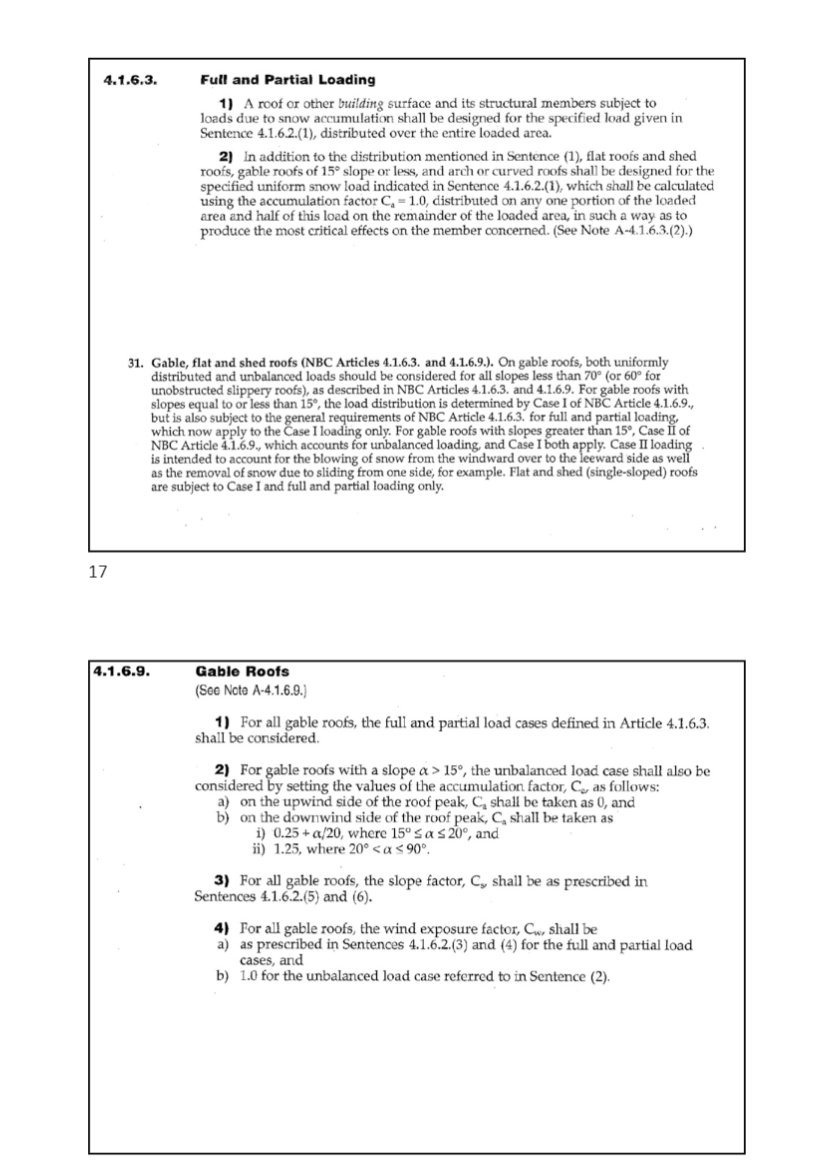
(a) Calculate the snow loading for a pumping station in Dartmouth with a 35 pitched roof containing asphalt shingles. Typical building section is shown below. The plan dimensions of the building are 25m x 45m. (5 Points) (b) Repeat part (a) except the roof slope is 10 and located in Truro. (c) Repeat part (a) except the roof slope is 40 and located in Lunenburg (5 Points) Calculate the snow load for a residential building with a flat roof: (a) Plan dimensions: 20m x 80m located in Pictou (b) Plan dimensions: 55m x 110m located in Amherst 25 m 42( 25 m Determine the snow load distribution on the roof of an elementary school with a typical cross section view shown in the following figure. The school is located in Halifax and measures 45 m in length. (15 Points) (5 Points) 40 m 42 (5 Points) (5 Points) Determine the lower roof and upper roof snow loads for the following residential building located in Bridgewater and measures 40 m in length (typical section shown below). Include a properly labelled snow load diagram. (15 Points) 10m 4.000 m Calculate the snow load distribution for the lower roof of a hospital. A typical building section is shown below. The building is located in Wolfville and measures 50m in length. Include a properly detailed snow load diagram. (15 Points) 4.5m 8m 4.500 m 8m 5m + 5m 5 6 Specified snow load S: SIs [Ss (CbCwCC) + Sr] Is importance factor for snow load as provided in Table 4.1.6.2., S = 1-in-50-year ground snow load, in kPa, determined in accordance with Subsection 1.1.3., C = basic roof snow load factor in Sentence (2), Cw = wind exposure factor in Sentences (3) and (4), C = slope factor in Sentences (5), (6) and (7), shape factor in Sentence (8), and 1-in-50-year associated rain load, in kPa, determined in accordance with Subsection 1.1.3., but not greater than S,(CCC,C). I: Importance factor for snow load Table 4.1.6.2-A page 4-14 C S, Importance Category Low Normal High Post-disaster ULS 0.8 1 1.15 1.25 Importance Factor, I Use and Occupancy Buildings that represent a low direct or indirect hazard to human life in the event of failure, including: low human-occupancy buildings, where it can be shown that collapse is not likely to cause injury or other serious consequences minor storage buildings All buildings except those listed in Importance Categories Low, High and Post-disaster Buildings that are likely to be used as post-disaster shelters, including buildings whose primary National Building Code of Canada (Part 4) Table 4.1.2.1 Page 4-3: Importance categories for building: For determining S, W and E as an elementary, middle or secondary school as a community centre Manufacturing and storage facilities containing toxic, explosive or other hazardous substances in sufficient quantities to be dangerous to the public if released Post-disaster buildings are buildings that are essential to the provision of services in the event of a disaster, and include: hospitals, emergency treatment facilities and blood banks telephone exchanges power generating stations and electrical substations control centres for air, land and marine transportation public water treatment and storage facilities, and pumping stations sewage treatment facilities and buildings having critical national defence functions .buildings of the following types, unless exempted from this designation by the authority having jurisdiction SLS 0.9 emergency response facilities fire, rescue and police stations, and housing for vohicles, aircraft or boals used for such purposes communications facilities, including radio and television stations 0.9 0.9 0.9 Importance Category Low Normal High Post-disaster 5 6 7 Climate Data S, and S: 8 S: Ground snow load The ground snow load and associated rain load are listed in Design Data for Selected Canadian Locations in Appendix C of NBCC. Province and Location Nova Scotia Amherst Antigonish Bridgewater Canso Debert Digby Greenwood (CFB) Halifax Region Dartmouth Halifax = { [S, C,c,c,d+ $) Appendix C- Climatic Data Nova Scotia Elev, m Design Temperature De- January July 2.5% gree- Days Below 2.5% 1% Dry Wet C C C C 18C 25 -21 -24 27 10 10 -15 -17 27 5 -13 -15 25 58858 N 45 -21 -24 27 21 35 -15 -17 25 28 -18 -20 29 15 Min. Rain, mm 4500 -17 -20 27 21 4510 -15 S: Associated rain load 20 4020 22 4140 One Day Ann. Rain, Rain 1/50, mm mm 10 -16 -18 26 20 4100 18 55 -16-18 26 20 4000 17 18 118 118 950 1.12 1150 220 1.25 1250 240 123 1100 4140 16 144 1300 1.45 1475 260 4400 15 123 1325 1.48 1400 260 4500 18 118 1000 1.16 1.16 1200 240 1.27 1275 260 1.05 1100 280 118 1000 15 130 1100 118 925 16 Moist. Index Driv- Snow Load, Ann. ing Rain kPa, 1/50 Tot Wind Ppn., Pres- mm sures, S, S Pa, 1/5 144 1250 150 1350 1.49 1.40 1400 280 1500 280 7 Hourly Wind Pressures, kPa 1/10 1/50 0.48 2.4 0.6 0.37 2.3 0.6 0.42 0.54 1.9 0.6 0.43 0.55 1.7 0.6 0.48 0.61 2.1 0.6 0.37 0.48 2.2 0.6 0.43 0.55 27 0.6 0.42 0.54 1.6 0.6 0.45 0.58 1.9 0.6 0.45 0.58 11 12 Wind Exposure Factor Cw: S = Is [Ss (Cb CwCsCa.) + Sr] Cw: Wind exposure factor 3== COVER 3) Except as provided for in Sentence (4), the wind exposure factor, Cw, shall be 1.0. 4) For buildings in the Low and Normal Importance Categories as set out in Table 4.1.2.1., the wind exposure factor, Cw, given in Sentence (3) may be reduced to 0.75 for rural areas only, or to 0.5 for exposed areas north of the treeline, where a) the building is exposed on all sides to wind over open terrain as defined in Clause 4.1.7.3.(5)(a), and is expected to remain so during its life, b) the area of roof under consideration is exposed to the wind on all sides with no significant obstructions on the roof, such as parapet walls, within a distance of at least 10 times the difference between the height of the obstruction and CCS/Y metres, where y is the specific weight of snow on roofs as specified in Article 4.1.6.13., and c) the loading does not involve the accumulation of snow due to drifting from adjacent surfaces. Roof Slope Factor C: S = Is [Ss (Cb, CCC) + Sr] Cs: Roof slope factor C-1-(30) 20 for 30 9 10 Basic Roof Snow Load Factor C: Ch: Basic roof snow load Basic Roof snow -0.8 ground snow ii) S = Is [S(Chow Cs C JwCC) + Sz] 2) The basic roof snow load factor, Cb, shall a) be determined as follows: i) where C = 0.8 for le S 70 and C-70 a = [1 1-(1-0.8Cw) exp _Lc70)] 100 for le > 70 C 1 = characteristic length of the upper or lower roof, defined as 2w-w/1, in m, w smaller plan dimension of the roof, in m, and 1 = larger plan dimension of the roof, in m, or b) conform to Table 4.1.6.2.-B, using linear interpolation for intermediate values of l.C. (See Note A-4.1.6.2.(2).) 13 14 6) The slope factor, C, for unobstructed slippery roofs where snow and ice can slide completely off the roof shall be a) 1.0 where the roof slope, a, is equal to or less than 15, b) (60-a)/45 where a is greater than 15 but not greater than 60, and c) 0 where a exceeds 60. 7) Unless otherwise stated in this Subsection, the slope factor, C, shall be 1.0 when used in conjunction with accumulation factors for increased snow loads. Specified snow load: S = Is [Ss (CbCws Ca) + Sr] Ca: Roof shape factor SEN 8) The accumulation factor, C, shall be 1.0, which corresponds to the uniform snow load case, except that where appropriate for the shape of the roof, it shall be assigned other values that account for a) increased non-uniform snow loads due to snow drifting onto a roof that is at a level lower than other parts of the same building or at a level lower than another building within 5 m of it horizontally, as prescribed in Articles 4.1.6.5., 4.1.6.6. and 4.1.6.8., 14 15 b) increased non-uniform snow loads on areas adjacent to roof projections, such as penthouses, large chimneys and equipment, as prescribed in Articles 4.1.6.7. and 4.1.6.8., c) non-uniform snow loads on gable, arch or curved roofs and domes, as prescribed in Articles 4.1.6.9. and 4.1.6.10., d) increased snow or ice loads due to snow sliding as prescribed in Article 4.1.6.11., e) f) increased snow loads in roof valleys, as prescribed in Article 4.1.6.12., and increased snow or ice loads due to meltwater draining from adjacent building elements and roof projections. 9) For shapes not addressed in Sentence C, corresponding to the non-uniform snow load case shall be established based on applicable field observations, special analyses including local climatic effects, appropriate model tests, or a combination of these methods. Roof profile I Distribution of snow load, S a Case I Case II(2) NBCC 4.1.6.9 Unbalanced Snow Load Load case 1 11 Roof slope 0 a 90 15 as 20 20 a 90 Cw 1.0(3) 1.0 1.0 Factors C f(a)() f (a) f(a)() Ca 1.0 0.25+ a/20 1.25 Snow distributions and snow loading factors for gable, flat and roofs Notes to Figure G-1: (1) Varies as a function of siopea as defined in NBC Sentences 4.1.6.2.(5) and (6). (2) Case Il loading does not apply to gable roofs with slopes of 15 or less, to single-sloped (shed) roofs or to fit roofs (3) For Low and Normal Importance Category buildings, as described in NBC Sentence 4.1.6.2(4), C, may be reduced to 0.75 or, in exposed areas north of the treeline, to 0.5. 4.1.6.3. 17 Full and Partial Loading 1) A roof or other building surface and its structural members subject to loads due to snow accumulation shall be designed for the specified load given in Sentence 4.1.6.2.(1), distributed over the entire loaded area. 4.1.6.9. 2) In addition to the distribution mentioned in Sentence (1), flat roofs and shed roofs, gable roofs of 15 slope or less, and arch or curved roofs shall be designed for the specified uniform snow load indicated in Sentence 4.1.6.2.(1), which shall be calculated using the accumulation factor C = 1.0, distributed on any one portion of the loaded area and half of this load on the remainder of the loaded area, in such a way as to produce the most critical effects on the member concerned. (See Note A-4.1.6.3.(2).) 31. Gable, flat and shed roofs (NBC Articles 4.1.6.3. and 4.1.6.9.). On gable roofs, both uniformly distributed and unbalanced loads should be considered for all slopes less than 70 (or 60 for unobstructed slippery roofs), as described in NBC Articles 4.1.6.3. and 4.1.6.9. For gable roofs with slopes equal to or less than 15, the load distribution is determined by Case I of NBC Article 4.1.6.9., but is also subject to the general requirements of NBC Article 4.1.6.3. for full and partial loading, which now apply to the Case I loading only. For gable roofs with slopes greater than 15, Case II of NBC Article 4.1.6.9., which accounts for unbalanced loading, and Case I both apply. Case II loading is intended to account for the blowing of snow from the windward over to the leeward side as well as the removal of snow due to sliding from one side, for example. Flat and shed (single-sloped) roofs are subject to Case I and full and partial loading only. Gable Roofs (See Note A-4.1.6.9.) 1) For all gable roofs, the full and partial load cases defined in Article 4.1.6.3. shall be considered. 2) For gable roofs with a slope a > 15, the unbalanced load case shall also be considered by setting the values of the accumulation factor, C, as follows: a) on the upwind side of the roof peak, C, shall be taken as 0, and b) on the downwind side of the roof peak, C, shall be taken as i) 0.25 +a/20, where 15 sa s 20, and ii) 1.25, where 20
Step by Step Solution
3.37 Rating (150 Votes )
There are 3 Steps involved in it
The skin friction coefficient Cf for a laminar boundary ... View full answer

Get step-by-step solutions from verified subject matter experts
 Study Help