Question: Use the Excel workbook template below to complete the assignment. Note that instructions are provided in each of the examples except the Hybrid Car where
Use the Excel workbook template below to complete the assignment. Note that instructions are provided in each of the examples except the Hybrid Car where you create your own solution. Note that some of the problems contain information not necessary in the solution and there could be multiple interpretations of some of the data. So follow the assumptions in each sheet or make your own if preferred. The objective is to learn to make carbon footprint calculations.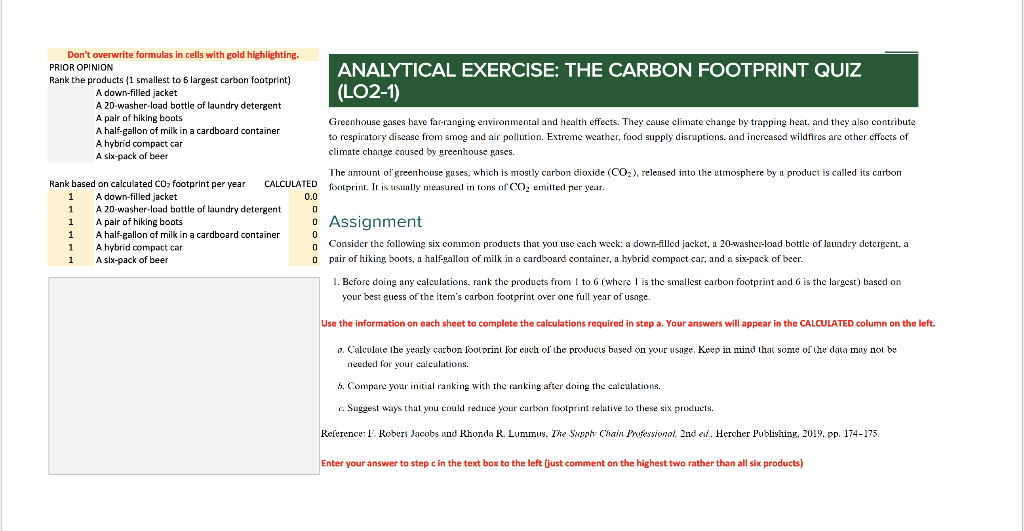
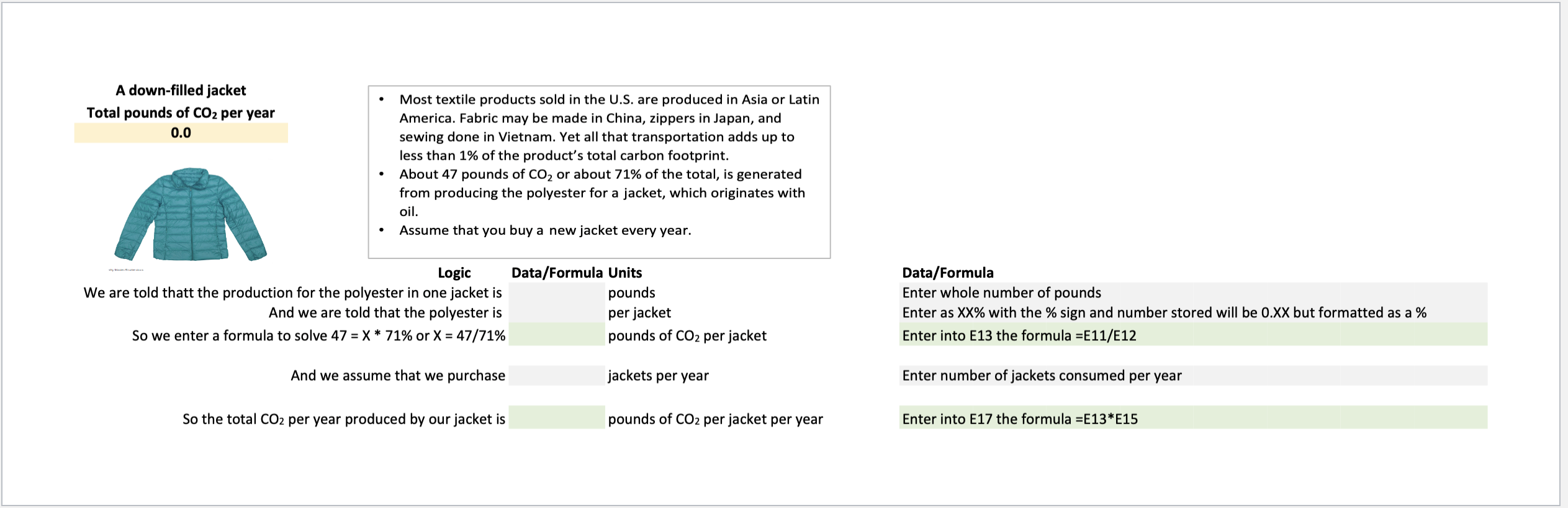
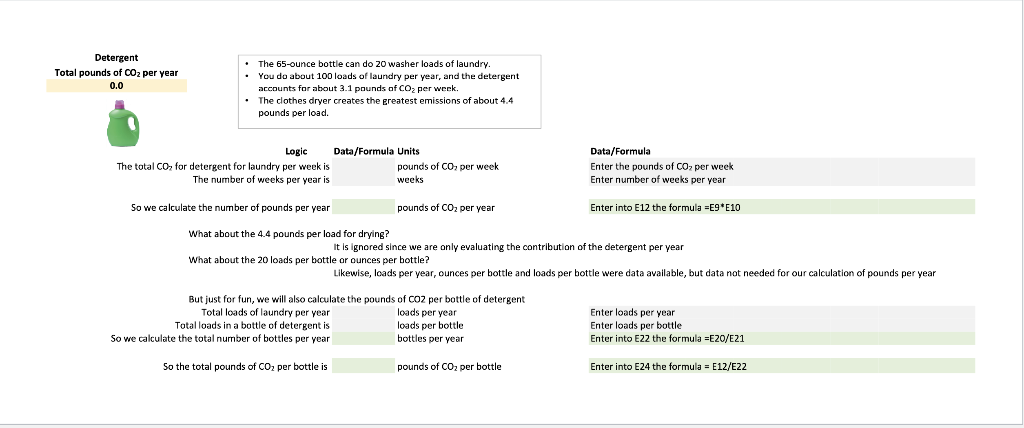
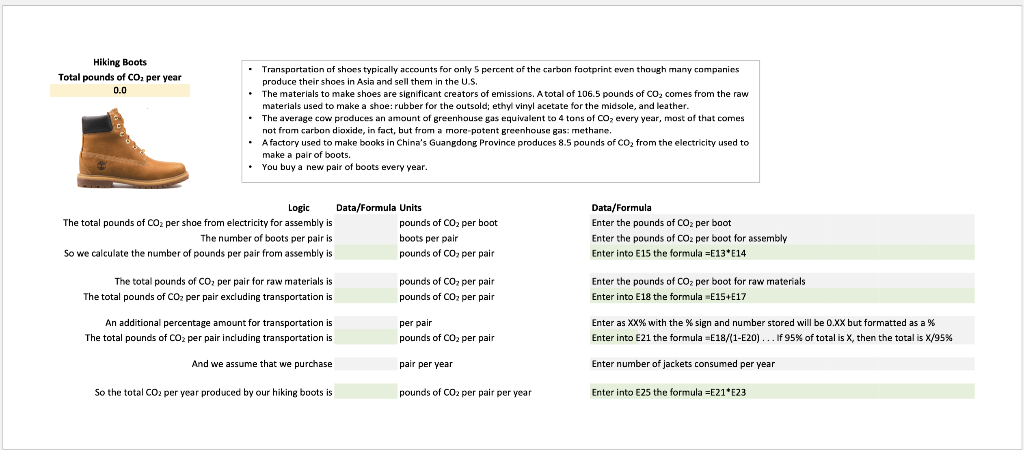
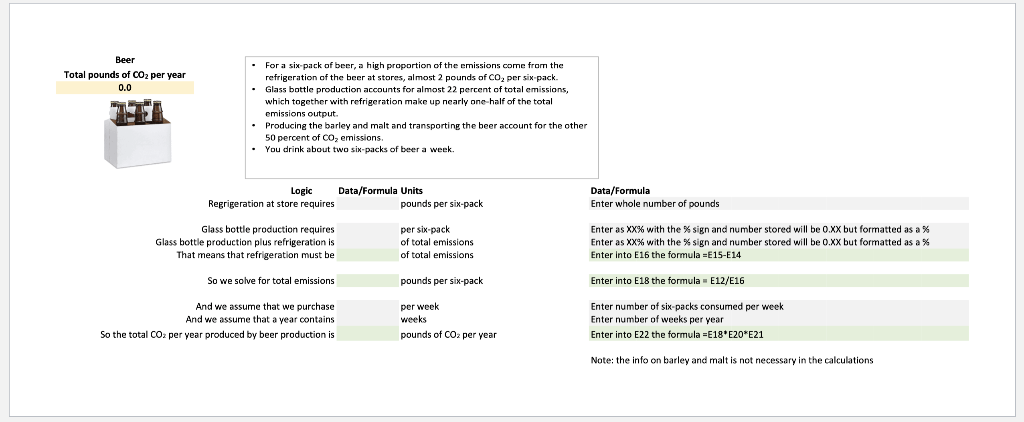
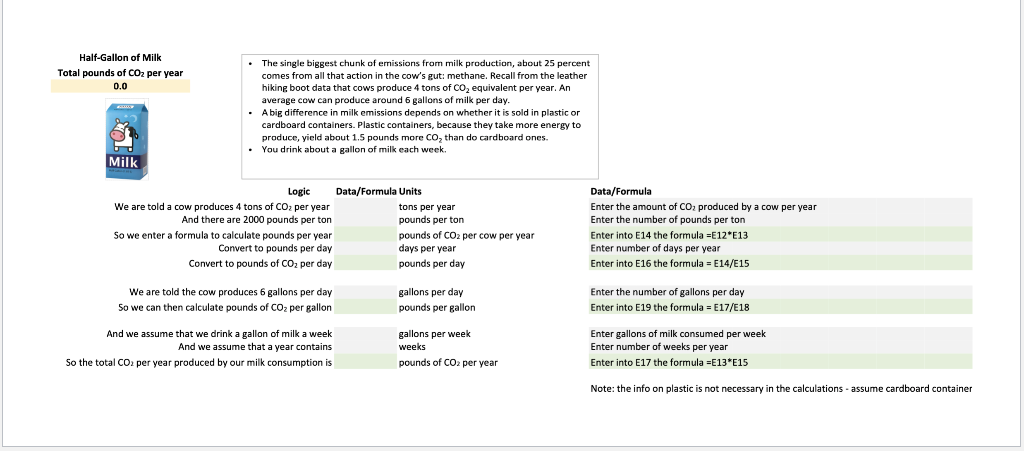
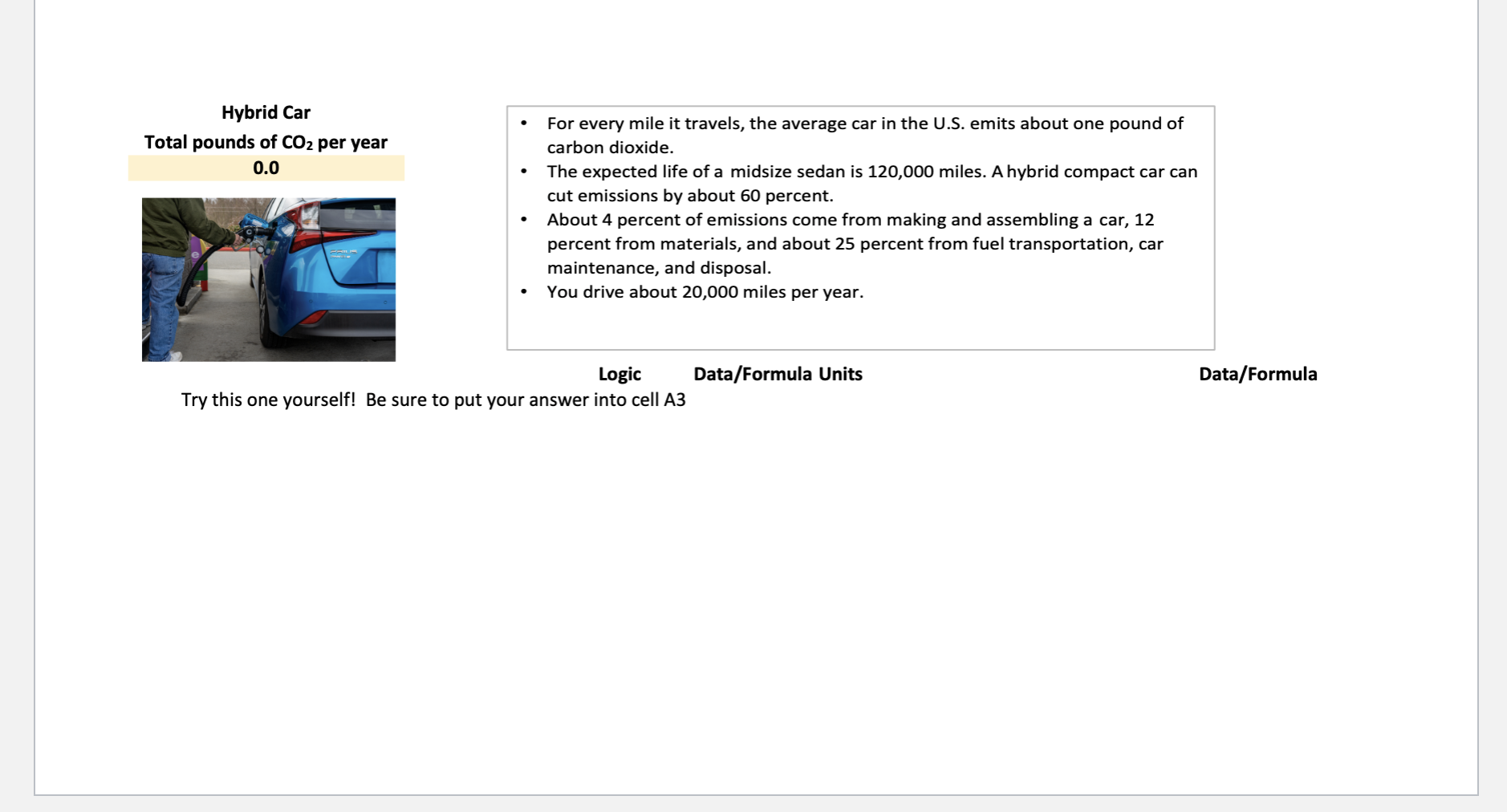
Don't overwrite formulas in cells with gold highlighting. PRIOO R op Nivo o needed for your caleulations. 6. Compare your initial ranking with the ranking after doing the caleulations. c. Suggest ways that you could reduce your cartxon footprint relative to these six products. Relerence: 1 . Robert Jacobs and Rhonda R. Lunmus, The Supphy Chain Prufessianat, 2nd edi, Hercher Publishing. 2019, pp. 174-175. Enter your answer to step c in the text box to the left (just comment on the highest two rather than all six products) \begin{tabular}{c|c|} A down-filled jacket Total pounds of CO2 per year & - Most textile products sold in the U.S. are produced in Asia or Latin America. Fabric may be made in China, zippers in Japan, and sewing done in Vietnam. Yet all that transportation adds up to less than 1% of the product's total carbon footprint. \\ - About 47 pounds of CO2 or about 71% of the total, is generated from producing the polyester for a jacket, which originates with oil. \\ - Assume that you buy a new jacket every year. \end{tabular} - The 65-ounce bottle can do 20 washer loads of laundry. - You do about 100 loads of laundry per year, and the detergent accounts far about 3.1 paunds of CO2 per weck. - The clothes dryer creates the greatest emissions of about 4.4 pounds per load. \begin{tabular}{cl} \multicolumn{1}{c}{ Logic } & Data/Formula Units \\ The total CO2 for detergent for laundry per week is & pounds of CO2 per week \\ The number of weeks per year is & weeks \end{tabular} Data/Formula Enter the pounds of CO2 per week Enter number of weeks per year So we calculate the number of pounds per year pounds of CO2 per year Enter into E12 the formula =E9E10 What about the 4.4 pounds per load for drying? It is ignored since we are only evaluating the contribution of the detergent per year What about the 20 loads per bottle or ounces per bottle? Likewise, loads per year, ounces per bottle and loads per bottle were data available, but data not needed for our calculation of pounds per year Hiking Boots - Transportation of shoes typically accounts for only 5 percent of the carbon faotprint even though many companies Total pounds of CO2 per year produce their shoes in Asia and sell them in the U.S. - The materials to make shoes are significant creators of emissions. A total of 106.5 pounds of CO2 comes from the raw materials used to make a shoe: rubber for the outsold; ethyl vinyl acetate for the midsole, and leather. - The average cow produces an amount of greenhouse gas equivalent to 4 tons of CO2 every year, most of that comes not from carbon dioxide, in fact, but from a more-potent greenhouse gas: methane. - A factory used to make books in China's Guangdong Province produces 8.5 pounds of CO2 from the electricity used to make a pair of boots. - You buy a new pair of boots every year. - For a six-pack of beer, a high proportion of the emissions come fram the refrigeration of the beer at stores, almost 2 pounds of CO2 per six-pack- - Glass battle production accounts for almost 22 percent of total emissions, which together with refrigeration make up nearly one-half of the total emissions output. - Producing the barley and malt and transporting the beer account for the other 50 percent of CO2 emissions. - You drink about twa six-packs of beer a week. Data/Formula Enter whole number of pounds Enter as XX% with the % sign and number stored will be 0.XX but formatted as a % Enter as XX% with the % sign and number stored will be 0.XX but formatted as a % Enter into E16 the formula =E15-E14 Enter into E18 the formula = E12/E16 Enter number of six-packs consumed per week Enter number of weeks per year Enter into E22 the formula =E18E20E21 Note: the info on barley and malt is not necessary in the calculations - The single biggest chunk of emissions from milk production, about 25 percent comes from all that action in the cow's gut: methane. Recall from the leather hiking boot data that cows produce 4 tons of CO2 equivalent per year. An average cow can produce around 6 gallons of milk per day. - A big difference in milk emissions depends on whether it is sold in plastic or cardboard containers. Plastic containers, because they take more energy to produce, yield about 1.5 pounds more CO2 than do cardboard ones. - You drink about a gallon of milk each week. Data/Formula Enter the amount of CO2 produced by a cow per year Enter the number of pounds per ton Enter into E14 the formula =E12*E13 Enter number of days per year Enter into E16 the formula = E14/E15 Enter the number of gallons per day Enter into E19 the formula = E17/E18 Enter gallons of milk consumed per week Enter number of weeks per year Enter into E17 the formula =E13*E15 Note: the info on plastic is not necessary in the calculations - assume cardboard container Hybrid Car Total pounds of CO2 per year 0.0 - For every mile it travels, the average car in the U.S. emits about one pound of carbon dioxide. The expected life of a midsize sedan is 120,000 miles. A hybrid compact car can cut emissions by about 60 percent. - About 4 percent of emissions come from making and assembling a car, 12 percent from materials, and about 25 percent from fuel transportation, car maintenance, and disposal. - You drive about 20,000 miles per year. Logic Data/Formula Units









 Study Help