



Question: Use the following information to complete steps 1 through 3, then use that information to answer questions 1 through 10. COMPUTING DILUTED EARNINGS PER SHARE
Use the following information to complete steps 1 through 3, then use that information to answer questions 1 through 10.
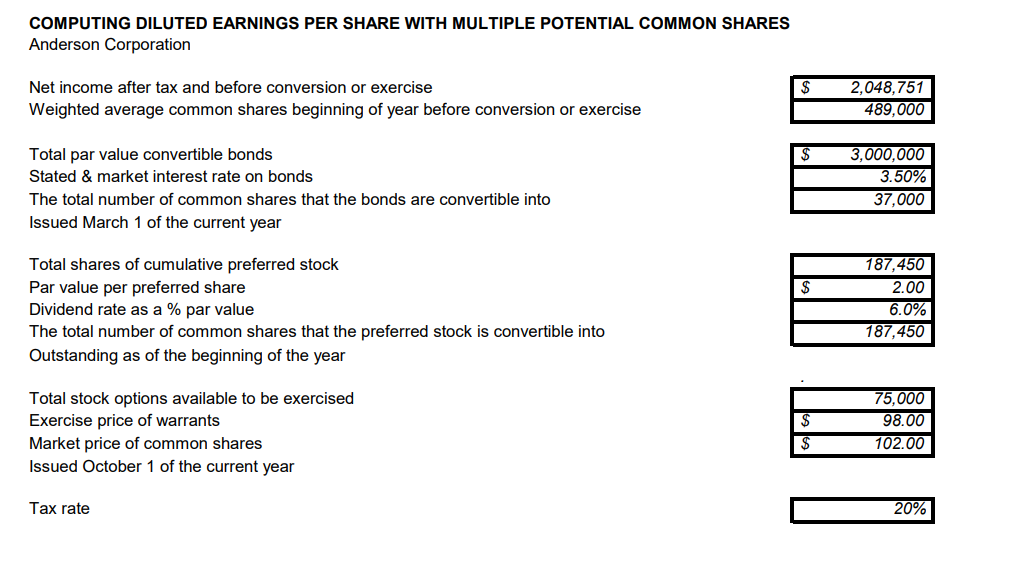
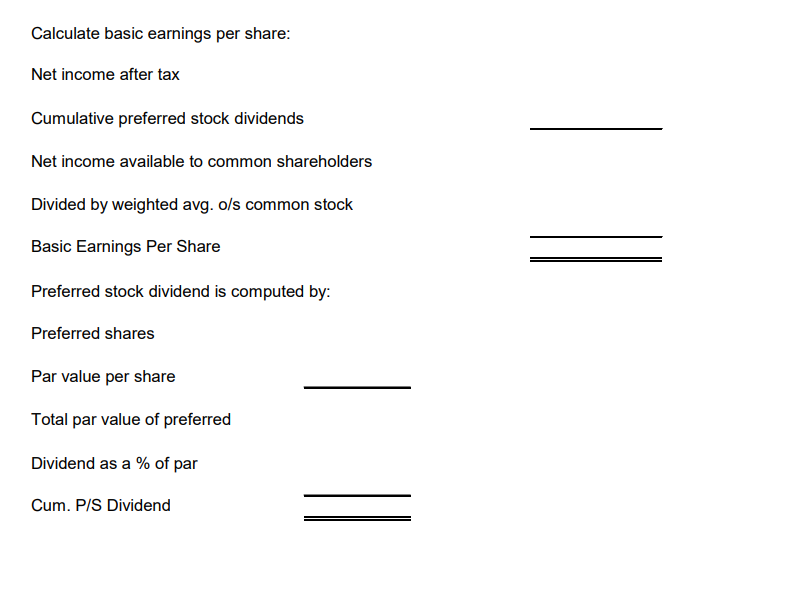
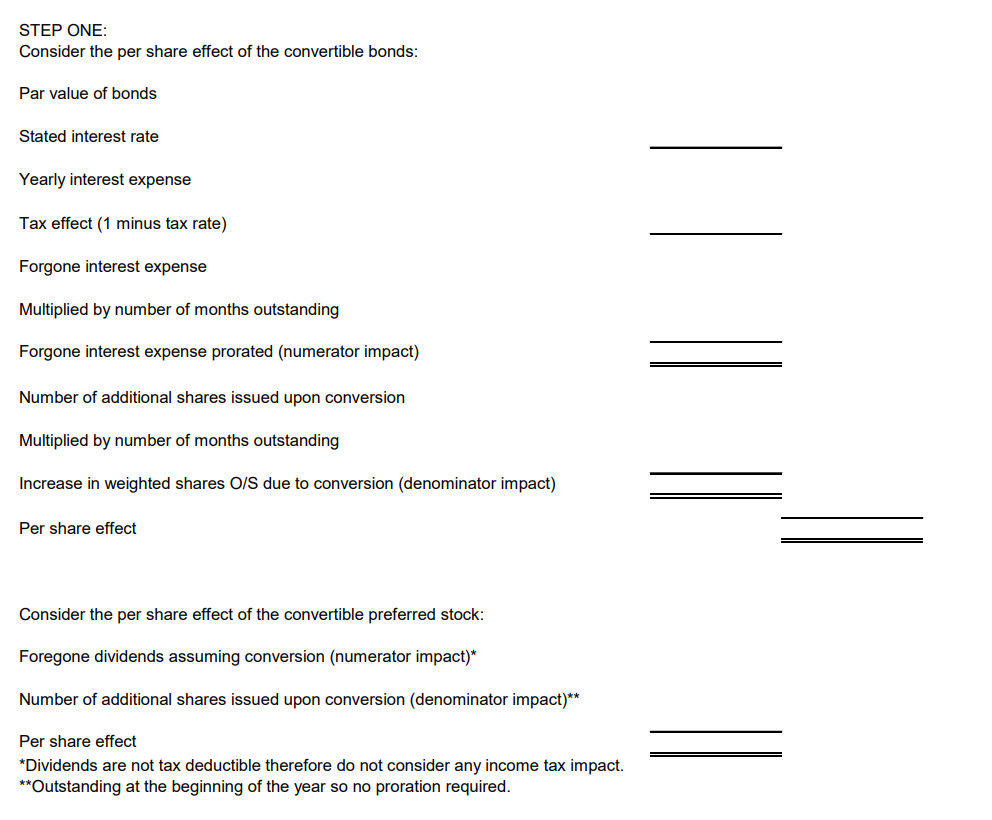
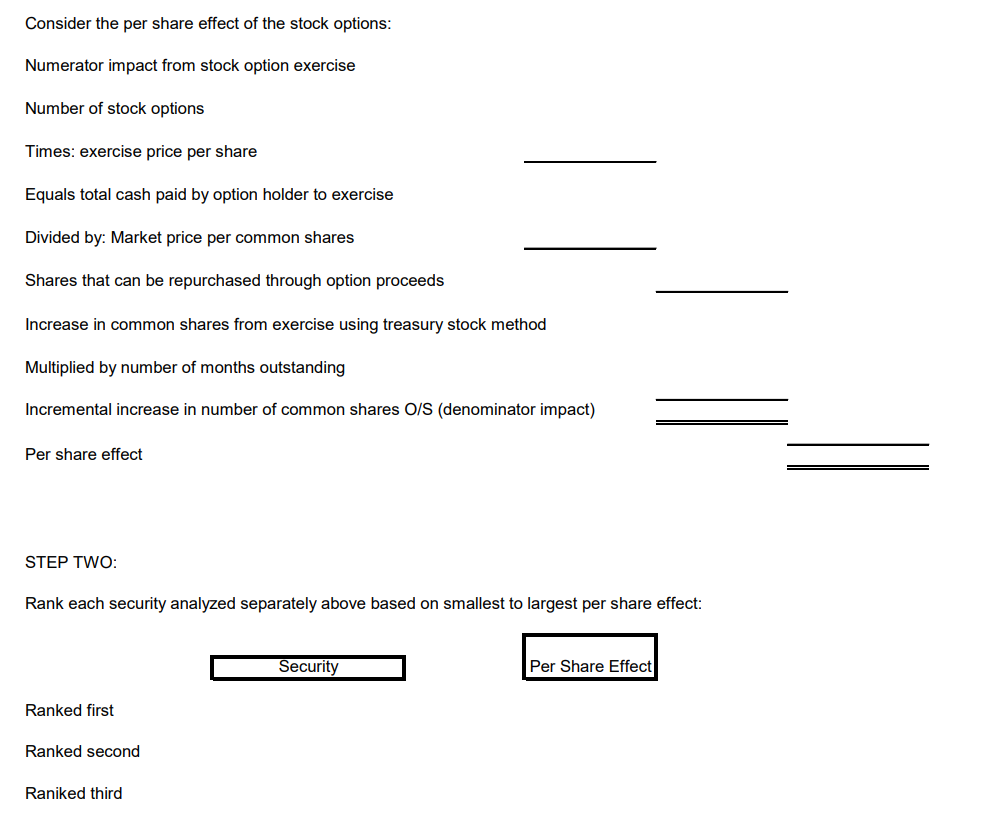
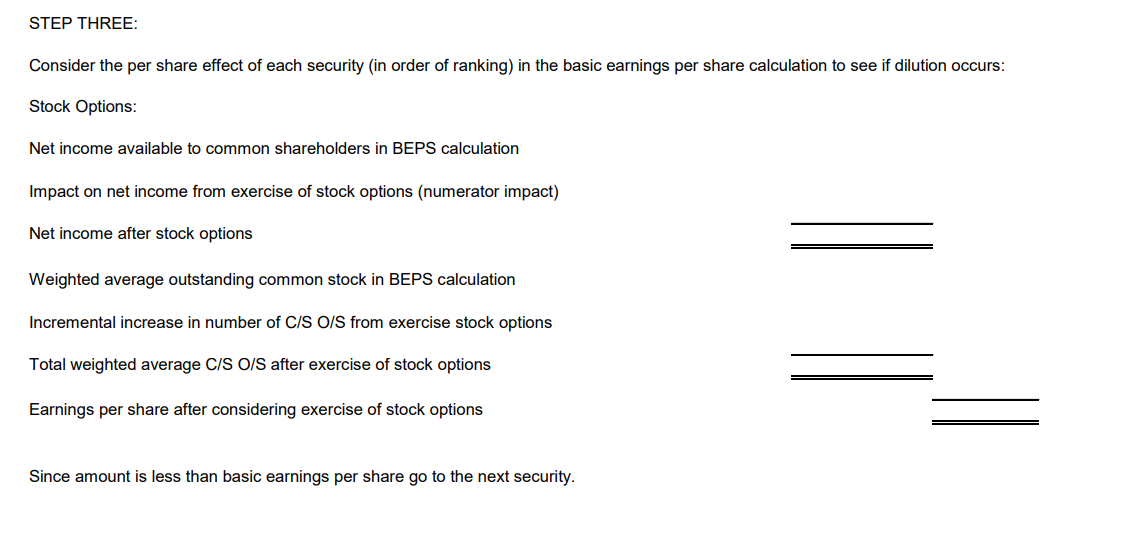
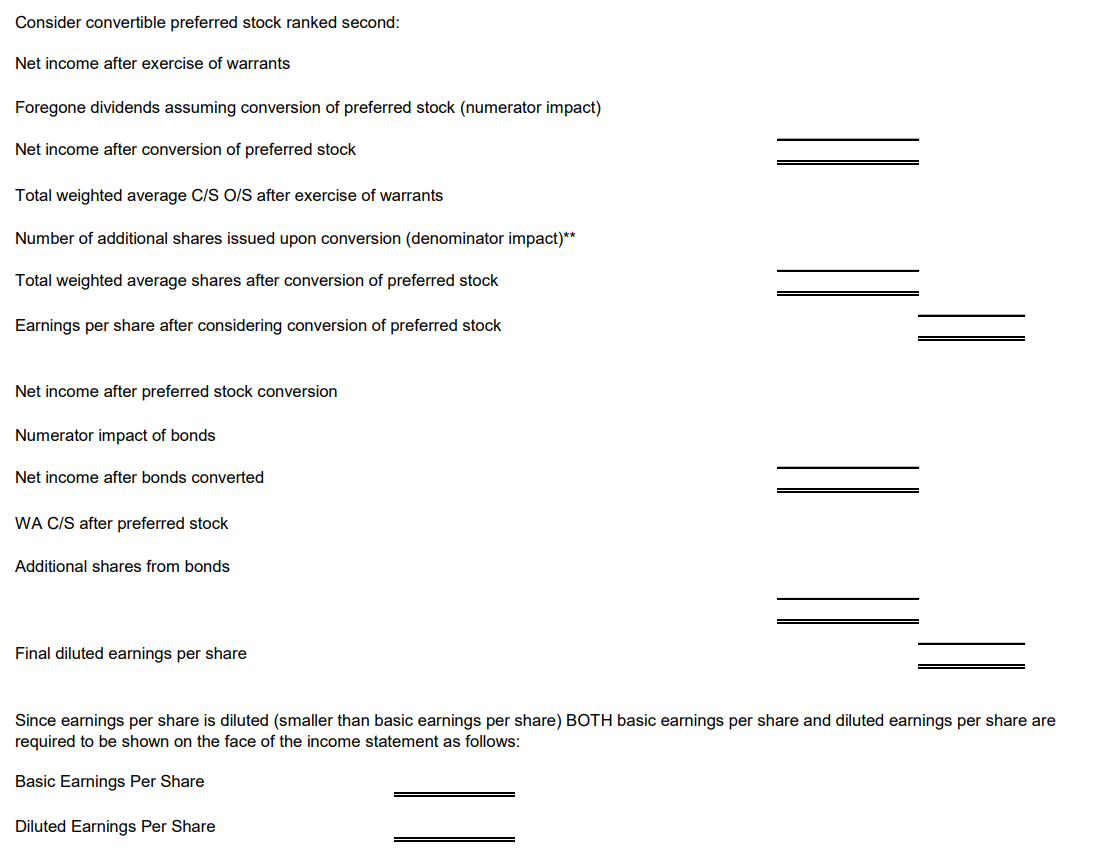
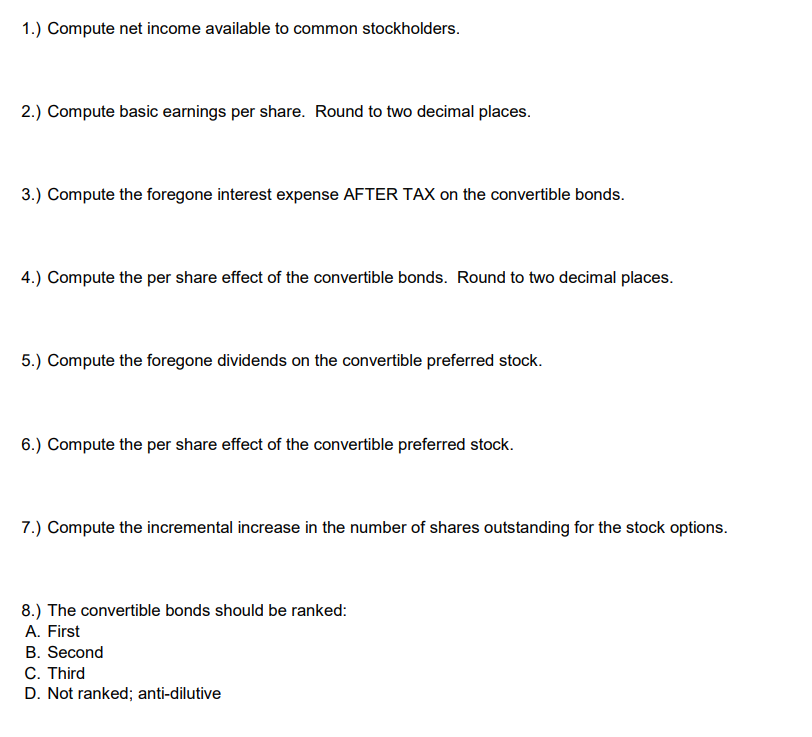
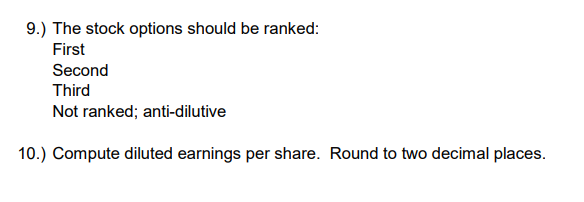
COMPUTING DILUTED EARNINGS PER SHARE WITH MULTIPLE POTENTIAL COMMON SHARES Anderson Corporation Net income after tax and before conversion or exercise Weighted average common shares beginning of year before conversion or exercise \begin{tabular}{|rr|} \hline$2,048,751 \\ \hline 489,000 \\ \hline \end{tabular} Total par value convertible bonds Stated \& market interest rate on bonds The total number of common shares that the bonds are convertible into \begin{tabular}{|r|} \hline$3,000,000 \\ \hline 3.50% \\ \hline 37,000 \\ \hline \end{tabular} Issued March 1 of the current year Total shares of cumulative preferred stock Par value per preferred share Dividend rate as a % par value The total number of common shares that the preferred stock is convertible into Outstanding as of the beginning of the year Total stock options available to be exercised Exercise price of warrants Market price of common shares \begin{tabular}{|lr|} \hline & 75,000 \\ \hline$ & 98.00 \\ \hline$ & 102.00 \\ \hline \end{tabular} Issued October 1 of the current year Tax rate 20% Calculate basic earnings per share: Net income after tax Cumulative preferred stock dividends Net income available to common shareholders Divided by weighted avg. o/s common stock Basic Earnings Per Share Preferred stock dividend is computed by: Preferred shares Par value per share Total par value of preferred Dividend as a \% of par Cum. P/S Dividend STEP ONE: Consider the per share effect of the convertible bonds: Par value of bonds Stated interest rate Yearly interest expense Tax effect ( 1 minus tax rate) Forgone interest expense Multiplied by number of months outstanding Forgone interest expense prorated (numerator impact) Number of additional shares issued upon conversion Multiplied by number of months outstanding Increase in weighted shares O/S due to conversion (denominator impact) Per share effect Consider the per share effect of the convertible preferred stock: Foregone dividends assuming conversion (numerator impact) Number of additional shares issued upon conversion (denominator impact) Per share effect *Dividends are not tax deductible therefore do not consider any income tax impact. Outstanding at the beginning of the year so no proration required. Consider the per share effect of the stock options: Numerator impact from stock option exercise Number of stock options Times: exercise price per share Equals total cash paid by option holder to exercise Divided by: Market price per common shares Shares that can be repurchased through option proceeds Increase in common shares from exercise using treasury stock method Multiplied by number of months outstanding Incremental increase in number of common shares O/S (denominator impact) Per share effect STEP TWO: Rank each security analyzed separately above based on smallest to largest per share effect: Security Per Share Effect Ranked first Ranked second Raniked third STEP THREE: Consider the per share effect of each security (in order of ranking) in the basic earnings per share calculation to see if dilution occurs: Stock Options: Net income available to common shareholders in BEPS calculation Impact on net income from exercise of stock options (numerator impact) Net income after stock options Weighted average outstanding common stock in BEPS calculation Incremental increase in number of C/SO/S from exercise stock options Total weighted average C/S O/S after exercise of stock options Earnings per share after considering exercise of stock options Since amount is less than basic earnings per share go to the next security. viluted tarnings rer snare 1.) Compute net income available to common stockholders. 2.) Compute basic earnings per share. Round to two decimal places. 3.) Compute the foregone interest expense AFTER TAX on the convertible bonds. 4.) Compute the per share effect of the convertible bonds. Round to two decimal places. 5.) Compute the foregone dividends on the convertible preferred stock. 6.) Compute the per share effect of the convertible preferred stock. 7.) Compute the incremental increase in the number of shares outstanding for the stock options. 8.) The convertible bonds should be ranked: A. First B. Second C. Third D. Not ranked; anti-dilutive 9.) The stock options should be ranked: First Second Third Not ranked; anti-dilutive 10.) Compute diluted earnings per share. Round to two decimal places
Step by Step Solution
There are 3 Steps involved in it

Get step-by-step solutions from verified subject matter experts