







Question: Use the following table as an example for the next question: Remainder Iteration 0 1 2 Step Initial values 1: Rem = Rem - DV
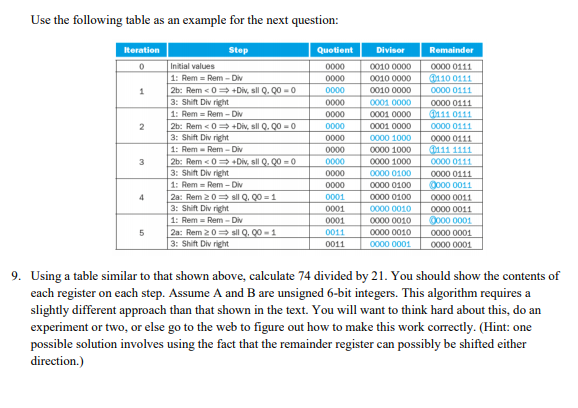
Use the following table as an example for the next question: Remainder Iteration 0 1 2 Step Initial values 1: Rem = Rem - DV 2b: Rem Div, sll 9.00 - 0 3: Shift Div right 1: Rem Rem - DV 2b: Rem Div. sll 0.00 = 0 3: Shift Div right 1: Rem Rem-Div 2a: Rem 20sIl Q.00 = 1 3: Shift Div right 1: Rem = Rem - DV 2a: Rem 20 il 9.00 - 1 3: Shift Div right Quotient 0000 0000 0000 0000 0000 0000 0000 0000 0000 0000 0000 0001 0001 0001 0011 0011 Divisor 0010 0000 0010 0000 0010 0000 0001 0000 0001 0000 0001 0000 0000 1000 0000 1000 0000 1000 0000 0100 0000 0100 0000 0100 0000 0010 0000 0010 0000 0010 0000 0001 0000 0111 1110 0111 0000 0111 0000 0111 0111 0111 0000 0111 0000 0111 111 1111 0000 0111 0000 0111 0000 0011 0000 0011 0000 0011 0000 0001 0000 0001 0000 0001 4 5 9. Using a table similar to that shown above, calculate 74 divided by 21. You should show the contents of each register on each step. Assume A and B are unsigned 6-bit integers. This algorithm requires a slightly different approach than that shown in the text. You will want to think hard about this, do an experiment or two, or else go to the web to figure out how to make this work correctly. (Hint: one possible solution involves using the fact that the remainder register can possibly be shifted either direction.)
Step by Step Solution
There are 3 Steps involved in it

Get step-by-step solutions from verified subject matter experts
 Study Help