







Question: Use the information below to answer the two questions that follow. A local company uses job-order costing and manufactures its products in two departments:
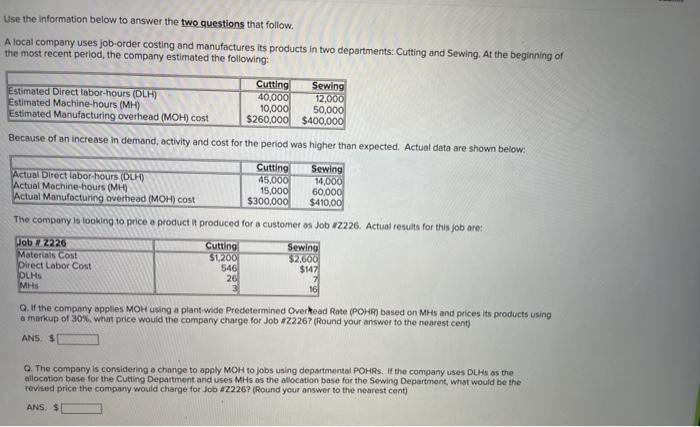
Use the information below to answer the two questions that follow. A local company uses job-order costing and manufactures its products in two departments: Cutting and Sewing. At the beginning of the most recent period, the company estimated the following: Estimated Direct labor-hours (DLH) Estimated Machine-hours (MH) Estimated Manufacturing overhead (MOH) cost Cutting 40,000 Sewing 12,000 10,000 $260,000 50,000 $400,000 Because of an increase in demand, activity and cost for the period was higher than expected. Actual data are shown below: Actual Direct labor-hours (DLH) Actual Machine-hours (MH) Actual Manufacturing overhead (MOH) cost) Cutting Sewing 45,000 14,000 15,000 60,000 $300,000 $410,00 The company is looking to price a product it produced for a customer as Job #2226. Actual results for this job are: 1 Job #2226 Materials Cost Direct Labor Cost OLHS MHs Cutting $1,200 Sewing $2,600 546 26 $147 7 16 Q. If the company applies MOH using a plant-wide Predetermined Overhead Rate (POHR) based on MHs and prices its products using a markup of 30%, what price would the company charge for Job #22267 (Round your answer to the nearest cent) ANS. $[ Q. The company is considering a change to apply MOH to jobs using departmental POHRS. If the company uses DLHs as the allocation base for the Cutting Department and uses MHs as the allocation base for the Sewing Department, what would be the revised price the company would charge for Job #2226? (Round your answer to the nearest cent) ANS. $
Step by Step Solution
There are 3 Steps involved in it

Get step-by-step solutions from verified subject matter experts
 Study Help