







Question: Use the Laplace transform to solve the following initial value problem: y + 25y = 86(t - 9) y(0) = 0, y'(0) =0 y(t) =
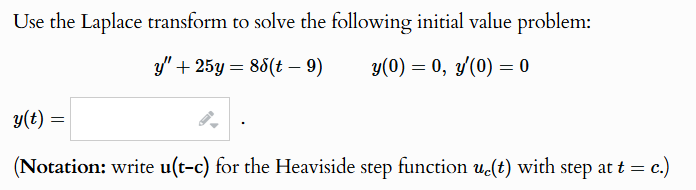
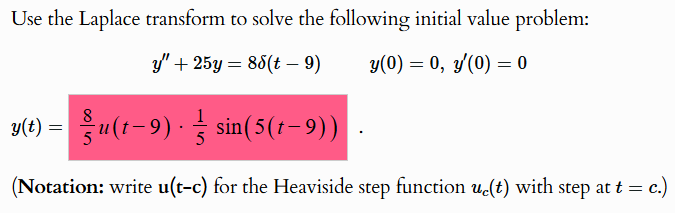
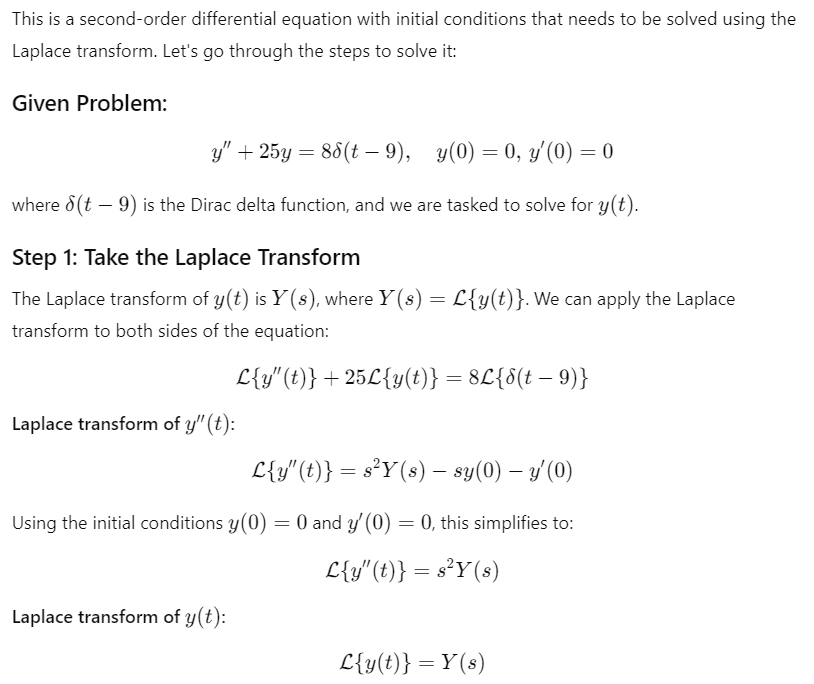
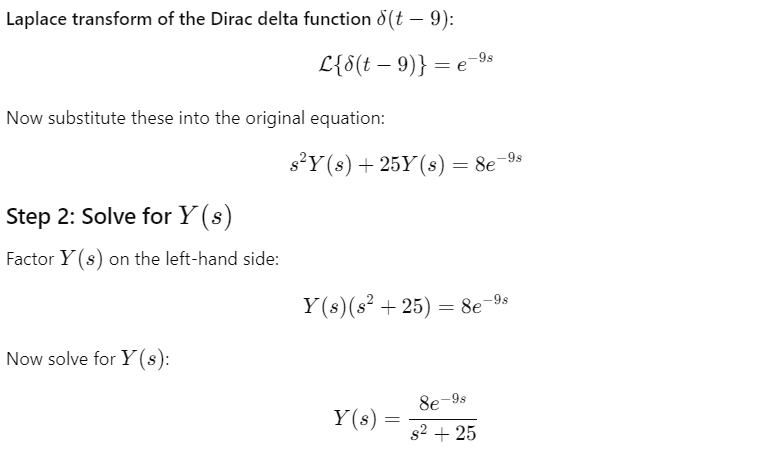
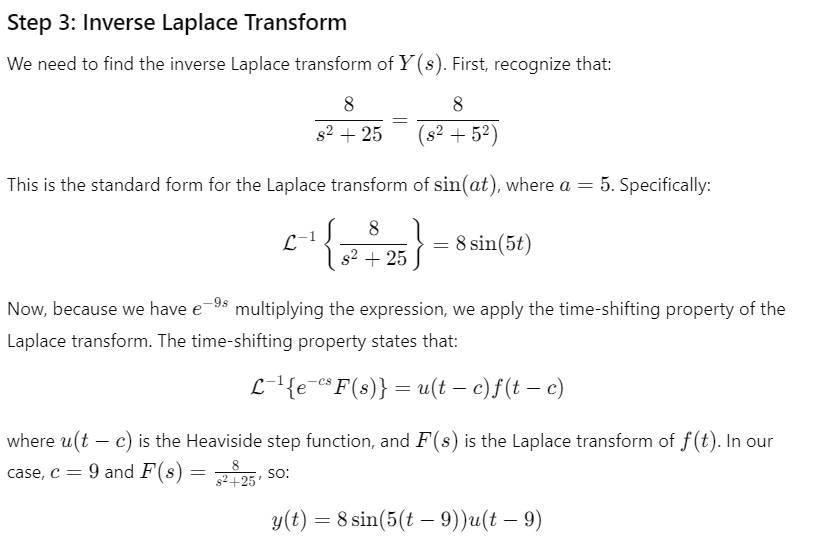

Use the Laplace transform to solve the following initial value problem: y" + 25y = 86(t - 9) y(0) = 0, y'(0) =0 y(t) = Notation: write u(t-c) for the Heaviside step function ue(t) with step at t = c.)Use the Laplace transform to solve the following initial value problem: y" + 25y = 86(t - 9) y(0) = 0, y'(0) =0 y( t) = 1 (1- 9) . - sin ( 5(t-9) ) (Notation: write u(t-c) for the Heaviside step function uc(t) with step at t = c.)This is a second-order differential equation with initial conditions that needs to be solved using the Laplace transform. Let's go through the steps to solve it: Given Problem: y" + 25y = 86(t -9), y(0) = 0, y'(0) = 0 where o(t - 9) is the Dirac delta function, and we are tasked to solve for y (t). Step 1: Take the Laplace Transform The Laplace transform of y(t) is Y(s), where Y(s) = Cty(t) }. We can apply the Laplace transform to both sides of the equation: Cly"(t) } + 25Cty(t)} = 8218(t-9)} Laplace transform of y" (t): Lly"(t) } = s?Y(s) - sy(0) - y'(0) Using the initial conditions y(0) = 0 and y' (0) = 0, this simplifies to: Ly"(t) } = s' Y(s) Laplace transform of y (t): Lly(t) } = Y(s)Laplace transform of the Dirac delta function o (t - 9): C{o(t - 9) } = e-98 Now substitute these into the original equation: s' Y (s) + 25Y (s) = 8e-9 Step 2: Solve for Y (s) Factor Y (s) on the left-hand side: Y(s) (82 + 25) = 8e-98 Now solve for Y (s): 8e-9s Y(s) 82 + 25Step 3: Inverse Laplace Transform We need to find the inverse Laplace transform of Y (s). First, recognize that: 8 8 $2 + 25 (82 + 52) This is the standard form for the Laplace transform of sin(at), where a = 5. Specifically: 8 $2 + 25 = 8 sin(5t) Now, because we have e multiplying the expression, we apply the time-shifting property of the Laplace transform. The time-shifting property states that: C-1{e-"F(s) } = u(t - c)f(t - c) where u(t - c) is the Heaviside step function, and F(s) is the Laplace transform of f (t). In our case, c = 9 and F(s) = $2425, 50. y(t) = 8 sin(5(t - 9))u(t - 9)Final Answer: y(t) = 8sin(5(t 9))u(t 9) This is the solution to the initial value problem. The Heaviside function u(f 9) ensures that the sine function only starts at = 9
Step by Step Solution
There are 3 Steps involved in it

Get step-by-step solutions from verified subject matter experts
 Study Help