





Question: Use the Policy Cycle method by James E. Anderson, in his Public Policy-Making (1974) to outlines a policy framework for the following issue. The changes
Use the "Policy Cycle" method by James E. Anderson, in his Public Policy-Making (1974) to outlines a policy framework for the following issue.
The changes that occur with aging can lead to problems with a persons ability to move around, or mobility. Mobility problems may be unsteadiness while walking, difficulty getting in and out of a chair, or falls. Muscle weakness, joint problems, pain, disease, and neurological (brain and nervous system) difficulties-common conditions in older people-can all contribute to mobility problems. Sometimes several mild problems occur at one time and combine to seriously affect mobility.
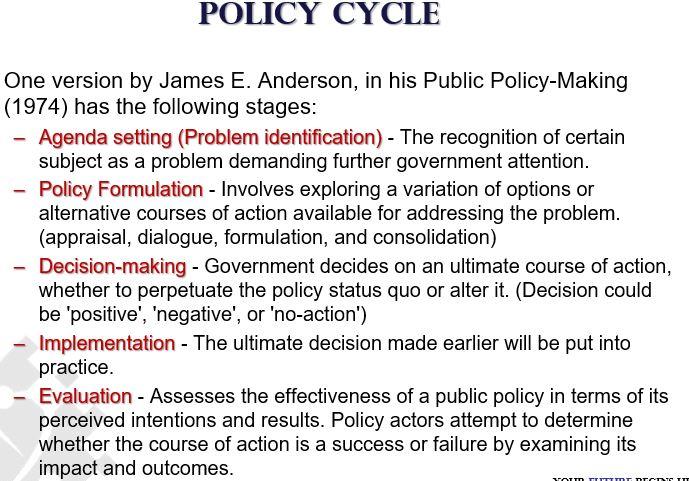
POLICY CYCLE One version by James E. Anderson, in his Public Policy-Making (1974) has the following stages: - Agenda setting (Problem identification) - The recognition of certain subject as a problem demanding further government attention. Policy Formulation - Involves exploring a variation of options or alternative courses of action available for addressing the problem. (appraisal, dialogue, formulation, and consolidation) Decision-making - Government decides on an ultimate course of action, whether to perpetuate the policy status quo or alter it. (Decision could be 'positive', 'negative', or 'no-action') Implementation - The ultimate decision made earlier will be put into practice. Evaluation - Assesses the effectiveness of a public policy in terms of its perceived intentions and results. Policy actors attempt to determine whether the course of action is a success or failure by examining its impact and outcomes. POLICY CYCLE One version by James E. Anderson, in his Public Policy-Making (1974) has the following stages: - Agenda setting (Problem identification) - The recognition of certain subject as a problem demanding further government attention. Policy Formulation - Involves exploring a variation of options or alternative courses of action available for addressing the problem. (appraisal, dialogue, formulation, and consolidation) Decision-making - Government decides on an ultimate course of action, whether to perpetuate the policy status quo or alter it. (Decision could be 'positive', 'negative', or 'no-action') Implementation - The ultimate decision made earlier will be put into practice. Evaluation - Assesses the effectiveness of a public policy in terms of its perceived intentions and results. Policy actors attempt to determine whether the course of action is a success or failure by examining its impact and outcomes.

