







Question: Use the reading to answer the questions. Please answer all it does not go against cheggs policy because all the questions relate to eachother 1.
"automated manager" is as a managerial control system for Uber drivers? Please explain.
2. What are the benefits to Uber of using technology-mediated control through its mobile app? What are the downsides?
3. What impact, if any, do you think Uber's use of technology-mediated control has on its organizational culture?
4. Do you think the Uber digital business model is a sustainable one? Please provide a rationale for your response
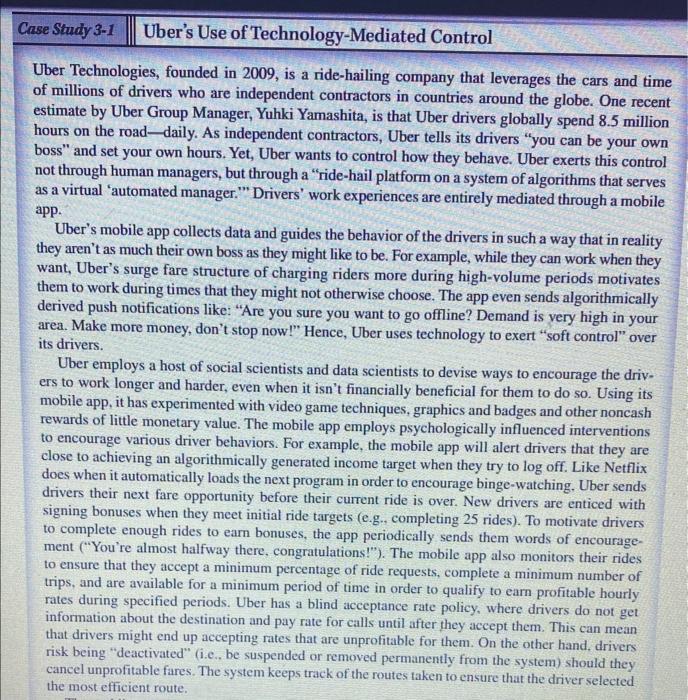
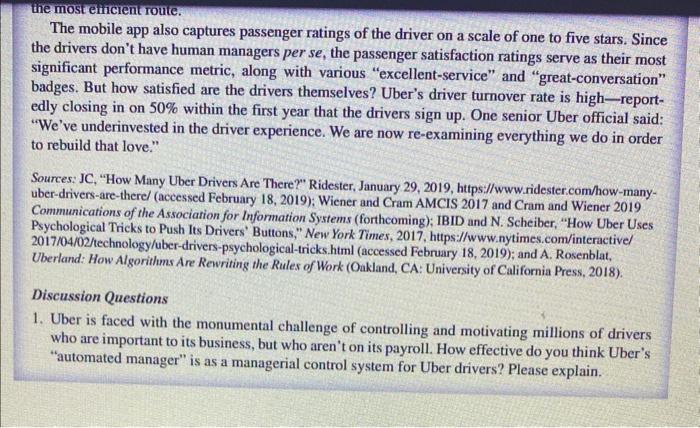
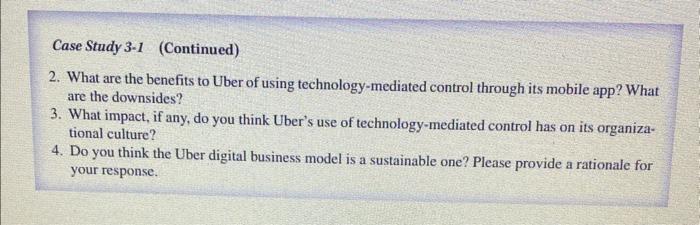
Uber Technologies, founded in 2009 , is a ride-hailing company that leverages the cars and time of millions of drivers who are independent contractors in countries around the globe. One recent estimate by Uber Group Manager, Yuhki Yamashita, is that Uber drivers globally spend 8.5 million hours on the road-daily. As independent contractors, Uber tells its drivers "you can be your own boss" and set your own hours. Yet, Uber wants to control how they behave. Uber exerts this control not through human managers, but through a "ride-hail platform on a system of algorithms that serves as a virtual 'automated manager." Drivers' work experiences are entirely mediated through a mobile app. Uber's mobile app collects data and guides the behavior of the drivers in such a way that in reality they aren't as much their own boss as they might like to be. For example, while they can work when they want, Uber's surge fare structure of charging riders more during high-volume periods motivates them to work during times that they might not otherwise choose. The app even sends algorithmically derived push notifications like: "Are you sure you want to go offline? Demand is very high in your area. Make more money, don't stop now!" Hence, Uber uses technology to exert "soft control" over its drivers. Uber employs a host of social scientists and data scientists to devise ways to encourage the drivers to work longer and harder, even when it isn't financially beneficial for them to do so. Using its mobile app, it has experimented with video game techniques, graphics and badges and other noncash rewards of little monetary value. The mobile app employs psychologically influenced interventions to encourage various driver behaviors. For example, the mobile app will alert drivers that they are close to achieving an algorithmically generated income target when they try to log off. Like Netflix does when it automatically loads the next program in order to encourage binge-watching, Uber sends drivers their next fare opportunity before their current ride is over. New drivers are enticed with signing bonuses when they meet initial ride targets (e.g., completing 25 rides). To motivate drivers to complete enough rides to earn bonuses, the app periodically sends them words of encouragement ("You're almost halfway there, congratulations!"). The mobile app also monitors their rides to ensure that they accept a minimum percentage of ride requests, complete a minimum number of trips, and are available for a minimum period of time in order to qualify to earn profitable hourly rates during specified periods. Uber has a blind acceptance rate policy, where drivers do not get information about the destination and pay rate for calls until after they accept them. This can mean that drivers might end up accepting rates that are unprofitable for them. On the other hand, drivers risk being "deactivated" (i.e., be suspended or removed permanently from the system) should they cancel unprofitable fares. The system keeps track of the routes taken to ensure that the driver selected the most efficient route. The mobile app also captures passenger ratings of the driver on a scale of one to five stars. Since the drivers don't have human managers per se, the passenger satisfaction ratings serve as their most significant performance metric, along with various "excellent-service" and "great-conversation" badges. But how satisfied are the drivers themselves? Uber's driver turnover rate is high-reportedly closing in on 50% within the first year that the drivers sign up. One senior Uber official said: "We've underinvested in the driver experience. We are now re-examining everything we do in order to rebuild that love." Sources: JC, "How Many Uber Drivers Are There?" Ridester, January 29, 2019, https://www.ridester.com/how-manyuber-drivers-are-there/ (accessed February 18, 2019); Wiener and Cram AMCIS 2017 and Cram and Wiener 2019 Communications of the Association for Information Systems (forthcoming); IBID and N. Scheiber, "How Uber Uses Psychological Tricks to Push Its Drivers' Buttons," New York Times, 2017, https://www.nytimes.com/interactivel 2017/04/02/technology/uber-drivers-psychological-tricks.html (accessed February 18, 2019); and A. Rosenblat, Uberland: How Algorithms Are Rewriting the Rules of Work (Oakland, CA: University of California Press, 2018). Discussion Questions 1. Uber is faced with the monumental challenge of controlling and motivating millions of drivers who are important to its business, but who aren't on its payroll. How effective do you think Uber's "automated manager" is as a managerial control system for Uber drivers? Please explain. Case Study 3-1 (Continued) 2. What are the benefits to Uber of using technology-mediated control through its mobile app? What are the downsides? 3. What impact, if any, do you think Uber's use of technology-mediated control has on its organizational culture? 4. Do you think the Uber digital business model is a sustainable one? Please provide a rationale for your response
Step by Step Solution
There are 3 Steps involved in it

Get step-by-step solutions from verified subject matter experts
 Study Help