



Question: Use the reference sheet Templates for Time Value of Money to create in excel a well-labeled amortization schedules for the scenarios discussed below and prepare
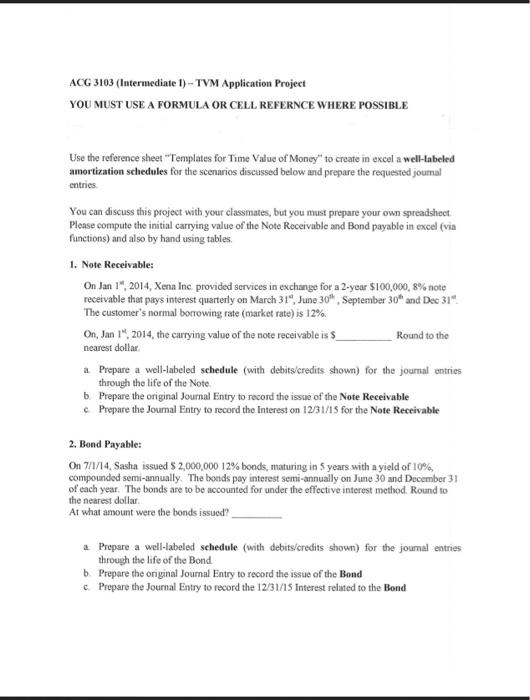
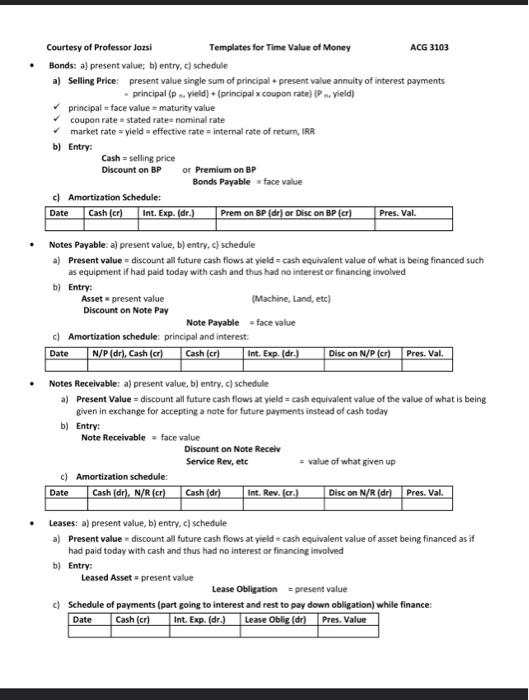
Use the reference sheet "Templates for Time Value of Money" to create in excel a well-labeled amortization schedules for the scenarios discussed below and prepare the requested joumal entries. You can discuss this project with your classmates, but you must prepare your own spreadshect Please compute the initial carrying value of the Note Receivable and Bond payable in excel (via functions) and also by hand using tables. 1. Note Receivable: On Jan 1,2014, Xena Inc provided services in exchange for a 2 -year $100,000,8% note receivable that pays interest quarterly on March 314, June 30t, September 30th and Dec 31e. The customer's normal borrowing rate (market rate) is 12%. On, Jan 1n,2014, the carrying value of the note receivable is $ Round to the nearest dollar: a. Prepare a well-labeled schedule (with debits/credits shown) for the journal entries through the life of the Note. b. Prepare the original Journal Entry to record the issue of the Note Receivable c. Propare the Joumal Entry to record the Interest on 12/31/15 for the Note Receivable 2. Bond Payable: On 7/1/14, Sasha issued $2,000,00012% bonds, maturing in $ years with a yield of 10%, compoundod semi-annually. The bocds pay interest semi-annually on June 30 and December 31 of each year. The bonds are to be accounted for under the effective interest method. Round to the nearest dollar. At what amount were the bonds issued? a. Prepare a well-labeled schedule (with debits/credits shown) for the journal entries through the life of the Bond. b. Prepare the original Joumal Entry to record the issue of the Bond c. Prepare the Journal Entry to record the 12/31/15 Interest reluted to the Bond Courtesy of Professor Jozsi Templates for Time Value of Money ACG 3103 - Bonds: a) present value; b) entry, c) schedule a) Selling Price: present value single sum of principal + present value annuity of interest payments -principal(pn.yield)+(principalxcouponrate)(pn.vield) principal = face value = maturity value coupon rate = stated rate = nominal rate market rate = yield = effective rate = internal rate of return, 1RR b) Entry: Cash = selling price Discount on BP or Premium on BP Bonds Payable * face value c) Amortization Schedule: \begin{tabular}{|l|l|l|l|l|} \hline Date & Cash (cr) & Int. Exp. (dr.) & Prem on B.P (dr) or Disc on BP (cr) & Pres. Val. \\ \hline & & & & \\ \hline \end{tabular} - Notes Payable: a) present value, bj entry, cj schedule a) Present value = discount all future cash flows at yield = cash equivalent value of what is being financed such as equipment if had paid today with cash and thus had no interest or financing irvolved b) Entry: Asset = present value (Machine, land, etc) Discount on Note Pay Note Payable = face value c) Amortization schedule: principal and interest: [ - Notes Receivable: a) present value, b) entry, c) schedule a) Present Value = discount all future cash flows at yild = cash equivalent value of the value of what is being given in exchange for accepting a note for future purments instead of cash today b) Entry: Note Receivable = face value Discount on Note Receiv Service Rev, etc = value of what given up c) Amortization schedule: - Leases: a) present value, b) entry, cl schedule a) Present value = discount all future cash flows at yield = cash equivalent value of asset being financed as if had paid today with cash and thus had no interest or financing imvolved b) Entry: Leased Asset = present value Lease Obligation = present value c) Schedule of payments (part going to interest and rest to pay down obligation) while finance
Step by Step Solution
There are 3 Steps involved in it

Get step-by-step solutions from verified subject matter experts