







Question: use tinkercad to solve the problem i need tk see the display Apply what you have learned in Lab #1 and expand it to a
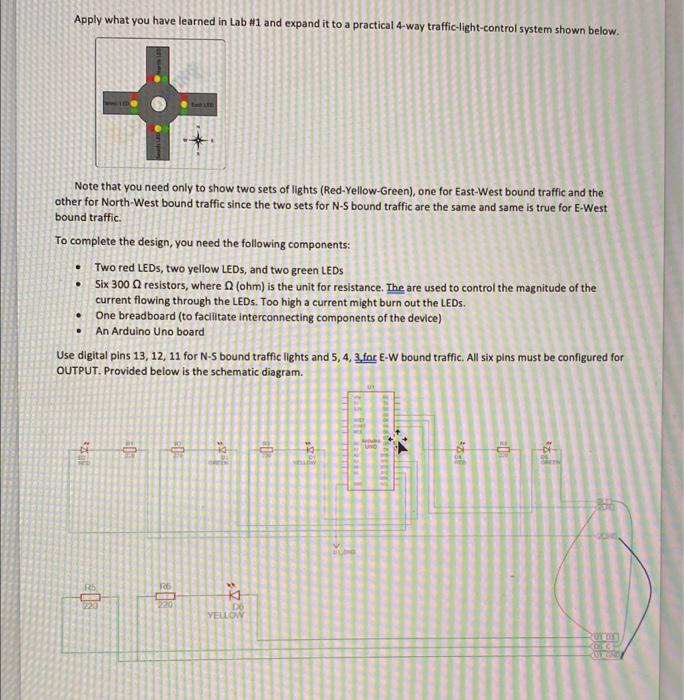
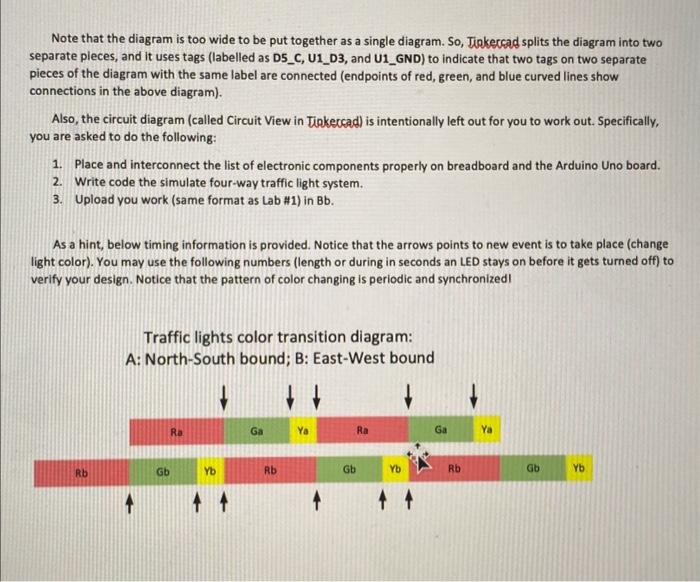
Apply what you have learned in Lab #1 and expand it to a practical 4-way traffic-light-control system shown below. Note that you need only to show two sets of lights (Red-Yellow-Green), one for East-West bound traffic and the other for North-West bound traffic since the two sets for N-S bound traffic are the same and same is true for E-West bound traffic. To complete the design, you need the following components: - Two red LEDs, two yellow LEDs, and two green LEDs - Six 300 resistors, where (ohm) is the unit for resistance. The are used to control the magnitude of the current flowing through the LEDs. Too high a current might burn out the LEDs. - One breadboard (to facilitate interconnecting components of the device) - An Arduino Uno board Use digital pins 13, 12, 11 for N-S bound traffic lights and 5,4,3 for E-W bound traffic. All six pins must be configured for OUTPUT. Provided below is the schematic diagram. Note that the diagram is too wide to be put together as a single diagram. So, Jipkercad splits the diagram into two separate pleces, and it uses tags (labelled as D5_C, U1_D3, and U1_GND) to indicate that two tags on two separate pieces of the diagram with the same label are connected (endpoints of red, green, and blue curved lines show connections in the above diagram). Also, the circuit diagram (called Circuit View in Tipkercad) is intentionally left out for you to work out. Specifically, you are asked to do the following: 1. Place and interconnect the list of electronic components properly on breadboard and the Arduino Uno board. 2. Write code the simulate four-way traffic light system. 3. Upload you work (same format as Lab H1) in Bb. As a hint, below timing information is provided. Notice that the arrows points to new event is to take place (change light color). You may use the following numbers (length or during in seconds an LED stays on before it gets turned off) to verify your design. Notice that the pattern of color changing is periodic and synchronized Traffic lights color transition diagram: A: North-South bound; B: East-West bound
Step by Step Solution
There are 3 Steps involved in it

Get step-by-step solutions from verified subject matter experts
 Study Help