







Question: using c++ In this program, you will write two functions: 1. INFIX TO POSTFIX -converts infix expression to postfix using stack and queue 2. EVALUATE
using c++
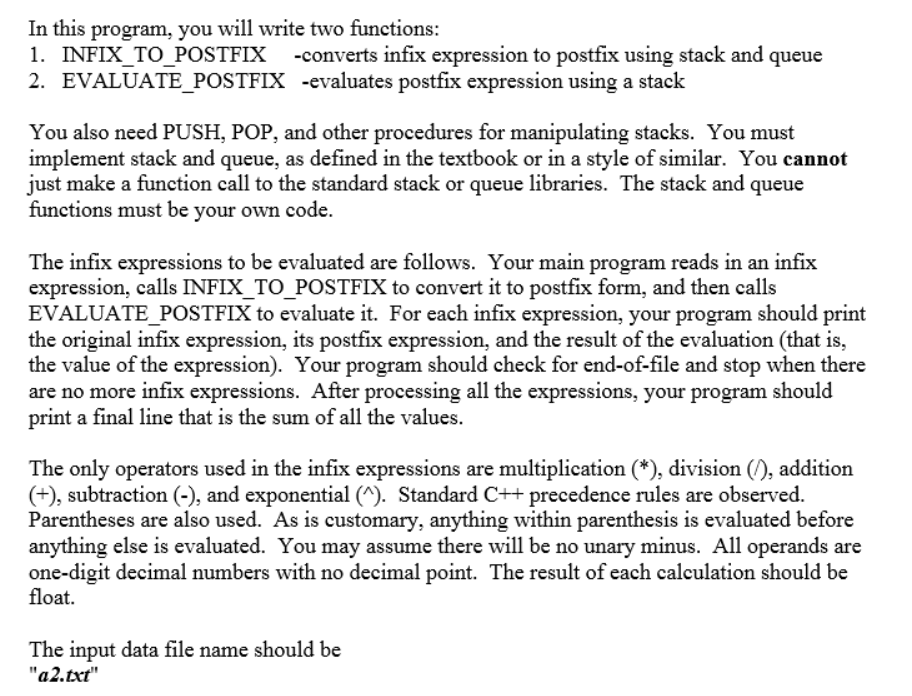
In this program, you will write two functions: 1. INFIX TO POSTFIX -converts infix expression to postfix using stack and queue 2. EVALUATE POSTFIX -evaluates postfix expression using a stack You also need PUSH, POP, and other procedures for manipulating stacks. You must implement stack and queue, as defined in the textbook or in a style of similar. You cannot just make a function call to the standard stack or queue libraries. The stack and queue functions must be vour own code. The infix expressions to be evaluated are follows. Your main program reads in an infix expression, calls INFIX_TO_POSTFIX to convert it to postfix form, and then calls EVALUATE_POSTFIX to evaluate it. For each infix expression, your program should print the original infix expression, its postfix expression, and the result of the evaluation (that is, the value of the expression). Your program should check for end-of-file and stop when there are no more infix expressions. After am should print a final line that is the sum of all the values. processing all the expressions, your progr The only operators used in the infix expressions are multiplication (*), division (), addition (+), subtraction (-), and exponential (^). Standard C++ precedence rules are observed. Parentheses are also used. As is customary, anything within parenthesis is evaluated before anythin All operands are one-digit decimal numbers with no decimal point. The result of each calculation should be float g else is evaluated. You may assume there will be no unary minus. The input data file name should be "a2.txt In this program, you will write two functions: 1. INFIX TO POSTFIX -converts infix expression to postfix using stack and queue 2. EVALUATE POSTFIX -evaluates postfix expression using a stack You also need PUSH, POP, and other procedures for manipulating stacks. You must implement stack and queue, as defined in the textbook or in a style of similar. You cannot just make a function call to the standard stack or queue libraries. The stack and queue functions must be vour own code. The infix expressions to be evaluated are follows. Your main program reads in an infix expression, calls INFIX_TO_POSTFIX to convert it to postfix form, and then calls EVALUATE_POSTFIX to evaluate it. For each infix expression, your program should print the original infix expression, its postfix expression, and the result of the evaluation (that is, the value of the expression). Your program should check for end-of-file and stop when there are no more infix expressions. After am should print a final line that is the sum of all the values. processing all the expressions, your progr The only operators used in the infix expressions are multiplication (*), division (), addition (+), subtraction (-), and exponential (^). Standard C++ precedence rules are observed. Parentheses are also used. As is customary, anything within parenthesis is evaluated before anythin All operands are one-digit decimal numbers with no decimal point. The result of each calculation should be float g else is evaluated. You may assume there will be no unary minus. The input data file name should be "a2.txt
Step by Step Solution
There are 3 Steps involved in it

Get step-by-step solutions from verified subject matter experts
 Study Help