







Question: using chapter 9 text as a base for your answer, discuss how interactive media have become responsive and customized to users through the notions of
using chapter 9 text as a base for your answer, discuss how interactive media have become responsive and customized to users through the notions of customisation and algorithmic culture, 500 words use two recent examples based on your own use of Facebook, twitter or YT 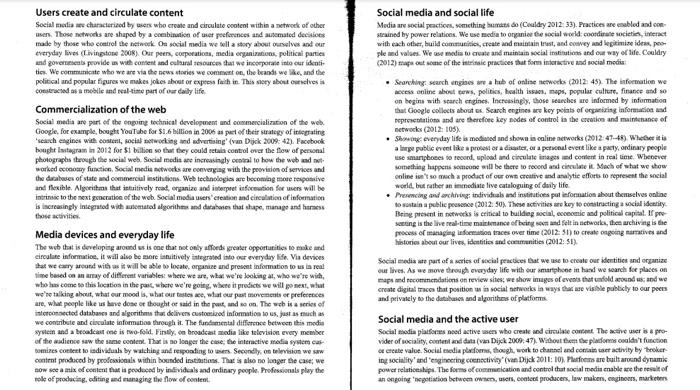
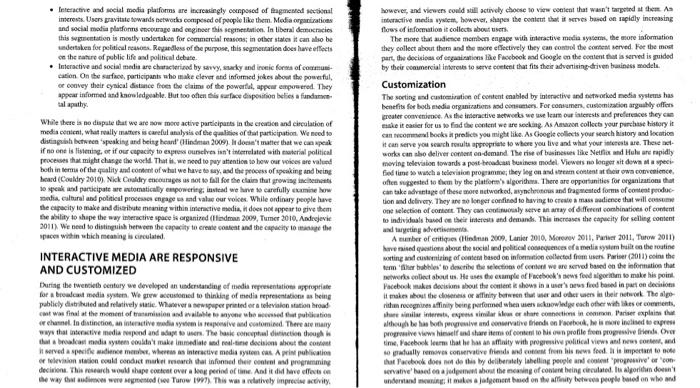
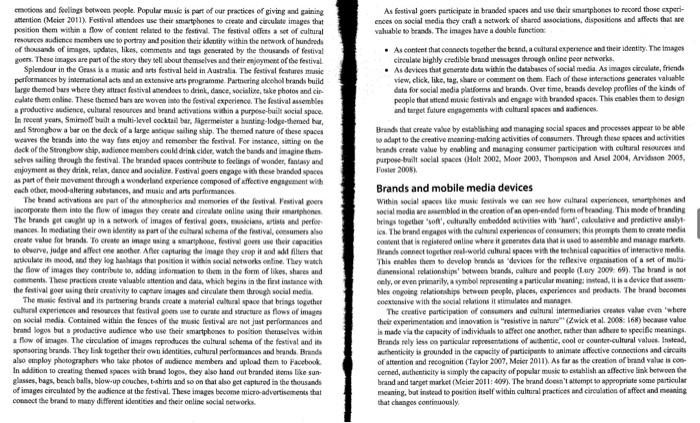
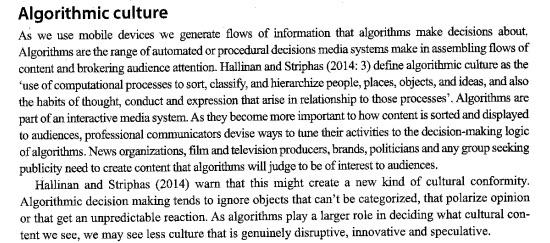
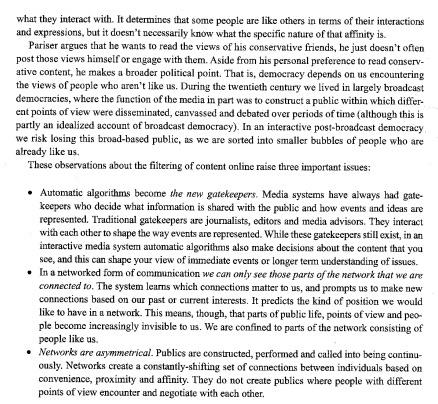
Users create and circulate content Social media se characterized by users who create and circulate content within a network of other use. Those networks are shaped by a combination of we preferences and automated decisions made by those who control the network On social media we will a story about ourselves and our everyday lives Livingstone 2008). Our peers, corporation, media organizations, political parties and government provide us with content and cultural resources that we incorporate into our identi ties. We communicate who we are via the news stories we comment on the brands we like and the political and popular figures we makes jokes about or express futh in. This story about iclesias contacted as a mobile and time part of our daily life Commercialization of the web Social media report of the enging technical development and commercialization of the web Google, for example, bought YouTube for $1.6 billion in 2006 as part of their strategy of integrating "search engines with content, social networking and advertising (van Dijck 2009: 42). Facebook bought Instagram in 2012 for $1 billion so that they could retala control over the flow of personal photographs tough the social web. Social media are increasingly central to how the web and wat worked my function Social media works are converging with the provision of services and the databases of state and commercial institi Web technologies are becoming more responsive and flexible. Algorithms that intuitively road, organize and interpret information for users will be intrinsic to the next generation of the web. Social media users creation and circulation of information is increasingly integrated with a lot and does that shape, manage and homes those activities Media devices and everyday life The web host is developing around us is one that not only fonds greater opportunities to make and circulate informatice. It will also be more intuitively integrated into our everyday life Via devices that we carry around with as it will be able to locate, arganize and present information to us in real time based on an army of different variables where we are, what we're looking at, who were with who come to this location in the past, where we're going where it predicts we will we're talking about what our moods, but our tastes e, what our past movements or preferences are, what people like us have done of thought or said in the out, and so on. The wch is a series of interconnected databases and algorithm that delivers customized Information to us, just as much as we contribute and circulate information through it. The fundamental difference between this medin system and abroadcast is twofold. Finally, on broadcast media like television every member of the wadience saw the same content. That is no longer the case, the interactive media system ca bomires content to individush by watching and responding to wers. Secondly, on television we w content produced by professionals within bounded in this. That is also no longer the case we now see a mix of content that is produced by individuals and ordinary people. Professionals play the role of producing, editing and managing the flow of content Social media and social life Media are social praction mething mando (Couldry 2012 33). Practices are enabled and.com strained by power relations. We use media to organice social world coordinate societat with each other, build communities, create and maintain trust and convey and legitimize idees, por ple med values. We were to create and maintain social institutions and our way of life. Couldry (2012) out of the trial practices that for interactive and social media Searching search engine wahub of online news (2012: 45). The information we access online shows, politics, health in maps, popular culture, finance and so on begins with starch engines. Increasingly, those searches are Indormed by information that Google collects shouts Search engines are key points of organising Information und repractitions and are therefore key nodes of control in the creation and maintenance of netwocks (2012: 105 Se everyday life is medited and shown is caline networks (201247-48). Whether it is a herpe public event like a protest or a disaster, or a personal event like a party, ordinary people use smanphoses to rend upload and circulate images and content in real time. Whenever something happens won will be there to record and circulate it. Much of what we show online is so much a product of our own creative and analytie efforts to represent the social world, but rather an immediate live cataloguing of daily life Presencing and arch individuals and institutions pot information about themselves online to sustain a public pose (2012. 50. These activities are key to contacting a cisl identity Being present in networks is ceitical to building social, economic and political capital. If pre setting is the live real-time malance of being and felt in etworks, the chiving is die process of managing information traces over time (2012: 1) to create ongoing mamatives and Histories about our lives, identities and communities (2012: 51) Social media se part of a series of social practices that we use to create our identities and organize our lives. As we move through everyday life with our smartphone in hand we search to places on maps and recommendations on review sites, we show in ages of events that follows and we create digital traces that position in social stories in ways that we visible publicly to our peers and privately to the databases and algorithms of platforms Social media and the active user Social media platforms need active users who create and circulate content. The active user is pro- vider of sociality, contend data (Dick 2009.47) Without the deplados cuales function o create value. Social media platforms, though work to channel and contain aer activity by broker in sociality and engineering cenectivity (van Dijck 2011:10). Platforms are built around ayam power relationships. The form of communication and control that social media cnable use the result of an ongoing wiwin between we, users, content producers, lawmaken, engineers, marketers Interact and social media platforms are increasingly composed of Bagmented imterests. Users pravitate towards betwork composed of people like them. Modia organizations and social media platforms courage and cugineer this segmentation. In liberal democracies this mention is mostly undertaken for commercial reasons in other states it can also be undertaken for political Reedless of the purpose, this segmentation does have effects on the nature of public life and political care Interactive and social media are characterized by savvy, sky and cons of com cation on the surf, participants who make clever and informed jokes about the powerful convey their cynical distance from the claims of the powerful, appeur empowered. They appear informed and coledgeable. But too often the surface disposition des a fundam talapathy While there is no put that we are now more active participants in the creation and circulation of media content, what really matter is careful analysis of the qualities of that participation. We need to distinguish between posting and being heart line 2009). It doesn't matter that we can speak if no one is fing, if our capacity to express ounce isn't interrelated with material political processes that might change the world. That we need to pay attention to how our voices are value both in terms of the quality and content of what we have to say, and the process of speaking and being board (Couldry 2010). Ni Caldey come sotto fall for the claim that growing inte to peak and participate we wtomatically empowering, instead we have so carefully examine how media cultural and political processages and value our voice. While ordinary people have the capacity to make and distribute meaning within interactive media does not appear to give them the ability to shape the way Interactive pace is organized lidman 2009, Tumer 2010. Andrejeve 2011) We need to distinguish between the capacity to create content and the city to the space within which meaning is crud INTERACTIVE MEDIA ARE RESPONSIVE AND CUSTOMIZED During the twentieth century we developed an understanding of media representation appropriate for a broadcast media system. We wed to thinking of media representation as being publicly distributed and relatively atie. Weer weer printed or a television station ct was final at the moment of trail and wailable to anyone who weet potation channel to distinction, an intentive media vyem is industomized. There are many ways that interactive media pond and power. These comptal diction through the broadcast media system to make mediante la tine decision shout the it werved a wife wanee me, where interactive media system. A private of television station could conduct mult march that infomed the contenidorming decision. This research would shape cost over a period of time. And we loc the way that were de Torow 1997). This was tively impresivity however, and viewers could still actively choose to content that wasn't targeted at them. As interactive media vyem, however, shapes the content that it te based on pidly increasing flows of information is collects about us The more that audience memben engage with interactive media system, the more information they collect about them and the more effectively they can control the commerved. For the inest pers, the decision of organisations like Facebook and Google on the content that is serveis prided by their commercial Interests to serve content that fits their advertising driven business models Customization The sorting and customization of content enabled by interactive and worked media systems has benefits for both media organizations and consume For Consumers, customization arguably offers greater convenience. As the Interactive networks we wen ou laterests and preferences they can make it easier for us to find the content we are seeking As Amazon collect your purchase history it can hoksipratich you might like. As Google collects your search history and location it can serve you ewch out appropriate to where you live and what your interests are. There work can sho deliver content on-demand. The rise of business like Netflix and Hulu rs rapidly moving television towards a postcode business model Viewers no longer sit down speci fied time to watch a television programme they in the content at their own convenience often weggested to them by the platform's algorithm. There are opportunities for organization that can take advantage of these more networked asynchronous and fragmented form of content produc tion and delivery. They are no longer confined to having to create a maswadience that will on selection of cont. They can coily sve of different combinations of content to individuals used their interests and demands. This increases the capacity for selling content and targeting advent A number of cities in 2009. Lanier 2010 May 2011, 2011, Tow 2011) have questions about the social and political consequences of amaliyomulte the routine itting and coming of content based on information collected from Pariser (2011) in the tem bubbles to describe the election of content we are served based on the information that wars but Hewes the example of Facebook's new foods to make his point Pacebook makes decisions out the content shows in a ser fred one in parton decision it makes out the conser affinity between that wer and her wens is their network. The al richroeg in being performed when we wind each other with us orci, share si interpretimilar worshare come in common are explains that the bel both end convative friends on the lensorence to express progressive www.and starter of Non profile from progress and her time, Facebook leorm that he ha affinity with progressive political views and come, and so will remove or friends and from the www feel. It is important to me that arbook does do this tydeliberately labelling people and controver vasen a jehout the newing of content being rulated. It algorithun don't understand it makes a jemaet based on the affinity people beled on www emocions and feelings between people. Popular music is part of our practices of giving and gaining attention (Meier 2011) Festival tendees use their sartphones to create and circulate images that position them within a flow of content related to the festival. The festival otsas of cultural resources Budince members to portray and position their identity within the network of hundreds of thousands of images, updates, like, comments and tap generated by the thousands of festival goers. These images are part of the story they tell about themselves and their enjoyment of the festival Splendour in the Game is a music and arts festival held in Australia. The festival festures music performances by international acts and an extensive arts programme Partnering alcohol brands build large themed bars where they attract festival attendees to drink, dance, socialine, take photos and in culate them celine. These themed bars are woven into the festival experience. The festival assembles a productive wunce, cultural resources and brand stitions within a purpose-built social space In recent years, Smirnoff built a multi-level cocktail bar, Nigermeister a hunting lodge-themed and Strongbow a bar on the deck of a large que sailing ship. The themed nature of these space weaves the brands into the way fans enjoy and remember the festival. For instance, sining on the deck of the Strongbowship, adience members could drinkelder, watch the bands and imagine them selves aing through the festival. The branded places contribute to feelings of wonder, fantasy and enjoyment as they drink, relax, dance and socialine Festival personage with these branded aces as part of their movement through a wonderland experience composed of affective engagement with each other, modatering substances, and music and arts performances The brand activation are part of the perior and memories of the festival Festival Incorporate them into the flow of image they cand circulate online wing their phones The brand get caug up in a work of images of festival gostins and perfor hances lo mediating their own identity part of the culturalschema of the stival, resumen also create value for brands. To create an image using umartphone, festival goes their capacities to observe, judge and affect ce mother After capturing the image they crop it and add filters that Articulate its mood, they log hashtags that position it within social networks atineThey watch the flow of images they contribute to adding information to them in the form of like, share and comments. These practices cvate valuable attention and data, which begin in the first instance with the festival goer using their creativity to capture images and circulate them through social media The music festival and its partnering brands create a material cultural space that brings together cultural experience and resources that festival is to curate and structure as flows of images on social media. Contained within the fences of the music festival are not just performances and brand logos but a productive audience who use their smartphones to position themselves within flow of images. The circulation of images reproduces the cultural scheme of the festival and its sponsoring brands. They link together their own identities, cultural performances and lands Bruna also employ photographers who take photos of dience members and upload them to Facebook In addition to creating themed spaces with brand logos, they also hand out branded items like sun glasses, bags, beach balls, blow-up couches, t-shirts and so on that also get captured in the thousands of images circulated by the audience at the festival. These images become micro advertisements that connect the brand to many different identities and their online social networks As festival goen participate in branded spaces and use their smartphones to record those experi- ences on social media they craft a network of shared association, dispositions and affects that we valuable to brands. The images have a double function . As content that connects together the brand, a cultural experience and their identity. The images circulate bighly credible brand messages through online peer networks. . As devices that generate data within the databases of social media. As images circulate, friends view.click. like, tag, share or comment on them. Each of these interactions generates valuable data for social media platforms and branch. Over time, brands developeoflies of the kind of people that uttond music festivals and engage with branded power. This enables them to design and target future engagements with cultural spaces and audiences Brands that create value by establishing rod managing social spaces and processes appear to be able to adapt to the creative meaning-making activities of commer. Through these spaces and activities hands create value by enabling and managing consumer participation with cultural resources and purpose-built social spaces (Holt 2002. Moor 200, Thompson and Anel 2004, Arvidson 2005, Foster 2008 Brands and mobile media devices Within social like music festivals we can see how cultural experience, marines and social media we mbled in the creation of an open-ended form ofbewading. This mode of hrunding brings together of culturally embedded estivities with hard, callative and predictive analys ies. The brand new with the cultural experiences of consumers, this prompt to create media in that is reghered online where it generates data that is red to assemble and manage Irands connect to the real world cultural space with the technical capacities of interactive media This enables them to develop and devices for the reflexive organisation of a set of mult danensional relationship between brands, calture and people (Lary 2009: 69). The brand is not cely, or even primarily a symbol representing a particular meaning ind, it is a device that assem bles ongoing relationship between people, places, experiences and products. The brand becomes coextensive with the social relations it stimulates and manager The creative participation of consumers and cultural intermediaries creates value even 'where their experimentation and innovation is resistive nature" (Zwick et al. 2008: 168) becae value is made via the capacity of individuals to affect one another, rather than adhere to specific meanings Brands rely is a particular representation of whetic, cool or countercultural values. Instead, authenticity is grounded in the capacity of participants to animate effective connections and circuits of attention and recognition (Taylor 2007. Mai 2011). As far as the creation of brand value is.com ered, authenticity is simply the capacity of popular music to establish an affective link between the brand and target market (Meier 2011: 409). The brand doesn't attempt to appropriate some particular meaning, but instead to position itself within cultural practices and circulation of affect and meaning that changes continuously Algorithmic culture As we use mobile devices we generate flows of information that algorithms make decisions about Algorithms are the range of automated or procedural decisions media systems make in assembling flows of content and brokering audience attention. Hallinan and Striphas (2014: 3) define algorithmic culture as the use of computational processes to sort, classify, and hierarchize people, places, objects, and ideas, and also the habits of thought, conduct and expression that arise in relationship to those processes'. Algorithms are part of an interactive media system. As they become more important to how content is sorted and displayed to audiences, professional communicators devise ways to tune their activities to the decision-making logic of algorithms. News organizations, film and television producers, brands, politicians and any group secking publicity need to create content that algorithms will judge to be of interest to audiences. Hallinan and Striphas (2014) warn that this might create a new kind of cultural conformity. Algorithmic decision making tends to ignore objects that can't be categorized, that polarize opinion or that get an unpredictable reaction. As algorithms play a larger role in deciding what cultural con- tent we see, we may see less culture that is genuinely disruptive, innovative and speculative. what they interact with. It determines that some people are like others in terms of their interactions and expressions, but it doesn't necessarily know what the specific nature of that affinity is. Pariser argues that he wants to read the views of his conservative friends, he just doesn't often post those views himself or engage with them. Aside from his personal preference to read conserv- ative content, he makes a broader political point. That is, democracy depends on us encountering the views of people who aren't like us. During the twentieth century we lived in largely broadcast democracies, where the function of the media in part was to construct a public within which differ- ent point of view were disseminated, canvassed and debated over periods of time (although this is partly an idealized account of broadcast democracy). In an interactive post-broadcast democracy we risk losing this broad-based public, as we are sorted into smaller bubbles of people who are already like us These observations about the filtering of content online raise three important issues: Automatic algorithms become the new gatekeepers. Media systems have always had gate keepers who decide what information is shared with the public and how events and ideas are represented. Traditional gatekeepers are journalists, editors and media advisors. They interact with each other to shape the way events are represented. While these gatekeepers still exist, in an interactive media system automatic algorithms also make decisions about the content that you sce, and this can shape your view of immediute events or longer ter understanding of issues. In a networked form of communication we can only see those parts of the network that we are connected to. The system leurs which connections matter to us, and prompts us to make new connections based on our past or current interests. It predicts the kind of position we would like to have in a network. This means, though, that parts of public life, points of view and peo ple become increasingly invisible to us. We are confined to parts of the network consisting of people like us Networks are asymmetrical. Publics are constructed, performed and called into being continu- ously. Networks create a constantly-shifting set of connections between individuals based on convenience, proximity and affinity. They do not create publics where people with different points of view encounter and negotiate with each other Step by Step Solution
There are 3 Steps involved in it
1 Expert Approved Answer
Step: 1 Unlock

Question Has Been Solved by an Expert!
Get step-by-step solutions from verified subject matter experts
Step: 2 Unlock
Step: 3 Unlock
 Study Help