







Question: Using convergent thinking 1. Cull your ideas 2. Identify the pros and cons 3. Perform a cost benefit analysis 4. Create an impact analysis 5.
Using convergent thinking
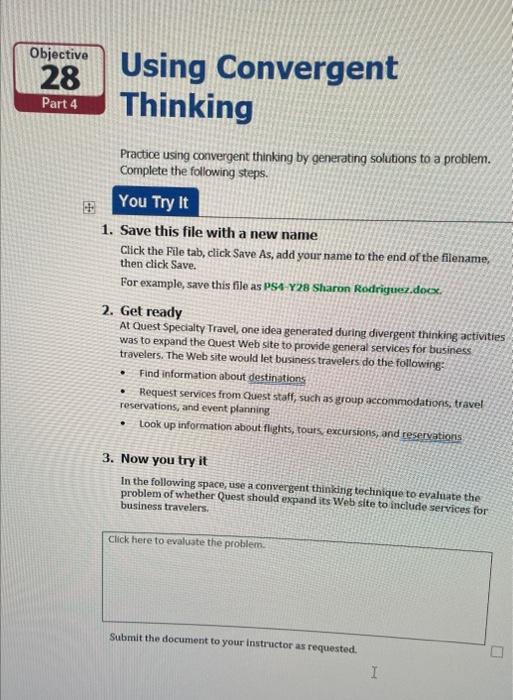
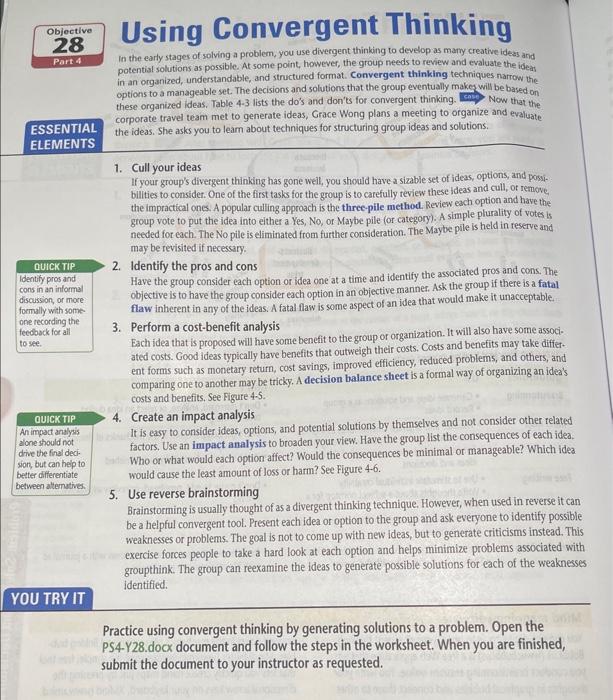
Practice using convergent thinking by generating solutions to a problem. Complete the following steps. 1. Save this file with a new name Click the File tab, click Save As, add your name to the end of the filename, then click Save. For example, save this file as PS4-Y28 Sharon Rodriguez, docx. 2. Get ready At Quest Specialty Travel, one idea generated during divergent thinking activities was to expand the Quest Web site to provide general services for business travelers. The Web site would let business travelers do the following: - Find information about destinations - Request services from quest staff, such as group accommodations, travel reservations, and event planning - Look up information about flights, tours, excursions, and reservationts 3. Now you try it In the following space, use a convergent thinking techinique to evaluate the problem of whether Quest should expand its Web site to include services for business travelers. Click here to evaluate the problem. Submit the document to your instructor as requested. Using Convergent Thinking In the early stages of solving a problem, you use divergent thinking to develop as mary creative ideas and potential solutions as possible. At some point, however, the group needs to review and evaluate the ideat in an organized, understandable, and structured format. Convergent thinking techniques narrow the options to a manageable set. The decisions and solutions that the group eventually maker will be based on these organized ideas. Table 4-3 lists the do's and don'ts for convergent thinking. case Now that the corporate travel team met to generate ideas, Grace Wong plans a meeting to organize and evaluate the ideas. She asks you to leam about techniques for structuring group ideas and solutions. 1. Cull your ideas If your group's divergent thinking has gone weil, you should have a sizable set of ideas, options, and possebillities to consider. One of the first tasks for the group is to carefully teview these ideas and cull, ot remove the impractical ones. A popular culling approach is the three-pile method. Revies each option and have the group vote to put the idea into either a Yes, No, or Maybe pile (or category). A simple plurality of votes is needed for each. The No pile is eliminated from further consideration. The Maybe pile is held in reserve and may be revisited if necessary. 2. Identify the pros and cons Have the group consider each option or idea one at a time and identify the associated pros and cons. The objective is to have the group consider each option in an objective manner. Ask the group if there is a fatal flaw inherent in any of the ideas. A fatal flaw is some aspect of an idea that would make it unacceptable. 3. Perform a cost-benefit analysis Each idea that is proposed will have some benefit to the group or organization. It will also have some associated costs. Good ideas typically have benefits that outweigh their costs. Costs and benefits may take diffiet. ent forms such as monetary return, cost savings, improved efficiency, reduced problems, and others, and comparing one to another may be tricky. A decision balance sheet is a formal way of organizing an idea's costs and benefits, See Figure 4.5 . 4. Create an impact analysis It is easy to consider ideas, options, and potential solutions by themselves and not consider other telated factors. Use an impact analysis to broaden your view. Have the group list the consequences of each idea. Who or what would each option affect? Would the consequences be minimal or manageable? Which idea would cause the least amount of loss or harm? See Figure 46. 5. Use reverse brainstorming Brainstorming is usually thought of as a divergent thinking technique. However, when used in reverse it can be a helpful convergent tool. Present each idea or option to the group and ask everyone to identify possible weaknesses or problems. The goal is not to come up with new ideas, but to generate criticisms instead. This exercise forces people to take a hard look at each option and helps minimize problems associated with groupthink. The group can reexamine the ideas to generate possible solutions for each of the weaknesses identified. Practice using convergent thinking by generating solutions to a problem. Open the PS4-Y28.docx document and follow the steps in the worksheet. When you are finished, submit the document to your instructor as requested
Step by Step Solution
There are 3 Steps involved in it

Get step-by-step solutions from verified subject matter experts
 Study Help