







Question: Using data from 50 workers, a researcher estimates wage = 60 + 61Education + 62Experience + 63Age + , where Wage is the hourly wage
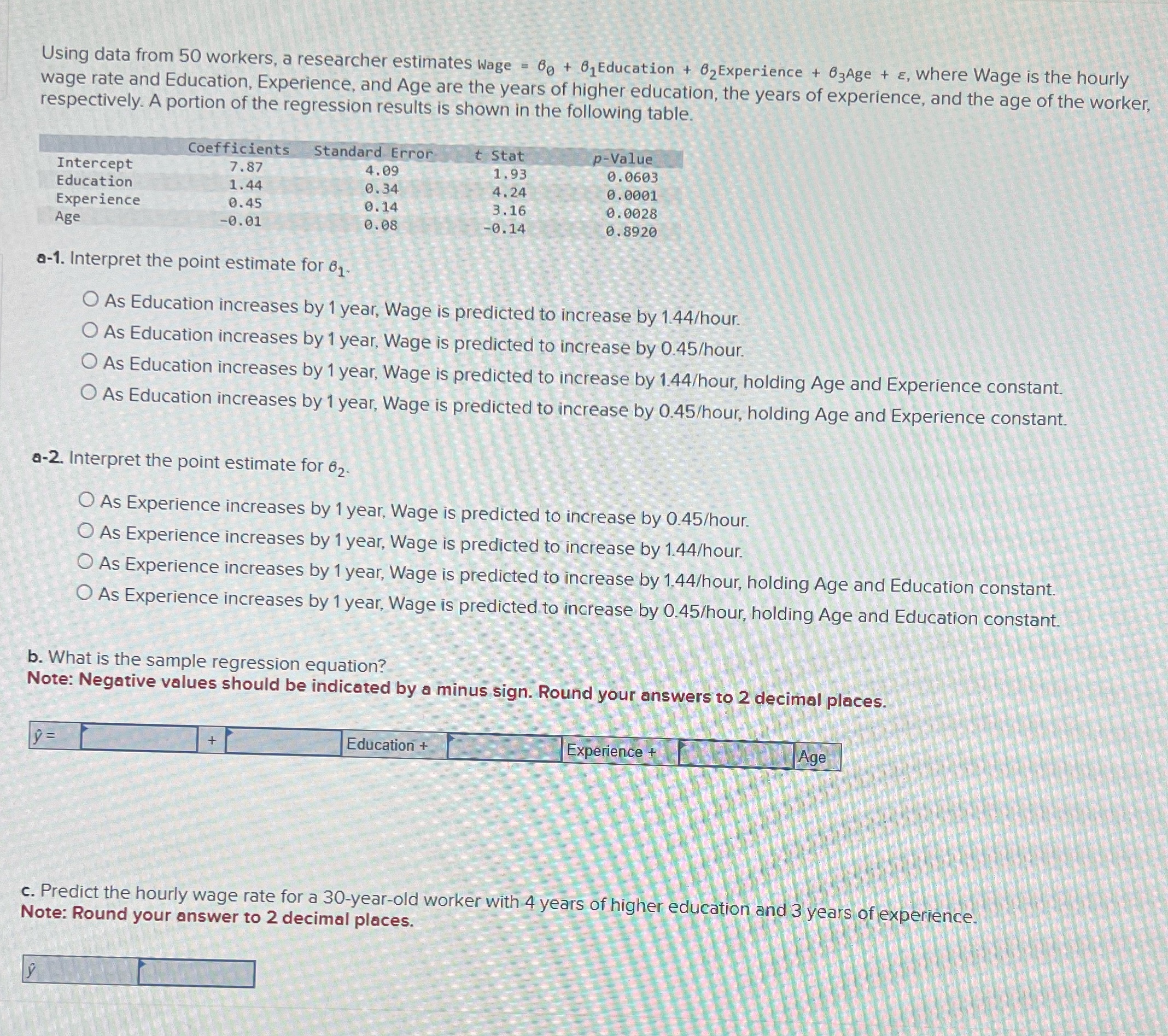
Using data from 50 workers, a researcher estimates wage = 60 + 61Education + 62Experience + 63Age + , where Wage is the hourly wage rate and Education, Experience, and Age are the years of higher education, the years of experience, and the age of the worker, respectively. A portion of the regression results is shown in the following table. Coefficients Standard Error t Stat p-Value Intercept 7.87 4.09 1.93 0. 0603 Education 1.44 0. 34 4.24 0. 0001 Experience 0.45 0. 14 3.16 0. 0028 Age -0. 01 0. 08 -0. 14 0. 8920 a-1. Interpret the point estimate for 61- O As Education increases by 1 year, Wage is predicted to increase by 1.44/hour. O As Education increases by 1 year, Wage is predicted to increase by 0.45/hour. O As Education increases by 1 year, Wage is predicted to increase by 1.44/hour, holding Age and Experience constant. O As Education increases by 1 year, Wage is predicted to increase by 0.45/hour, holding Age and Experience constant. a-2. Interpret the point estimate for 62- O As Experience increases by 1 year, Wage is predicted to increase by 0.45/hour. As Experience increases by 1 year, Wage is predicted to increase by 1.44/hour. As Experience increases by 1 year, Wage is predicted to increase by 1.44/hour, holding Age and Education constant. O As Experience increases by 1 year, Wage is predicted to increase by 0.45/hour, holding Age and Education constant. b. What is the sample regression equation? Note: Negative values should be indicated by a minus sign. Round your answers to 2 decimal places. y = Education + Experience + Age c. Predict the hourly wage rate for a 30-year-old worker with 4 years of higher education and 3 years of experience. Note: Round your answer to 2 decimal places
Step by Step Solution
There are 3 Steps involved in it

Get step-by-step solutions from verified subject matter experts
 Study Help