Question: Using example from your own experience as a leader or follower to illustrate, explain the six basic principles of persuasion examined in chapter 12, and
Using example from your own experience as a leader or follower to illustrate, explain the six basic principles of persuasion examined in chapter 12, and whether or not they were effect in each case ?
SUBJECT: BUSINESS LEADERSHIP
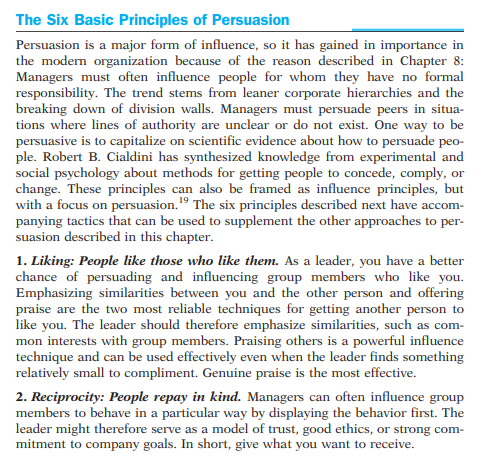
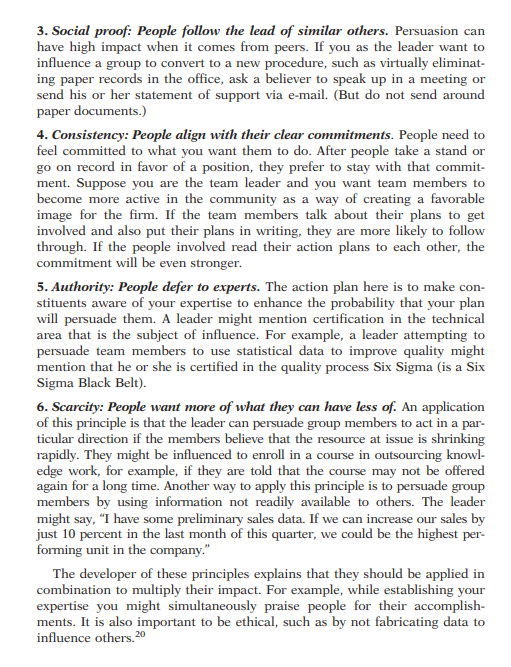
The Six Basic Principles of Persuasion Persuasion is a major form of influence, so it has gained in importance in the modern organization because of the reason described in Chapter 8: Managers must often influence people for whom they have no formal responsibility. The trend stems from leaner corporate hierarchies and the breaking down of division walls. Managers must persuade peers in situa- tions where lines of authority are unclear or do not exist. One way to be persuasive is to capitalize on scientific evidence about how to persuade peo- ple. Robert B. Cialdini has synthesized knowledge from experimental and social psychology about methods for getting people to concede, comply, or change. These principles can also be framed as influence principles, but with a focus on persuasion." The six principles described next have accom- panying tactics that can be used to supplement the other approaches to per- suasion described in this chapter. 1. Liking: People like those who like them. As a leader, you have a better chance of persuading and influencing group members who like you. Emphasizing similarities between you and the other person and offering praise are the two most reliable techniques for getting another person to like you. The leader should therefore emphasize similarities, such as com- mon interests with group members. Praising others is a powerful influence technique and can be used effectively even when the leader finds something relatively small to compliment. Genuine praise is the most effective. 2. Reciprocity: People repay in kind. Managers can often influence group members to behave in a particular way by displaying the behavior first. The leader might therefore serve as a model of trust, good ethics, or strong com- mitment to company goals. In short, give what you want to receive. m 3. Social proof: People follow the lead of similar others. Persuasion can have high impact when it comes from peers. If you as the leader want to influence a group to convert to a new procedure, such as virtually eliminat- ing paper records in the office, ask a believer to speak up in a meeting or send his or her statement of support via e-mail. (But do not send around paper documents.) 4. Consistency: People align with their clear commitments. People need to feel committed to what you want them to do. After people take a stand or go on record in favor of a position, they prefer to stay with that commit- ment. Suppose you are the team leader and you want team members to become more active in the community as a way of creating a favorable image for the firm. If the team members talk about their plans to get involved and also put their plans in writing, they are more likely to follow through. If the people involved read their action plans to each other, the commitment will be even stronger. 5. Authority: People defer to experts. The action plan here is to make con- stituents aware of your expertise to enhance the probability that your plan will persuade them. A leader might mention certification in the technical area that is the subject of influence. For example, a leader attempting to persuade team members to use statistical data to improve quality might mention that he or she is certified in the quality process Six Sigma (is a Six Sigma Black Belt). 6. Scarcity: People want more of what they can have less of. An application of this principle is that the leader can persuade group members to act in a par- ticular direction if the members believe that the resource at issue is shrinking rapidly. They might be influenced to enroll in a course in outsourcing knowl- edge work, for example, if they are told that the course may not be offered again for a long time. Another way to apply this principle is to persuade group members by using information not readily available to others. The leader might say, "I have some preliminary sales data. If we can increase our sales by just 10 percent in the last month of this quarter, we could be the highest per- forming unit in the company." The developer of these principles explains that they should be applied in combination to multiply their impact. For example, while establishing your expertise you might simultaneously praise people for their accomplish- ments. It is also important to be ethical, such as by not fabricating data to influence others.20









 Study Help