







Question: Using Exhibit 1 and 2, provide one example of something that may be affected if Leslies underperformance continues. Be sure to support your assumption using
Using Exhibit 1 and 2, provide one example of something that may be affected if Leslies underperformance continues. Be sure to support your assumption using the case content specifically from Exhibit 1 and 2. Limit your response to 6 sentences.
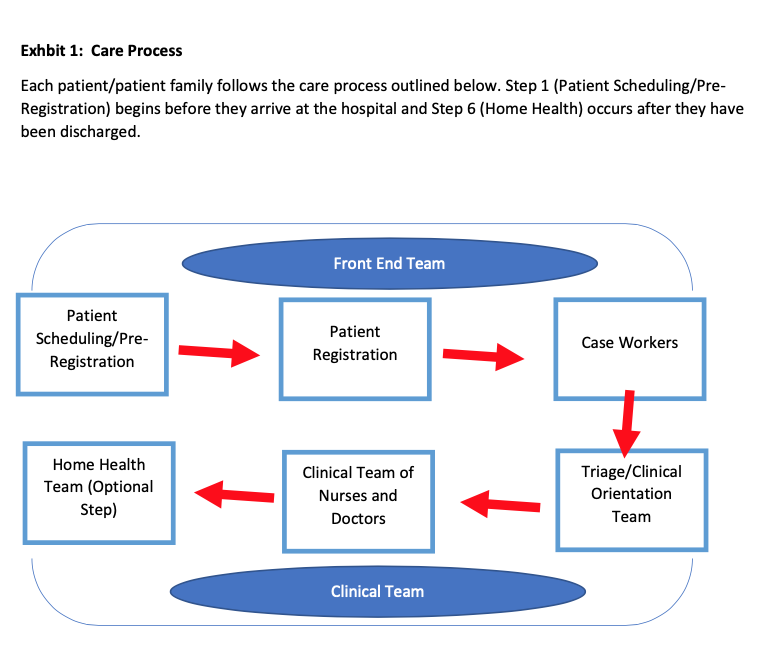
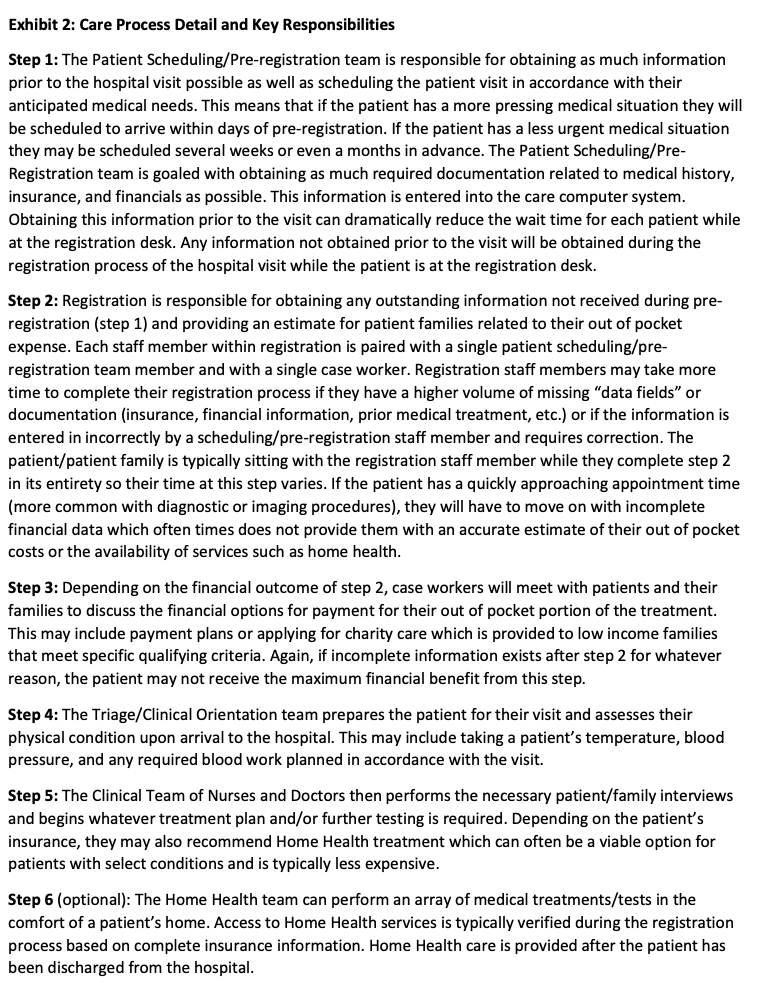
Exhbit 1: Care Process Each patient/patient family follows the care process outlined below. Step 1 (Patient Scheduling/Pre- Registration) begins before they arrive at the hospital and Step 6 (Home Health) occurs after they have been discharged. Front End Team Patient Scheduling/Pre- Registration Patient Registration Case Workers Home Health Team (Optional Step) Clinical Team of Nurses and Doctors Triage/Clinical Orientation Team Clinical Team Exhibit 2: Care Process Detail and Key Responsibilities Step 1: The Patient Scheduling/Pre-registration team is responsible for obtaining as much information prior to the hospital visit possible as well as scheduling the patient visit in accordance with their anticipated medical needs. This means that if the patient has a more pressing medical situation they will be scheduled to arrive within days of pre-registration. If the patient has a less urgent medical situation they may be scheduled several weeks or even a months in advance. The Patient Scheduling/Pre- Registration team is goaled with obtaining as much required documentation related to medical history, insurance, and financials as possible. This information is entered into the care computer system. Obtaining this information prior to the visit can dramatically reduce the wait time for each patient while at the registration desk. Any information not obtained prior to the visit will be obtained during the registration process of the hospital visit while the patient is at the registration desk. Step 2: Registration is responsible for obtaining any outstanding information not received during pre- registration (step 1) and providing an estimate for patient families related to their out of pocket expense. Each staff member within registration is paired with a single patient scheduling/pre- registration team member and with a single case worker. Registration staff members may take more time to complete their registration process if they have a higher volume of missing "data fields" or documentation (insurance, financial information, prior medical treatment, etc.) or if the information is entered in incorrectly by a scheduling/pre-registration staff member and requires correction. The patient/patient family is typically sitting with the registration staff member while they complete step 2 in its entirety so their time at this step varies. If the patient has a quickly approaching appointment time (more common with diagnostic or imaging procedures), they will have to move on with incomplete financial data which often times does not provide them with an accurate estimate of their out of pocket costs or the availability of services such as home health. Step 3: Depending on the financial outcome of step 2, case workers will meet with patients and their families to discuss the financial options for payment for their out of pocket portion of the treatment. This may include payment plans or applying for charity care which is provided to low income families that meet specific qualifying criteria. Again, if incomplete information exists after step 2 for whatever reason, the patient may not receive the maximum financial benefit from this step. Step 4: The Triage/Clinical Orientation team prepares the patient for their visit and assesses their physical condition upon arrival to the hospital. This may include taking a patient's temperature, blood pressure, and any required blood work planned in accordance with the visit. Step 5: The Clinical Team of Nurses and Doctors then performs the necessary patient/family interviews and begins whatever treatment plan and/or further testing is required. Depending on the patient's insurance, they may also recommend Home Health treatment which can often be a viable option for patients with select conditions and is typically less expensive. Step 6 (optional): The Home Health team can perform an array of medical treatments/tests in the comfort of a patient's home. Access to Home Health services is typically verified during the registration process based on complete insurance information. Home Health care is provided after the patient has been discharged from the hospital
Step by Step Solution
There are 3 Steps involved in it
1 Expert Approved Answer
Step: 1 Unlock

Question Has Been Solved by an Expert!
Get step-by-step solutions from verified subject matter experts
Step: 2 Unlock
Step: 3 Unlock
 Study Help