







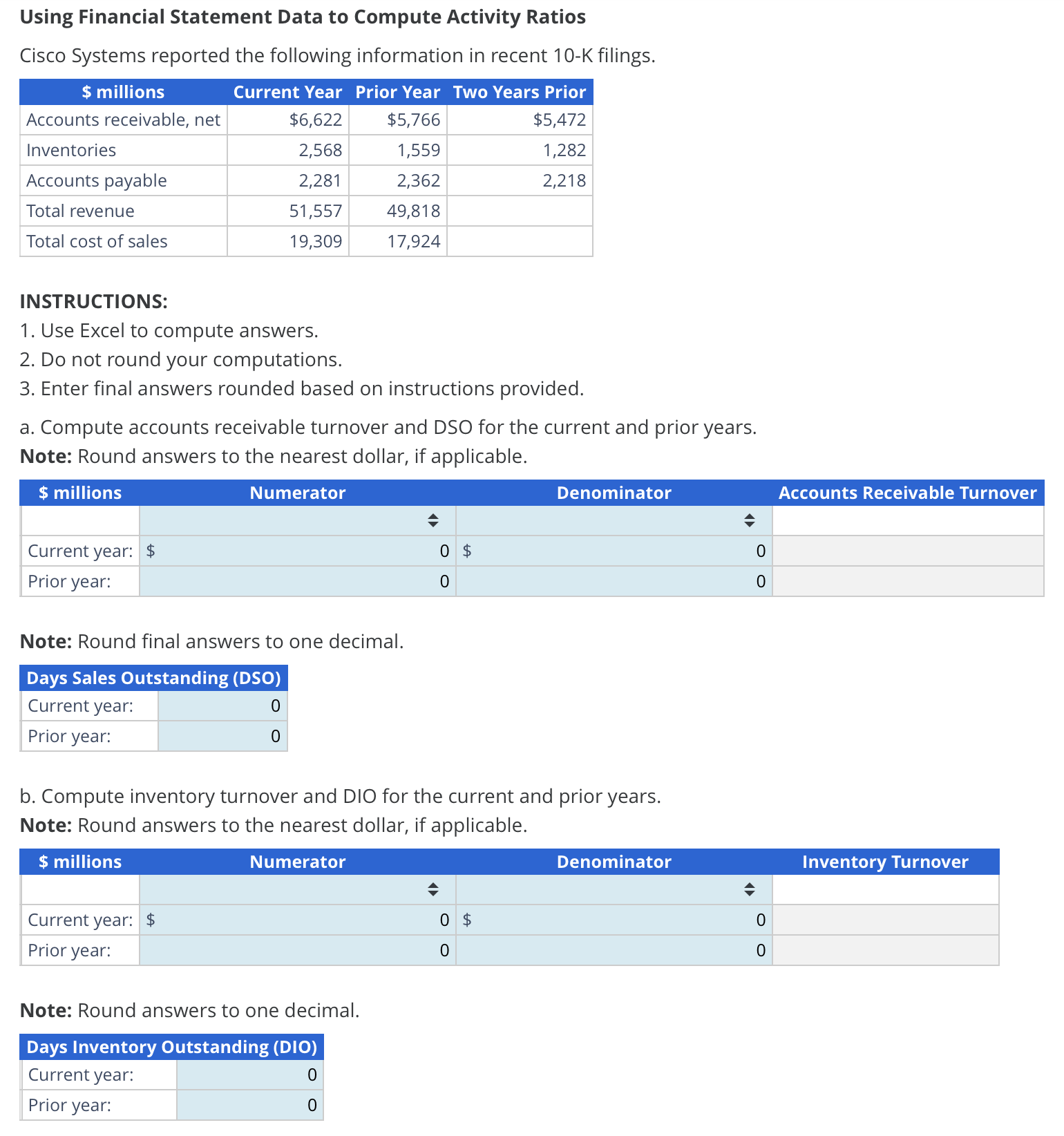
Question: Using Financial Statement Data to Compute Activity Ratios Cisco Systems reported the following information in recent 1 0 - K filings. $ millionsCurrent Year Prior
Using Financial Statement Data to Compute Activity Ratios
Cisco Systems reported the following information in recent K filings.
$ millionsCurrent Year Prior Year Two Years PriorAccounts receivable, net$$$InventoriesAccounts payableTotal revenueTotal cost of sales
INSTRUCTIONS:
Use Excel to compute answers.
Do not round your computations.
Enter final answers rounded based on instructions provided.
a Compute accounts receivable turnover and DSO for the current and prior years.
Note: Round answers to the nearest dollar, if applicable.
$ millionsNumeratorDenominatorAccounts Receivable TurnoverAccounts PayableAverage Accounts PayableAccounts Receivable, NetAverage Accounts Receivable, NetCost of SalesAverage Cost of SalesInventoriesAverage InventoriesRevenueAverage RevenueAccounts PayableAverage Accounts PayableAccounts Receivable, NetAverage Accounts Receivable, NetCost of SalesAverage Cost of SalesInventoriesAverage InventoriesRevenueAverage RevenueCurrent year:Prior year:
Note: Round final answers to one decimal.
Days Sales Outstanding DSOCurrent year:Prior year:
b Compute inventory turnover and DIO for the current and prior years.
Note: Round answers to the nearest dollar, if applicable.
$ millionsNumeratorDenominatorInventory TurnoverAccounts PayableAverage Accounts PayableAccounts Receivable, NetAverage Accounts Receivable, NetCost of SalesAverage Cost of SalesInventoriesAverage InventoriesRevenueAverage RevenueAccounts PayableAverage Accounts PayableAccounts Receivable, NetAverage Accounts Receivable, NetCost of SalesAverage Cost of SalesInventoriesAverage InventoriesRevenueAverage RevenueCurrent year:Prior year:
Note: Round answers to one decimal.
Days Inventory Outstanding DIOCurrent year:Prior year:
c Compute accounts payable turnover and DPO for the current and prior years.
Note: Round answers to the nearest dollar, if applicable.
$ millionsNumeratorDenominatorAccounts Payable TurnoverAccounts PayableAverage Accounts PayableAccounts Receivable, NetAverage Accounts Receivable, NetCost of SalesAverage Cost of SalesInventoriesAverage InventoriesRevenueAverage RevenueAccounts PayableAverage Accounts PayableAccounts Receivable, NetAverage Accounts Receivable, NetCost of SalesAverage Cost of SalesInventoriesAverage InventoriesRevenueAverage RevenueCurrent year:Prior year:
Note: Round answers to one decimal.
Days Payable Outstanding DPOCurrent year:Prior year:
d Compute cash conversion cycle for the current and prior years.
Note: Round answers to one decimal.
Cash Conversion CycleCurrent year:Prior year:
e Determine the cash flow impact arising from the change in DIO during the current year.
Note: Round answers to one decimal.
Note: Enter a cash inflow impact as positive and a cash outflow impact as negative.
$ millionsCOGS per day:Change in DIO during the year:Cash effect of DIO change:
Step by Step Solution
There are 3 Steps involved in it
1 Expert Approved Answer
Step: 1 Unlock

Question Has Been Solved by an Expert!
Get step-by-step solutions from verified subject matter experts
Step: 2 Unlock
Step: 3 Unlock
 Study Help