







Question: Using Haskell Implement the following functions. If you are not able to solve the problem, give a dummy implementation using the error function. For example,
Using Haskell
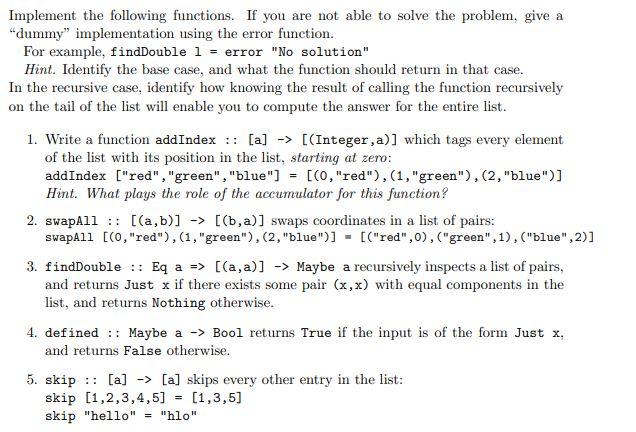
Implement the following functions. If you are not able to solve the problem, give a "dummy" implementation using the error function. For example, findDouble 1 = error "No solution" Hint. Identify the base case, and what the function should return in that case. In the recursive case, identify how knowing the result of calling the function recursively on the tail of the list will enable you to compute the answer for the entire list. 1. Write a function addIndex :: [a] -> [(Integer, a)] which tags every element of the list with its position in the list, starting at zero: add Index ["red","green","blue"] = [(0,"red"),(1,"green"), (2,"blue")] Hint. What plays the role of the accumulator for this function? 2. swapAll :: [(a,b)] -> [(b,a)] swaps coordinates in a list of pairs: swap 11 [00, "red"), (1, "green"), (2,"blue")] = [("red",0), ("green", 1), ("blue",2)] 3. findDouble :: Eq a => [(a,a)] -> Maybe a recursively inspects a list of pairs, and returns Just x if there exists some pair (x,x) with equal components in the list, and returns Nothing otherwise. 4. defined :: Maybe a -> Bool returns True if the input is of the form Just x, and returns False otherwise. 5. skip :: [a] -> [a] skips every other entry in the list: skip [1,2,3,4,5] = [1,3,5) skip "hello" = "hlo" Implement the following functions. If you are not able to solve the problem, give a "dummy" implementation using the error function. For example, findDouble 1 = error "No solution" Hint. Identify the base case, and what the function should return in that case. In the recursive case, identify how knowing the result of calling the function recursively on the tail of the list will enable you to compute the answer for the entire list. 1. Write a function addIndex :: [a] -> [(Integer, a)] which tags every element of the list with its position in the list, starting at zero: add Index ["red","green","blue"] = [(0,"red"),(1,"green"), (2,"blue")] Hint. What plays the role of the accumulator for this function? 2. swapAll :: [(a,b)] -> [(b,a)] swaps coordinates in a list of pairs: swap 11 [00, "red"), (1, "green"), (2,"blue")] = [("red",0), ("green", 1), ("blue",2)] 3. findDouble :: Eq a => [(a,a)] -> Maybe a recursively inspects a list of pairs, and returns Just x if there exists some pair (x,x) with equal components in the list, and returns Nothing otherwise. 4. defined :: Maybe a -> Bool returns True if the input is of the form Just x, and returns False otherwise. 5. skip :: [a] -> [a] skips every other entry in the list: skip [1,2,3,4,5] = [1,3,5) skip "hello" = "hlo
Step by Step Solution
There are 3 Steps involved in it

Get step-by-step solutions from verified subject matter experts
 Study Help