







Question: Using Induction, prove that A complete binary tree of height h has 2^h + 1 - 1 nodes. Build the Max-Heap from the following dataset:
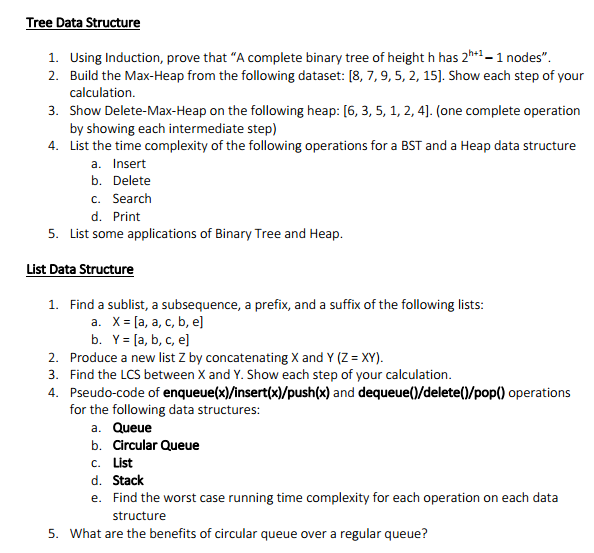
Using Induction, prove that "A complete binary tree of height h has 2^h + 1 - 1 nodes". Build the Max-Heap from the following dataset: [8, 7, 9, 5, 2, 15]. Show each step of your calculation. Show Delete-Max-Heap on the following heap: [6, 3, 5, 1, 2, 4]. (one complete operation by showing each intermediate step) List the time complexity of the following operations for a BST and a Heap data structure a. Insert b. Delete c. Search d. Print List some applications of Binary Tree and Heap. List Data Structure Find a sublist, a subsequence, a prefix, and a suffix of the following lists: a. X = [a, a, c, b, e] b. Y = [a, b, c, e] Produce a new list Z by concatenating X and Y (Z = XY). Find the LCS between X and Y. Show each step of your calculation. Pseudo-code of enqueue(x)/insert(x)/push(x) and dequeue()/delete()/pop() operations for the following data structures: a. Queue b. Circular Queue c. List d. Stack e. Find the worst case running time complexity for each operation on each data structure What are the benefits of circular queue over a regular queue
Step by Step Solution
There are 3 Steps involved in it

Get step-by-step solutions from verified subject matter experts
 Study Help