







Question: Using MATLAB: %%%%%%%%%%%%%%%%%%%%% compute spline coefficients here %%%%%%%%%%%%%%% format long e %%%%%%%%%%%%%%%%%% call sineval function here %%%%%%%%%%%%%%%%% X = 250; sineval(X,a,b,c) X = -100; sineval(X,a,b,c)
Using MATLAB:
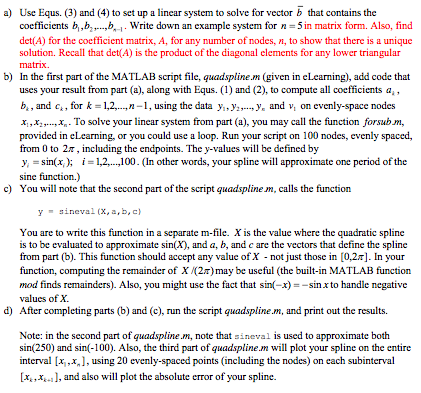
%%%%%%%%%%%%%%%%%%%%% compute spline coefficients here %%%%%%%%%%%%%%%
format long e
%%%%%%%%%%%%%%%%%% call sineval function here %%%%%%%%%%%%%%%%%
X = 250;
sineval(X,a,b,c)
X = -100;
sineval(X,a,b,c)
%%%%%%%%%%%%%%%%%%%%% plot spline %%%%%%%%%%%%%%%%%%%%%%%%%%%%%%%%%%%%
%number of points on which to plot. n = number of nodes
nplot = (n-1)*19+1;
xplot = zeros(nplot,1);
yplot = zeros(nplot,1);
%spacing between plot points
nspace = (x(n)-x(1))/(nplot-1);
k = 0;
for i = 1:n-1
for j = 1:19
k = k+1;
xplot(k) = x(i) + (j-1)*nspace;
yplot(k) = a(i) + b(i)*(xplot(k) - x(i)) + c(i)*(xplot(k) - x(i))^2;
end
end
xplot(nplot) = x(n);
yplot(nplot) = a(i) + b(i)*(x(n) - x(n-1)) + c(i)*(x(n) - x(n-1))^2;
plot(xplot,yplot)
figure
abserr = abs(yplot - sin(xplot));
plot(xplot,abserr)
function [y] = forsub(L,b)
%Forward-substitution
%accepts an nX1 vector b, an nXn lower triangular matrix L
%generates an nX1 solution vector y
n = size(b,1);
y = zeros(n,1);
y(1) = b(1);
for i = 2:n
y(i) = b(i);
for j = 1:i-1
y(i) = y(i) - L(i,j)*y(j);
end
end
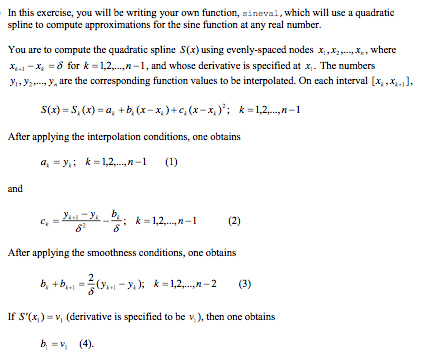
In this exercise, you will be writing your own function, sineval, which will use a quadratic spline to compute approximations for the sine function at any real number. You are to compute the quadratic spline S(x) using evenly-spaced nodes x,,x..x, where 4.1-x. = for k = 1,2, , n-1 , and whose derivative is specified at x-The numbers yy are the corresponding function values to be interpolated. On each interval [x,x, S(x) =5,(x) = a, th(x-%)+6(x-x,), k=1,2, ,n-1 After applying the interpolation conditions, one obtains a.-y. ; k=12, , n-1 (1) and After applying the smoothness conditions, one obtains If S (x)v (derivative is specified to be v), then one obtains a=v, (4). In this exercise, you will be writing your own function, sineval, which will use a quadratic spline to compute approximations for the sine function at any real number. You are to compute the quadratic spline S(x) using evenly-spaced nodes x,,x..x, where 4.1-x. = for k = 1,2, , n-1 , and whose derivative is specified at x-The numbers yy are the corresponding function values to be interpolated. On each interval [x,x, S(x) =5,(x) = a, th(x-%)+6(x-x,), k=1,2, ,n-1 After applying the interpolation conditions, one obtains a.-y. ; k=12, , n-1 (1) and After applying the smoothness conditions, one obtains If S (x)v (derivative is specified to be v), then one obtains a=v, (4)
Step by Step Solution
There are 3 Steps involved in it

Get step-by-step solutions from verified subject matter experts
 Study Help