







Question: USING MATLAB In this task, you will model a road as a queueing system. The aim is to investigate the effect of different aspects of
USING MATLAB
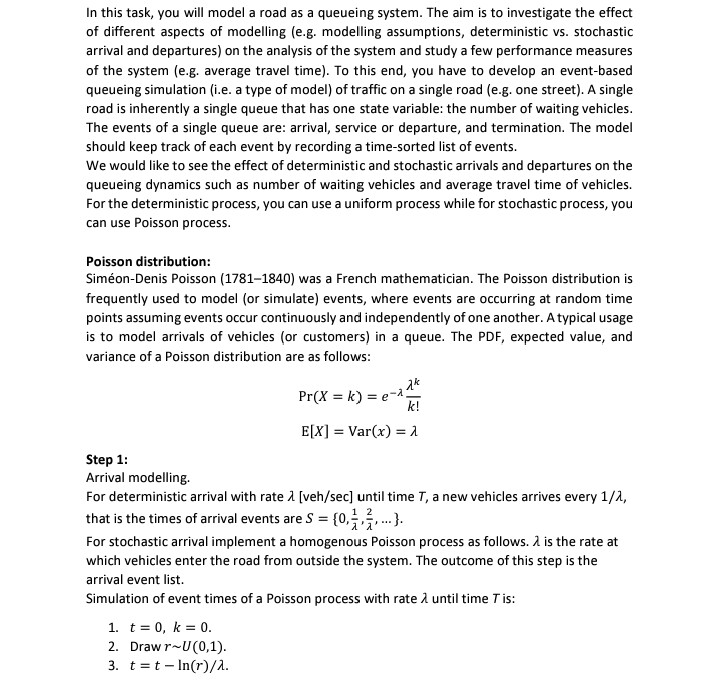
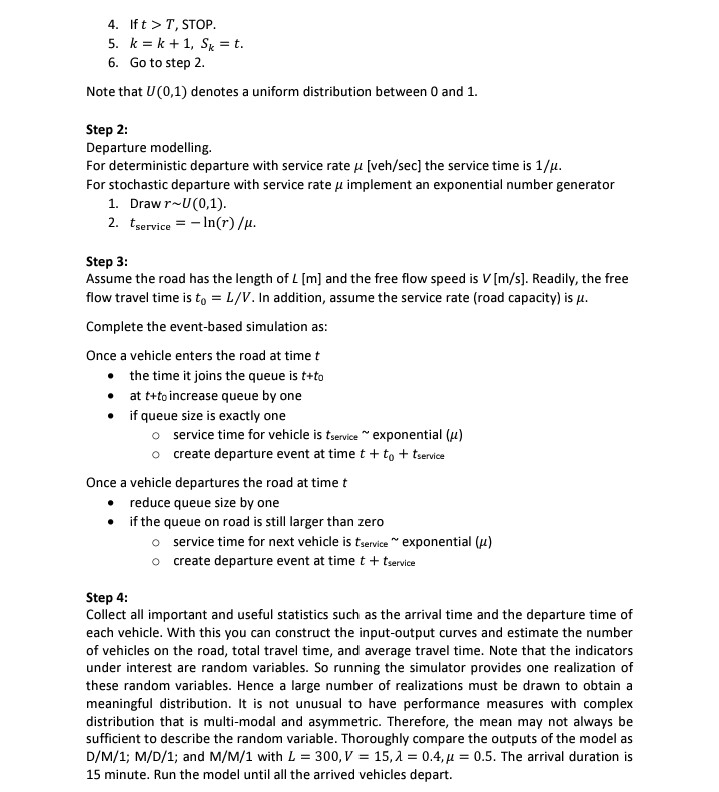
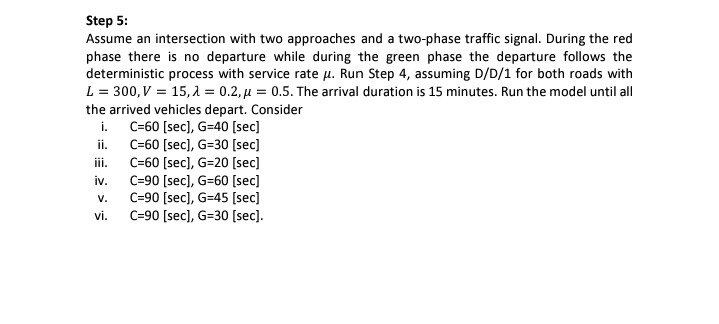
In this task, you will model a road as a queueing system. The aim is to investigate the effect of different aspects of modelling (e.g. modelling assumptions, deterministic vs. stochastic arrival and departures) on the analysis of the system and study a few performance measures of the system (e.g. average travel time). To this end, you have to develop an event-based queueing simulation (i.e. a type of model) of traffic on a single road (e.g. one street). A single road is inherently a single queue that has one state variable: the number of waiting vehicles The events of a single queue are: arrival, service or departure, and termination. The model should keep track of each event by recording a time-sorted list of events. We would like to see the effect of deterministic and stochastic arrivals and departures on the queueing dynamics such as number of waiting vehicles and average travel time of vehicles. For the deterministic process, you can use a uniform process while for stochastic process, you can use Poisson process Poisson distribution: Simon-Denis Poisson (1781-1840) was a French mathematician. The Poisson distribution is frequently used to model (or simulate) events, where events are occurring at random time points assuming events occur continuously and independently of one another. A typical usage is to model arrivals of vehicles (or customers) in a queue. The PDF, expected value, and variance of a Poisson distribution are as follows: Pr(X = k) = e- k! E[X] Var(x) 1 Step 1: Arrival modelling. For deterministic arrival with rate ? [veh/sec] until time T, a new vehicles arrives every 1/A, that is the times of arrival events are S10,..) For stochastic arrival implement a homogenous Poisson process as follows. ? is the rate at which vehicles enter the road from outside the system. The outcome of this step is the arrival event list. Simulation of event times of a Poisson process with rate ? until time T is: 'a 'a 1. t-0, k 0 2. Drawr U(0,1) In this task, you will model a road as a queueing system. The aim is to investigate the effect of different aspects of modelling (e.g. modelling assumptions, deterministic vs. stochastic arrival and departures) on the analysis of the system and study a few performance measures of the system (e.g. average travel time). To this end, you have to develop an event-based queueing simulation (i.e. a type of model) of traffic on a single road (e.g. one street). A single road is inherently a single queue that has one state variable: the number of waiting vehicles The events of a single queue are: arrival, service or departure, and termination. The model should keep track of each event by recording a time-sorted list of events. We would like to see the effect of deterministic and stochastic arrivals and departures on the queueing dynamics such as number of waiting vehicles and average travel time of vehicles. For the deterministic process, you can use a uniform process while for stochastic process, you can use Poisson process Poisson distribution: Simon-Denis Poisson (1781-1840) was a French mathematician. The Poisson distribution is frequently used to model (or simulate) events, where events are occurring at random time points assuming events occur continuously and independently of one another. A typical usage is to model arrivals of vehicles (or customers) in a queue. The PDF, expected value, and variance of a Poisson distribution are as follows: Pr(X = k) = e- k! E[X] Var(x) 1 Step 1: Arrival modelling. For deterministic arrival with rate ? [veh/sec] until time T, a new vehicles arrives every 1/A, that is the times of arrival events are S10,..) For stochastic arrival implement a homogenous Poisson process as follows. ? is the rate at which vehicles enter the road from outside the system. The outcome of this step is the arrival event list. Simulation of event times of a Poisson process with rate ? until time T is: 'a 'a 1. t-0, k 0 2. Drawr U(0,1)
Step by Step Solution
There are 3 Steps involved in it

Get step-by-step solutions from verified subject matter experts
 Study Help