







Question: USING MATLAB USING MATLAB Problem 2 A model for the atmospheric temperature and pressure as a function of altitude consists of two types of regions:
USING MATLAB
USING MATLAB
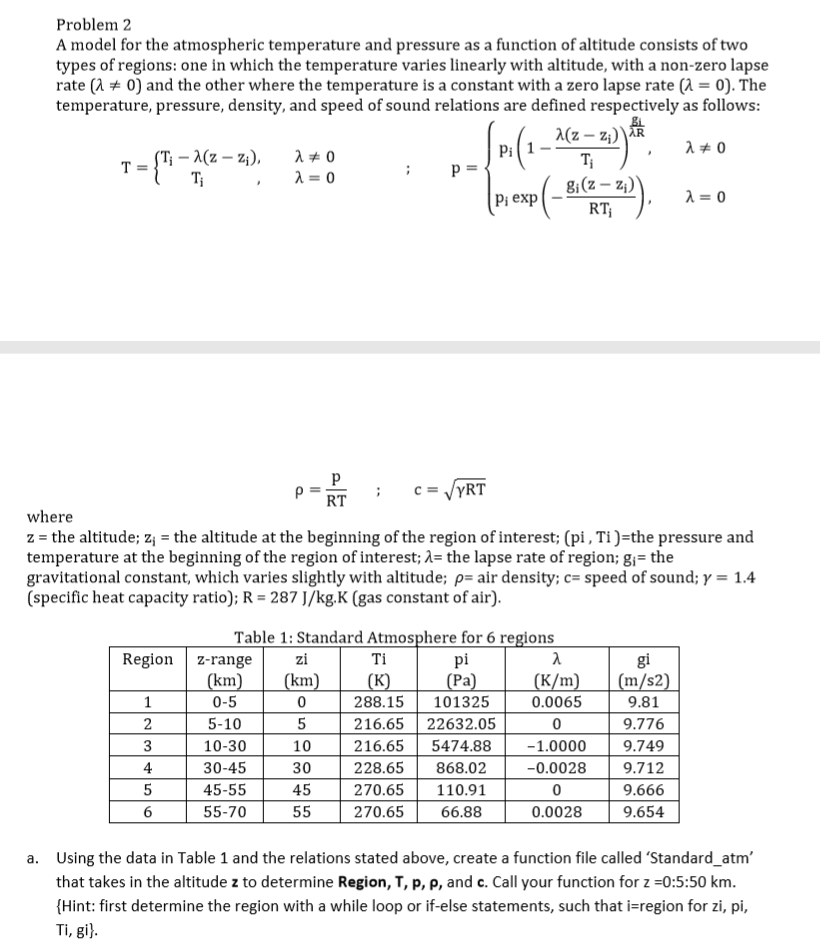
Problem 2 A model for the atmospheric temperature and pressure as a function of altitude consists of two types of regions: one in which the temperature varies linearly with altitude, with a non-zero lapse rate (1 + 0) and the other where the temperature is a constant with a zero lapse rate (1 = 0). The temperature, pressure, density, and speed of sound relations are defined respectively as follows: N az-z:)AR 170 _ST - A(z - zi), +0 T UT1= ; p ( gi(z zi) Piexp | 2 = 0 RT Pi 1- T= p =PL c= /YRT where z = the altitude; zi = the altitude at the beginning of the region of interest; (pi, Ti ) =the pressure and temperature at the beginning of the region of interest; A= the lapse rate of region; gi= the gravitational constant, which varies slightly with altitude; p= air density; c= speed of sound; y = 1.4 (specific heat capacity ratio); R = 287 J/kg.K (gas constant of air). Region zi gi un - WN Table 1: Standard Atmosphere for 6 regions z-range Ti (km) (km) (K) (Pa) (K/m 0- 5 0 288.15 101325 0.0065 5-10 216.65 22632.05 10-30 10 216.65 5474.88 -1.0000 30-45 30 228.65868.02 -0.0028 45-55 45 270.65 110.91 55-7055270.65 66.88 0.0028 (m/s2) 9.81 9.776 9.749 9.712 9.666 9.654 6 a. Using the data in Table 1 and the relations stated above, create a function file called 'Standard atm that takes in the altitude z to determine Region, T, P, P, and c. Call your function for z =0:5:50 km. (Hint: first determine the region with a while loop or if-else statements, such that i=region for zi, pi, Ti, gi}. Problem 2 A model for the atmospheric temperature and pressure as a function of altitude consists of two types of regions: one in which the temperature varies linearly with altitude, with a non-zero lapse rate (1 + 0) and the other where the temperature is a constant with a zero lapse rate (1 = 0). The temperature, pressure, density, and speed of sound relations are defined respectively as follows: N az-z:)AR 170 _ST - A(z - zi), +0 T UT1= ; p ( gi(z zi) Piexp | 2 = 0 RT Pi 1- T= p =PL c= /YRT where z = the altitude; zi = the altitude at the beginning of the region of interest; (pi, Ti ) =the pressure and temperature at the beginning of the region of interest; A= the lapse rate of region; gi= the gravitational constant, which varies slightly with altitude; p= air density; c= speed of sound; y = 1.4 (specific heat capacity ratio); R = 287 J/kg.K (gas constant of air). Region zi gi un - WN Table 1: Standard Atmosphere for 6 regions z-range Ti (km) (km) (K) (Pa) (K/m 0- 5 0 288.15 101325 0.0065 5-10 216.65 22632.05 10-30 10 216.65 5474.88 -1.0000 30-45 30 228.65868.02 -0.0028 45-55 45 270.65 110.91 55-7055270.65 66.88 0.0028 (m/s2) 9.81 9.776 9.749 9.712 9.666 9.654 6 a. Using the data in Table 1 and the relations stated above, create a function file called 'Standard atm that takes in the altitude z to determine Region, T, P, P, and c. Call your function for z =0:5:50 km. (Hint: first determine the region with a while loop or if-else statements, such that i=region for zi, pi, Ti, gi}
Step by Step Solution
There are 3 Steps involved in it

Get step-by-step solutions from verified subject matter experts
 Study Help