







Question: Using net present value and payback period to evaluate investment opportunities Problem 10-21A LO 10-2, 10-4 CHECK FIGURES a. NPV of #1: $3017972 b. Payback
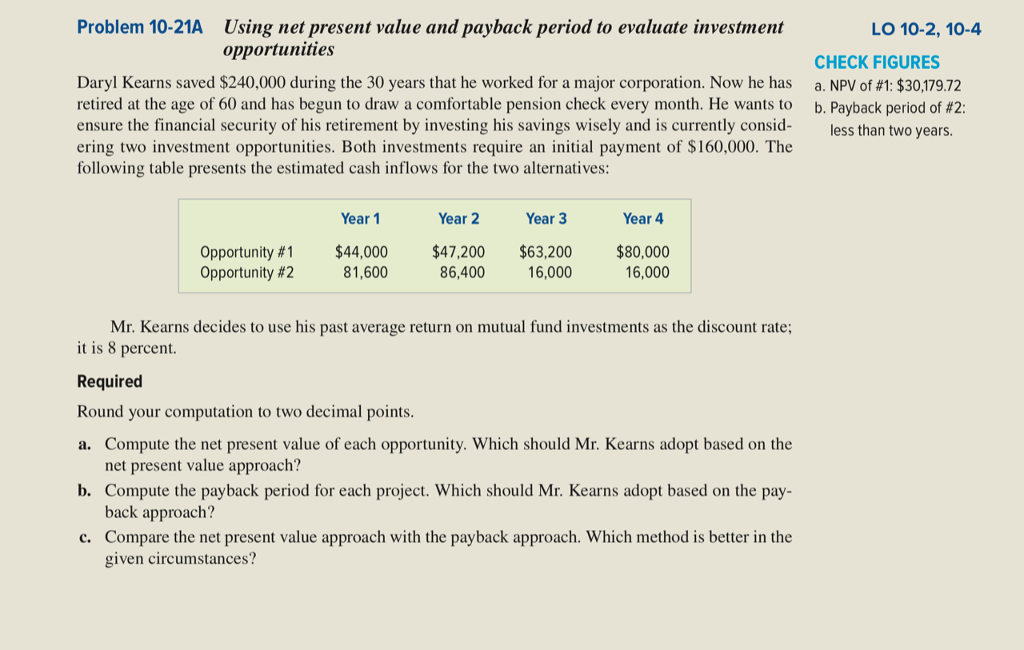
Using net present value and payback period to evaluate investment opportunities Problem 10-21A LO 10-2, 10-4 CHECK FIGURES a. NPV of #1: $3017972 b. Payback period of #2 Daryl Kearns saved $240,000 during the 30 years that he worked for a major corporation. Now he has retired at the age of 60 and has begun to draw a comfortable pension check every month. He wants to ensure the financial security of his retirement by investing his savings wisely and is currently consid ering two investment opportunities. Both investments require an initial payment of $160,000. The following table presents the estimated cash inflows for the two alternatives: less than two years Year 1 Year 2 Year 3 Year 4 Opportunity #1 Opportunity #2 $44,000 81,600 $47,200 86,400 $63,200 16,000 $80,000 16,000 Mr. Kearns decides to use his past average return on mutual fund investments as the discount rate; it is 8 percent. Required Round your computation to two decimal points a. Compute the net present value of each opportunity. Which should Mr. Kearns adopt based on the net present value approach? back approach? given circumstances? b. Compute the payback period for each project. Which should Mr. Kearns adopt based on the pay- c. Compare the net present value approach with the payback approach. Which method is better in the
Step by Step Solution
There are 3 Steps involved in it

Get step-by-step solutions from verified subject matter experts
 Study Help