Question: Using ONLY the information from Case Study 2 The World Leader in e-Commerce, identify what types of business ethical issues, from those covered in class,
Using ONLY the information from Case Study 2 The World Leader in e-Commerce, identify what types of business ethical issues, from those covered in class, apply to this company. Also, discuss the possible repercussions of unethical behavior for this company and how could the company improve its ethical behavior.
Business Ethics (250 words aprox.)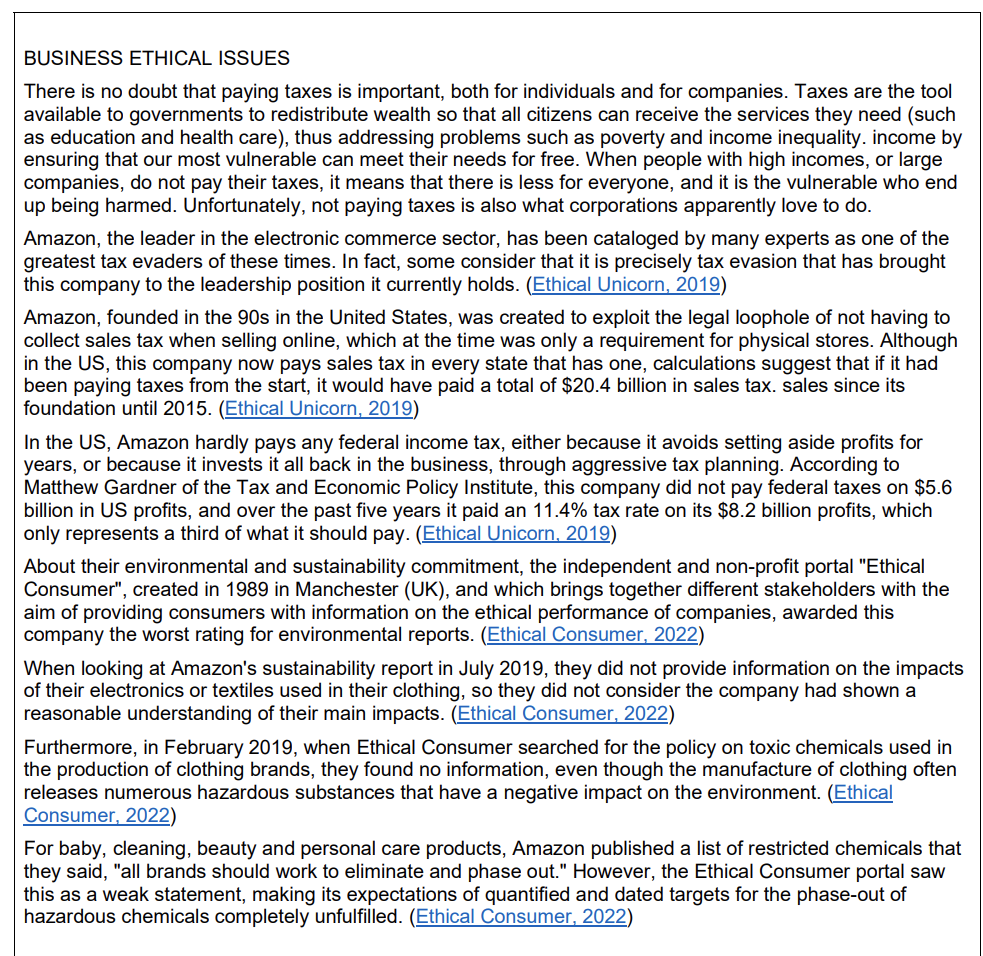
BUSINESS ETHICAL ISSUES There is no doubt that paying taxes is important, both for individuals and for companies. Taxes are the tool available to governments to redistribute wealth so that all citizens can receive the services they need (such as education and health care), thus addressing problems such as poverty and income inequality. income by ensuring that our most vulnerable can meet their needs for free. When people with high incomes, or large companies, do not pay their taxes, it means that there is less for everyone, and it is the vulnerable who end up being harmed. Unfortunately, not paying taxes is also what corporations apparently love to do. Amazon, the leader in the electronic commerce sector, has been cataloged by many experts as one of the greatest tax evaders of these times. In fact, some consider that it is precisely tax evasion that has brought this company to the leadership position it currently holds. (Ethical Unicorn, 2019) Amazon, founded in the 90s in the United States, was created to exploit the legal loophole of not having to collect sales tax when selling online, which at the time was only a requirement for physical stores. Although in the US, this company now pays sales tax in every state that has one, calculations suggest that if it had been paying taxes from the start, it would have paid a total of $20.4 billion in sales tax. sales since its foundation until 2015. (Ethical Unicorn, 2019) In the US, Amazon hardly pays any federal income tax, either because it avoids setting aside profits for years, or because it invests it all back in the business, through aggressive tax planning. According to Matthew Gardner of the Tax and Economic Policy Institute, this company did not pay federal taxes on $5.6 billion in US profits, and over the past five years it paid an 11.4% tax rate on its $8.2 billion profits, which only represents a third of what it should pay. (Ethical Unicorn, 2019) About their environmental and sustainability commitment, the independent and non-profit portal "Ethical Consumer", created in 1989 in Manchester (UK), and which brings together different stakeholders with the aim of providing consumers with information on the ethical performance of companies, awarded this company the worst rating for environmental reports. (Ethical Consumer, 2022) When looking at Amazon's sustainability report in July 2019, they did not provide information on the impacts of their electronics or textiles used in their clothing, so they did not consider the company had shown a reasonable understanding of their main impacts. (Ethical Consumer, 2022) Furthermore, in February 2019, when Ethical Consumer searched for the policy on toxic chemicals used in the production of clothing brands, they found no information, even though the manufacture of clothing often releases numerous hazardous substances that have a negative impact on the environment. (Ethical Consumer, 2022) For baby, cleaning, beauty and personal care products, Amazon published a list of restricted chemicals that they said, "all brands should work to eliminate and phase out." However, the Ethical Consumer portal saw this as a weak statement, making its expectations of quantified and dated targets for the phase-out of hazardous chemicals completely unfulfilled. (Ethical Consumer, 2022)









 Study Help