







Question: Using problem decomposition tree, solve the problem. ?(x,y) (4x 2 + y 2 4y + 5 + 4x = 0) The pics above are just
Using problem decomposition tree, solve the problem.
?(x,y) (4x2 + y2 4y + 5 + 4x = 0)
The pics above are just an example of a similar question
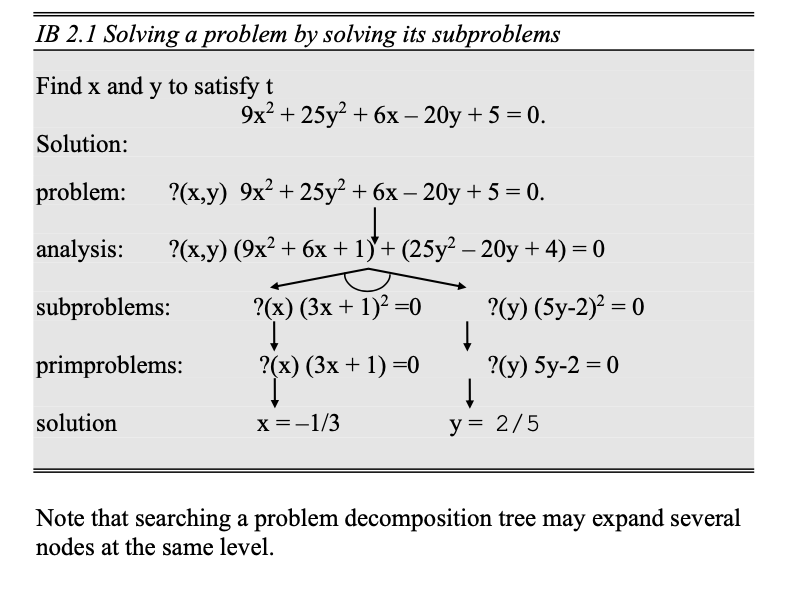
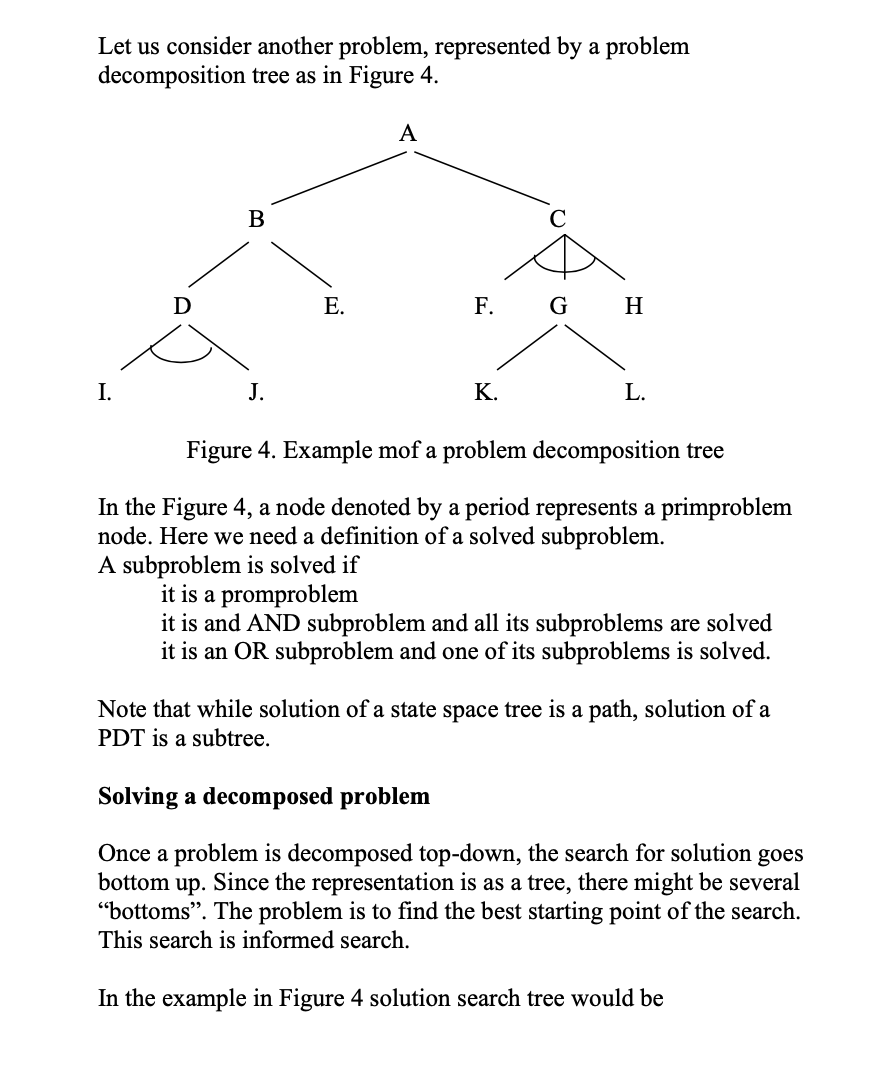
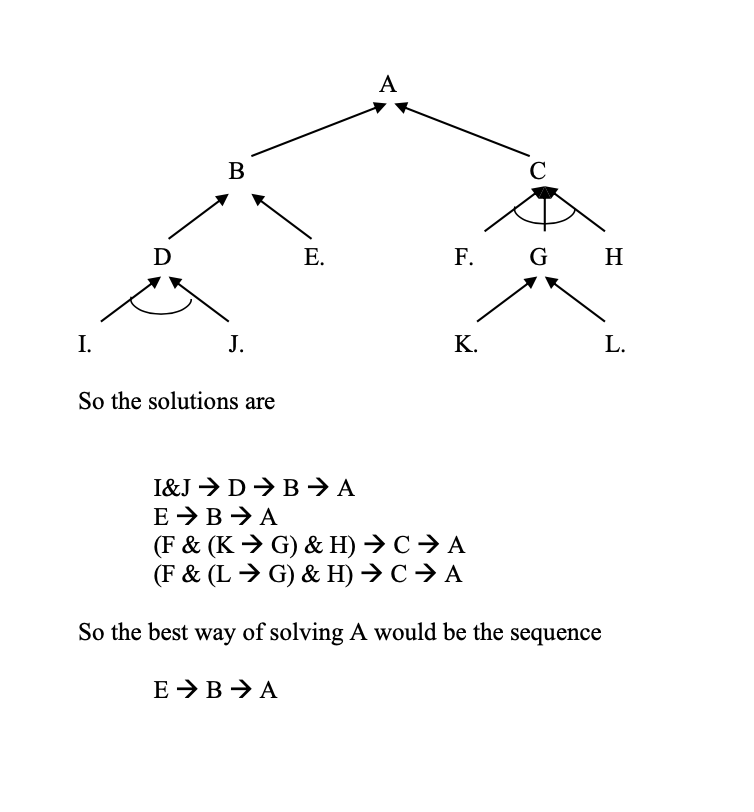
IB 2.1 Solving a problem by solving its subproblems Find x and y to satisfy t 9x2 + 25y2 + 6x 20y + 5 = 0. Solution: problem: ?(x,y) 9x + 25y2 + 6x 20y + 5 = 0. analysis: ?(x,y) (9x2 + 6x + 1)+ (25y2 20y + 4) = 0 18+(2 subproblems: ?(x) (3x + 1)2 =0 ?(y) (5y-2)2 = 1 primproblems: ?(x) (3x + 1) =0 ?(x) (3x + 1) = ?(y) 5y-2 = 0 solution x=-1/3 y= 2/5 Note that searching a problem decomposition tree may expand several nodes at the same level. Let us consider another problem, represented by a problem decomposition tree as in Figure 4. A B E. F. G H I. J. K. L. Figure 4. Example mof a problem decomposition tree In the Figure 4, a node denoted by a period represents a primproblem node. Here we need a definition of a solved subproblem. A subproblem is solved if it is a promproblem it is and AND subproblem and all its subproblems are solved it is an OR subproblem and one of its subproblems is solved. Note that while solution of a state space tree is a path, solution of a PDT is a subtree. Solving a decomposed problem Once a problem is decomposed top-down, the search for solution goes bottom up. Since the representation is as a tree, there might be several "bottoms. The problem is to find the best starting point of the search. This search is informed search. In the example in Figure 4 solution search tree would be A B D E. F. G H I. J. K. L. So the solutions are I&J DB A E B A (F & (K = G) & H) CA (F & (L G) & H) C + A So the best way of solving A would be the sequence E B A
Step by Step Solution
There are 3 Steps involved in it

Get step-by-step solutions from verified subject matter experts
 Study Help