







Question: Using python do the following: A newly discovered planetoid orbiting the sun was seen at 10 different posi tions before it disappeared from view. The
Using python do the following:
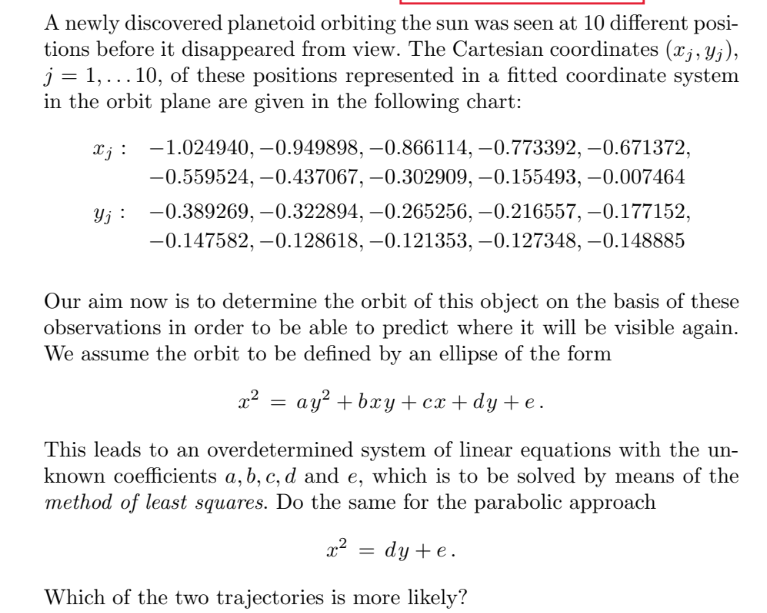
A newly discovered planetoid orbiting the sun was seen at 10 different posi tions before it disappeared from view. The Cartesian coordinates (xj,yj), j-,10, of these positions represented in a fitted coordinate system in the orbit plane are given in the following chart 1.024940,-0.949898.0.8661 14.-0.773392,-0.671372. 0.559524,-0.437067, -0.302909, -0.155493,-0.007464 52. -0.147582,-0.128618,-0.121353, -0.127348,-0.148885 ay : vj: -0.389269,-0.322894,-0.265256, -0.216557,-0.1771 Our aim now is to determine the orbit of this object on the basis of these observations in order to be able to predict where it will be visible again We assume the orbit to be defined by an ellipse of the form This leads to an overdetermined system of linear equations with the un known coefficients a,b,c,d and e, which is to be solved by means of the method of least squares. Do the same for the parabolic approach Which of the two trajectories is more likely? A newly discovered planetoid orbiting the sun was seen at 10 different posi tions before it disappeared from view. The Cartesian coordinates (xj,yj), j-,10, of these positions represented in a fitted coordinate system in the orbit plane are given in the following chart 1.024940,-0.949898.0.8661 14.-0.773392,-0.671372. 0.559524,-0.437067, -0.302909, -0.155493,-0.007464 52. -0.147582,-0.128618,-0.121353, -0.127348,-0.148885 ay : vj: -0.389269,-0.322894,-0.265256, -0.216557,-0.1771 Our aim now is to determine the orbit of this object on the basis of these observations in order to be able to predict where it will be visible again We assume the orbit to be defined by an ellipse of the form This leads to an overdetermined system of linear equations with the un known coefficients a,b,c,d and e, which is to be solved by means of the method of least squares. Do the same for the parabolic approach Which of the two trajectories is more likely
Step by Step Solution
There are 3 Steps involved in it

Get step-by-step solutions from verified subject matter experts
 Study Help